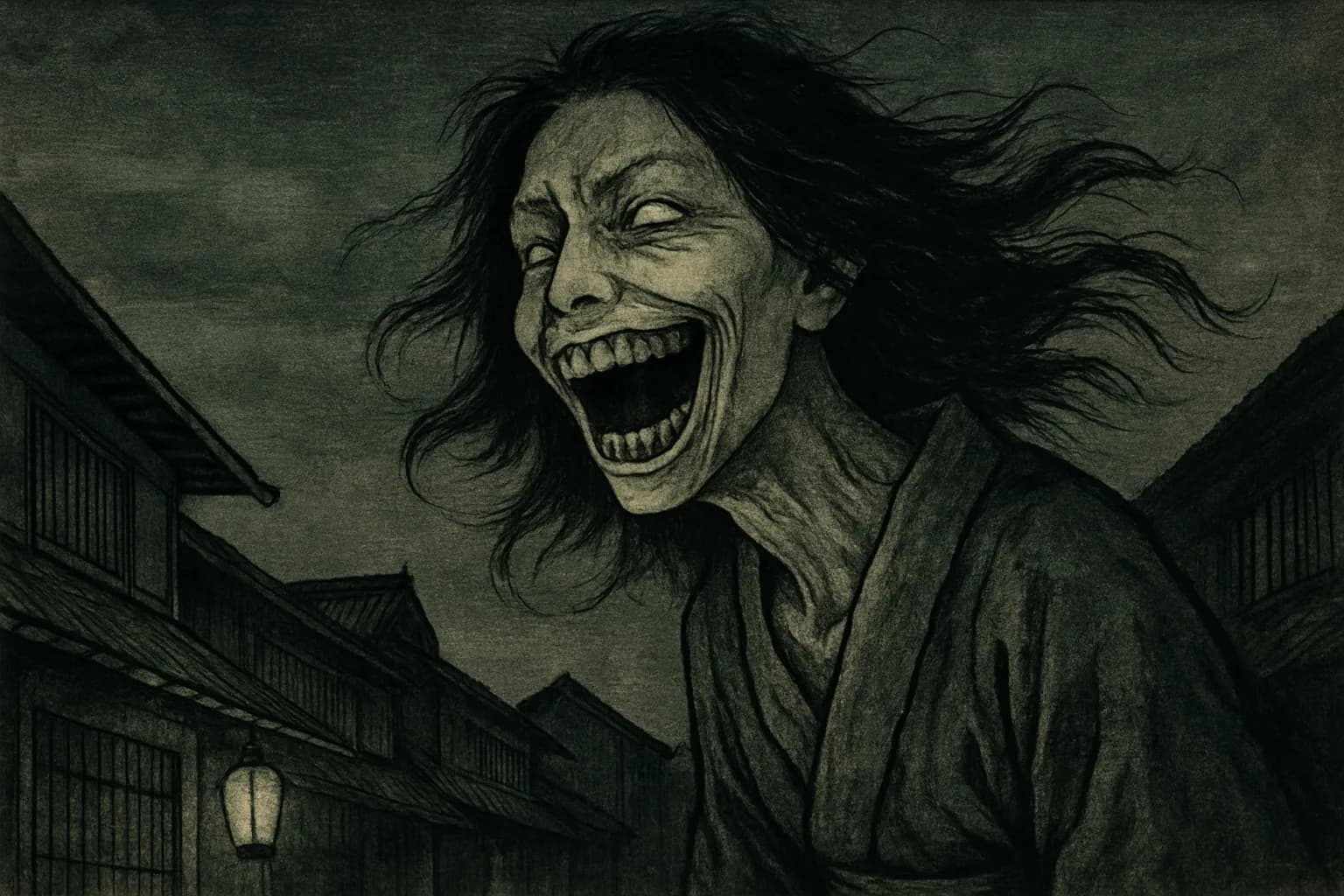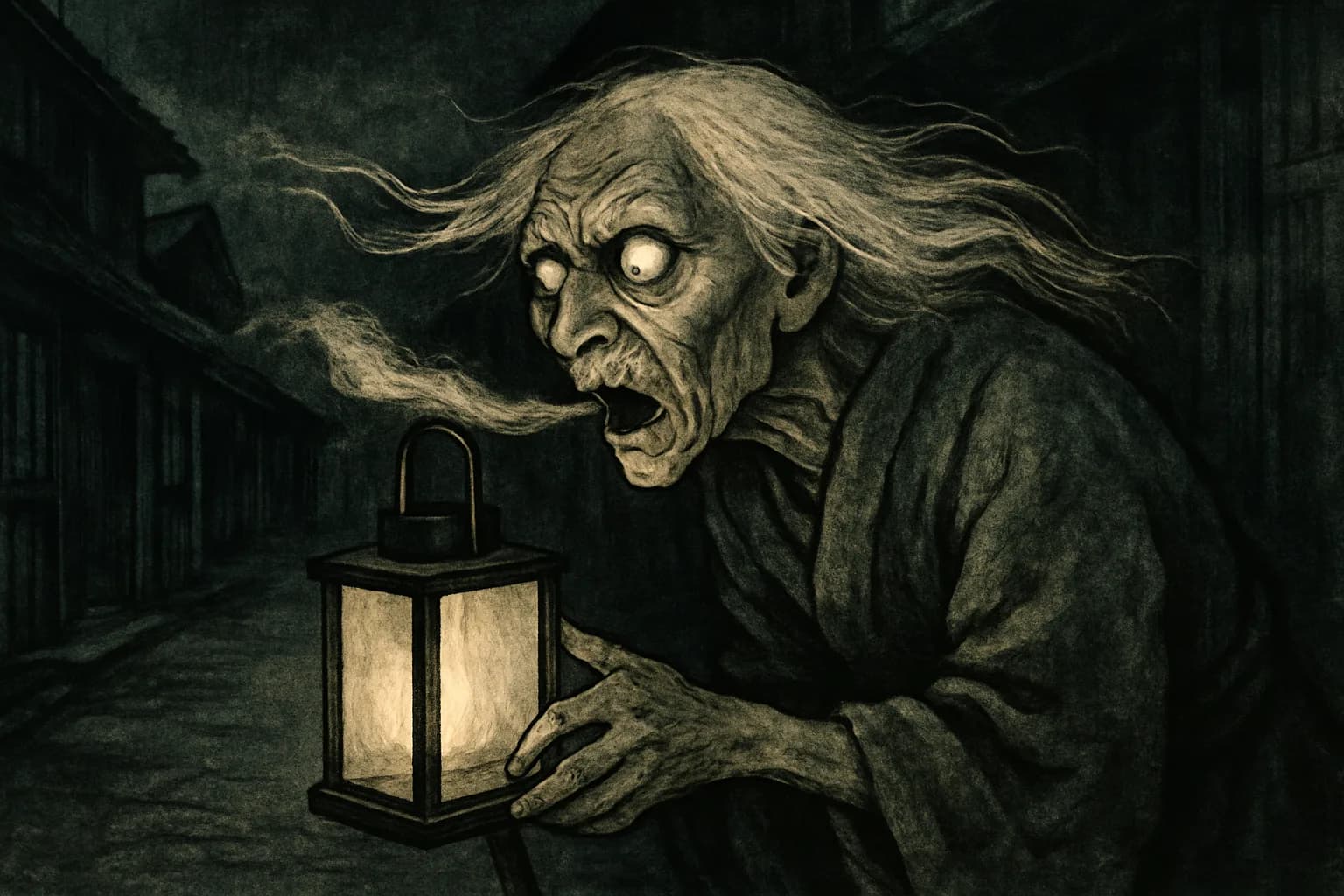
Somewhere on a dark Edo street, a paper lantern is doing its one job: holding back the night. Then, with no wind and no visible cause, the flame goes out. Toriyama Sekien had an answer for who did it. He called her Hikeshibaba, 火消 (hikeshi, "fire-extinguishing") + 婆 (baba, "old woman") — the fire-quenching hag, an entry in his 1779 print collection Konjaku Gazu Zoku Hyakki.
What does she look like?
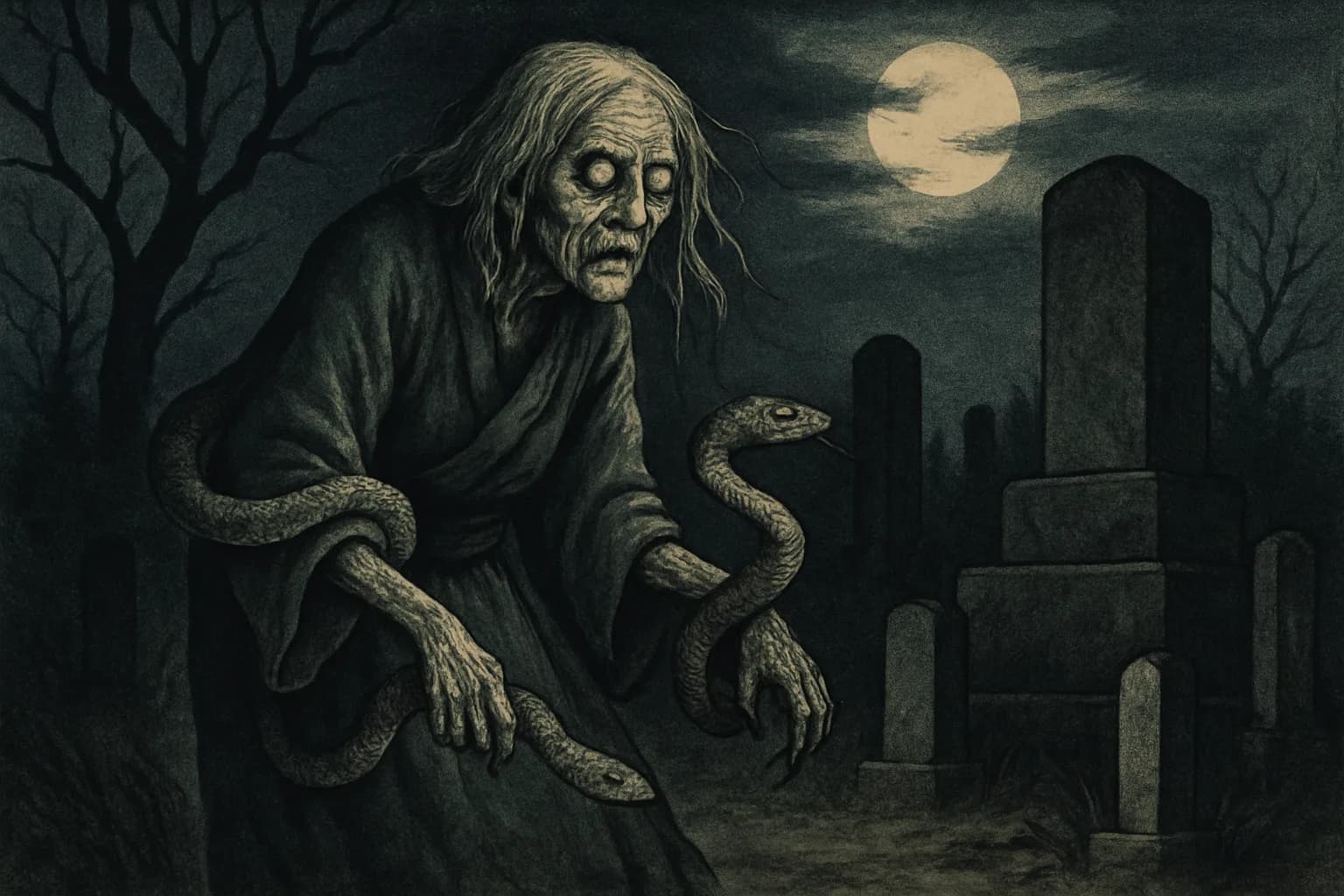
Sekien's print shows exactly what the name promises: a bent, white-haired old woman leaning toward a lit paper lantern, caught in the act of putting it out. The lantern in his illustration isn't generic — it's identified as one of the type hung outside the Yoshiwara pleasure quarters, Edo's licensed entertainment district, a detail that ties the hag to the city's nightlife rather than to some remote mountain road. She has no fangs, no claws, nothing built for violence. Her only tool is her breath, and the print doesn't even show her exhaling — the damage is already done by the time you notice her.
The habit that gives her her name
Later variants of the name — Fukikeshi-baba and Fukeshi-baba — all come from the same verb, fuku, "to blow." Accounts describe her working from a distance: a lantern, an andon lamp, a candle flame snuffed out in a single puff, with the old woman sometimes barely visible nearby. She isn't recorded stealing anything, cursing anyone, or dragging victims off. Her whole reputation rests on darkness itself — a snuffed light at a party, an andon that won't stay lit on a night walk home, blamed on her passing rather than on a draft or a bad wick.
Where it comes from
Sekien gave his own explanation, and it's stranger than a ghost story: pure Onmyōdō cosmology. Fire belongs to yang, the bright and active principle; an old woman, in this reading, is a concentration of yin, its opposite. Where yin grows strong enough, it will overpower yang — and a flame going out for no reason was as good a sign as any that the balance had tipped. Hikeshibaba is less a monster with a grudge than yin given a shape and an errand.
That explanation is very much Sekien's own. No older, place-rooted folk legend about a lantern-blowing hag survives from before his print, and modern researchers generally treat her as one of the artist's own literary inventions — built from a real belief (yin-yang cosmology, taken seriously in Edo-period life) rather than from a village ghost story handed down before him. Sekien did this often in his later collections: take an abstract anxiety, in this case the fear of being plunged into sudden darkness in a city built almost entirely of wood and paper, and give it an old woman's face.
A minor menace
Because her damage is only ever the dark itself, she reads as more of a nuisance than a threat — closer in spirit to Oshiroi-baba, another of Sekien's hags whose horror is more unsettling than dangerous, than to a child-snatching monster. But Edo was a city that burned down with regularity, where a candle knocked over in the dark could take out a whole block of wooden row houses. Blaming an old woman for extinguishing your light was one thing; the panic of fumbling for a way home with no lantern at all was another, and that discomfort is really what the print is selling.
Hikeshibaba today
Hikeshibaba never became a household name the way the kappa or the tengu did. She survives mainly on the page: reprinted in modern editions and translations of Sekien's yokai catalogues, filed alongside his other obscure Zoku Hyakki hags. She has turned up, under the variant name Fukkeshi-babaa, as a minor figure in the long-running GeGeGe no Kitarō franchise — one of the countless catalogue yokai the series has folded in over its decades on air, rather than one of Mizuki Shigeru's own inventions.
Mostly, though, she stays where Sekien put her: on a dark Edo street, mid-breath, a lantern going out for no reason anyone could prove.