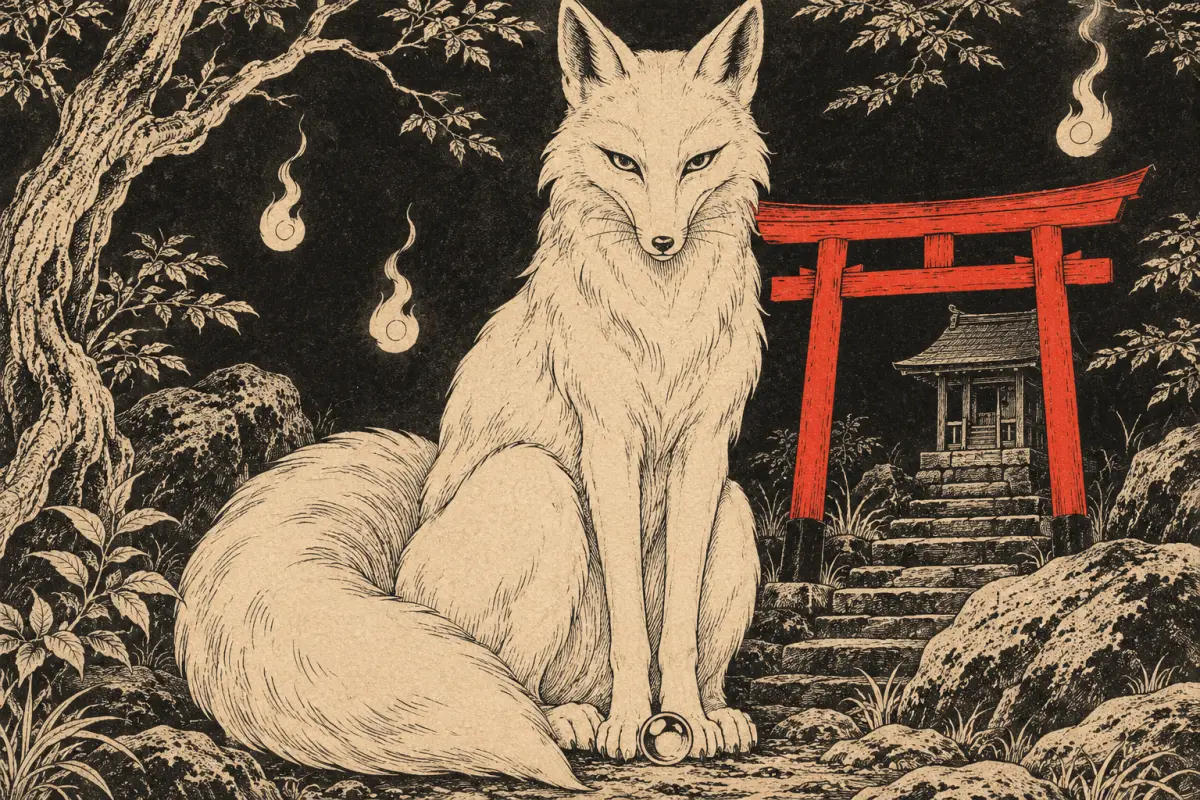
Most tattoo pages say a kitsune means cleverness, or protection, or luck. All of that is true. But in Japan, those meanings come from two different foxes. One is holy. It serves Inari, the Shinto god of rice (Shinto is Japan's native religion). The other is a trickster. It fools travelers, takes a woman's shape, and can even get inside a person.
The holy fox got its job in a surprising way: through spelling. An old name of the rice god was Miketsu-kami, "the god of food." Someone wrote that name with the characters 三狐神. They read the same, but they mean "three-fox god." Two Japanese dictionaries give this as one reason the fox became the rice god's messenger.
The nine tails have a twist too. In Japan, a nine-tailed fox was first a lucky sign, listed in 927. Japan's famous fox villain got her nine tails only around 1800.
So the fox is holy at the shrine and dangerous on the dark road. A kitsune tattoo means whichever fox you draw.
What do people put into a kitsune tattoo?
A fox tattoo can carry very different wishes. It depends on which fox you draw, and what it holds.
| If you want it to say | Draw | The story behind it |
|---|---|---|
| "Let my work prosper." | A white fox with a key in its mouth | The key opens the rice storehouse. Rice was Japan's money until the 19th century. |
| "Let my wish come true." | A white fox with a round jewel | The jewel is a jewel that grants wishes. The fox is the god's messenger. |
| "Nothing fools me." | A fox with many tails | A fox gains power as it ages. Nine tails is the oldest, strongest fox. |
| "A love I had to let go." | A fox mother with her child | Kuzunoha, the fox wife, left her son when her secret came out. |
| "A good year is coming." | Foxes carrying small flames | Farmers counted the fox fires at Ōji to guess the next rice harvest. |
| "I have two sides." | A fox that is half holy, half wild | The same animal serves the rice god and fools travelers on dark roads. |
Every row makes you ask "why?" Why would a key mean money? Why would a fox mother mean lost love? Each section below answers one row, in the same order.
Why does a fox with a key bring business luck?
Because the key opens a rice storehouse, and rice was money. A key to the rice was a key to wealth.
That answer raises three more questions. Let's take them one at a time.
Why does the fox hold a key at all? Look at a pair of foxes at an Inari shrine. Often one holds a key in its mouth. Japan's tourism agency explains it at Kōmyōin Inari, a small shrine in Nikkō. The key opens the storehouse where rice is kept.
Why is rice the same as money? Until the 19th century, rice was Japan's money. So a full rice store was like a full bank. For this reason, the agency says, Inari stands for success and money too. Today Inari is a god of good business as well as rice.
Why does a rice god have a fox? This is the root of it. There are two reasons, and both are in Japanese dictionaries.
The first is the spelling you met above. Miketsu-kami means "the god of food." One dictionary says people joined it to 三狐神, a "three-fox god" with the same sound. A larger dictionary is more blunt. It calls 三狐神 a mistake in writing. Either way, a fox ended up inside the rice god's name.
How can spelling do that? Japanese is written with characters borrowed from China. Many characters share one sound. A writer picks characters for their sound. But each character also has a meaning, and that meaning comes along. Here, the meaning was "fox."
The second reason is a goddess. In Buddhism, Inari was linked with Dakiniten. She was thought to be a fox spirit. Japan's tourism agency notes she is shown riding a fox. So the fox came in from two sides at once.
By 1775, a Japanese dictionary of local words could simply say it. People call the fox Inari's messenger.
Why is that fox everywhere? Inari has about 30,000 shrines across Japan, says Fushimi Inari Taisha, the head shrine in Kyoto. Many of them have stone foxes at the gate. The fox had an address in almost every village. Our guide Why Is the Fox Everywhere? counts how often it shows up in yokai stories.
So follow the chain. Food god, then "three-fox god," then the fox at the gate. Then the key to the rice, then rice as money. A fox with a key holds the rice god's storehouse, and that means your money.
Why does a white fox with a jewel grant wishes?
Because the jewel itself is a wish-granting jewel, and the fox is the one who serves the god. Your wish goes to Inari. The fox is the god's messenger.
At Kōmyōin Inari in Nikkō, the tourism agency says, the round jewel is a jewel that grants wishes. Carved jewels sit on the shrine doors and on the roof tiles too. The jewel belongs to the shrine, not only to the fox.
Why is the fox the messenger, and not the god? The head shrine is very clear here. Inari is not a fox. Many English pages get this wrong. The fox only carries the god's messages.
Why is that fox white? Because nobody can see it. This is the head shrine's own answer. Fushimi Inari Taisha says the messenger foxes are not the foxes you see in the mountains. Like the god, they cannot be seen. For this reason, it says, they are called byakko-san, "white foxes."
The shrine does not explain the step from "unseen" to "white." But white foxes had a special place long before. A real fox is reddish brown, so a white one is rare. In 657, Japan's official history, the Nihon Shoki, recorded a white fox seen in Iwami, in western Japan. A rare animal was news, and a sign. A fox no one can see is the rarest fox of all.
Why one key and one jewel, and not two of each? We could not find a shrine that explains it. What the foxes hold also changes from shrine to shrine. Keys and jewels are the most common. But rice sheaves, scrolls and fox cubs show up too. So the pair is a local choice, not one fixed set.
A white fox with a jewel is a messenger nobody can see, carrying your wish to the god.
Why do more tails mean a stronger fox?
Because a fox gains power as it gets older, and the tails show its age. More tails means an older fox. An older fox is a stronger one.
Why does age give a fox power? The idea came from China. An old Chinese book, the Xuanzhongji, sets out the steps. A fox of 50 can turn into a woman. At 100 it becomes a beautiful woman. At 1,000 it becomes a heavenly fox. Japan's Wamyōshō dictionary, from the 930s, repeats it: a fox of 100 turns into a woman. So the fox arrived in Japanese books already able to change shape. The older it was, the more it could do.
Why stop at nine? Nine is the biggest single-digit number. Count from one to nine, and nine is the end. So nine tails is "the most there can be."
Was the nine-tailed fox always evil? No, and this is the surprise. In Japan, it was first a lucky sign. The Engishiki, a book of court rules finished in 927, lists it among good omens.
The villain came later. Japan's most famous fox villain is Tamamo-no-Mae, a court lady who makes an emperor ill. In a medieval telling, Tamamo no Sōshi, her fox has only two tails. The nine came with books of the Edo period (1603–1868). The key one is Ehon Sangoku Yōfuden, from 1803–1805. Those writers joined her story to Daji, a fox queen of Chinese fiction. Daji already had nine tails, so Tamamo-no-Mae got them too.
A popular rule says a fox grows one tail every hundred years. We found no old book that says this. Our guide How Many Tails Does a Kitsune Have? tells the whole story.
Nine tails means a fox that has lived through everything. Nobody fools it. It does the fooling.
Why is the fox mother a symbol of lost love?
Because the most-loved fox story is about a mother who had to leave her child. Her name is Kuzunoha.
Kuzunoha is a fox who takes a woman's shape. She marries a man named Abe no Yasuna, and they have a son. Years later, her secret comes out, and she must go. Before she leaves, she writes a poem for them:
"If you miss me, come and find me in the forest of Shinoda, in Izumi."
The poem ends with her own name, kuzu no ha, "kudzu leaf." Shinoda is a real forest, in today's Izumi city, Osaka.
Why must she go? In the story, she can stay only while she is hidden. Once her secret is out, she has to leave.
Her son grows up to be Abe no Seimei. He was a real man who lived around the year 1000. He was Japan's most famous onmyōji, a court expert in stars and signs.
Why is this the scene people remember? Because of the stage. A late medieval book, the Hoki-shō, already tells the story. Then a puppet play made it famous: Ashiya Dōman Ōuchi Kagami by Takeda Izumo, in 1734. Kabuki, Japan's popular stage, took it up the next year.
The farewell scene became a show of skill. Kuzunoha writes the poem on a paper door, but she is holding her baby. Her writing hand is not free. So in kabuki she writes with her other hand. Then she writes backwards, then in mirror letters. At last she holds the brush in her mouth. The tricks are not a fox's magic. They are a mother who will not put her child down.
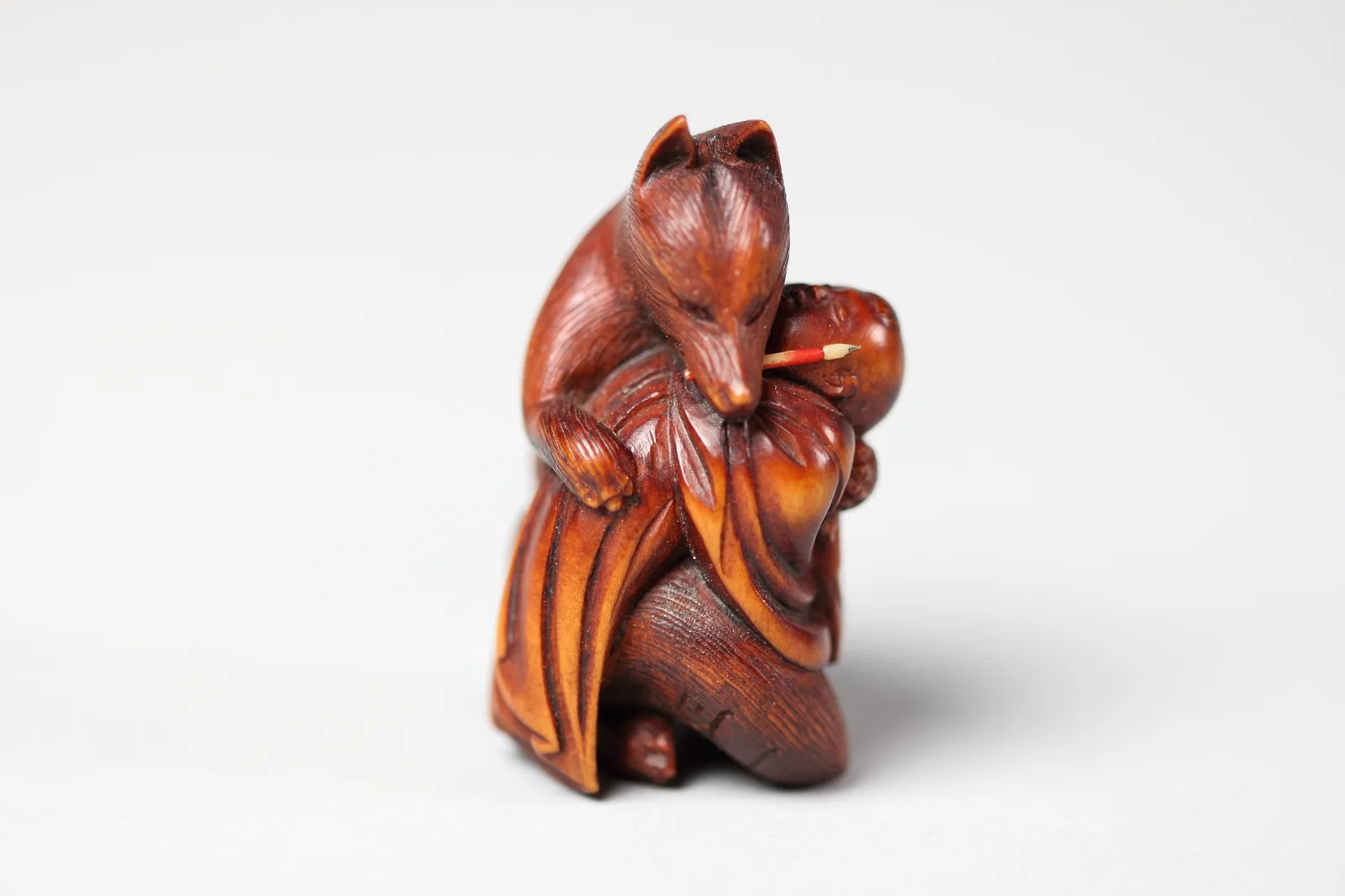
A netsuke, a small carved toggle once worn on a kimono sash, from the 19th century. It shows Kuzunoha as a fox, holding her baby, with the brush in her mouth. The Metropolitan Museum of Art, public domain (CC0).
Is she the only fox wife who left? No. The Nihon Ryōiki is a book of Buddhist tales begun around 787 and finished by the 820s. In it, a man in Mino Province (today's Gifu) marries a beautiful woman. The family dog barks at her, and she turns back into a fox. He calls after her: "Kitsu-ne," "Come and sleep." The book says that is how the fox got its name. Scholars call this a folk story about the word, not its real origin. But even here, the fox is not a monster. She is a wife her husband asks to come back.
A fox mother on skin is not a trickster. She is love that could not stay.
Why do fox fires mean a good year?
Because farmers read the fox fires as a forecast for the rice. More fires meant a better harvest.
What is fox fire? In Japanese it is kitsunebi. It means cold lights over the fields at night, blamed on foxes.
Where did farmers count them? The most famous fox fires were at Ōji, in the north of today's Tokyo. On New Year's Eve, foxes from the whole region were said to gather under a great tree. Then they went on to Ōji Inari Shrine. Farmers counted their fires to guess the next year's rice harvest. The artist Utagawa Hiroshige printed the scene in 1857.
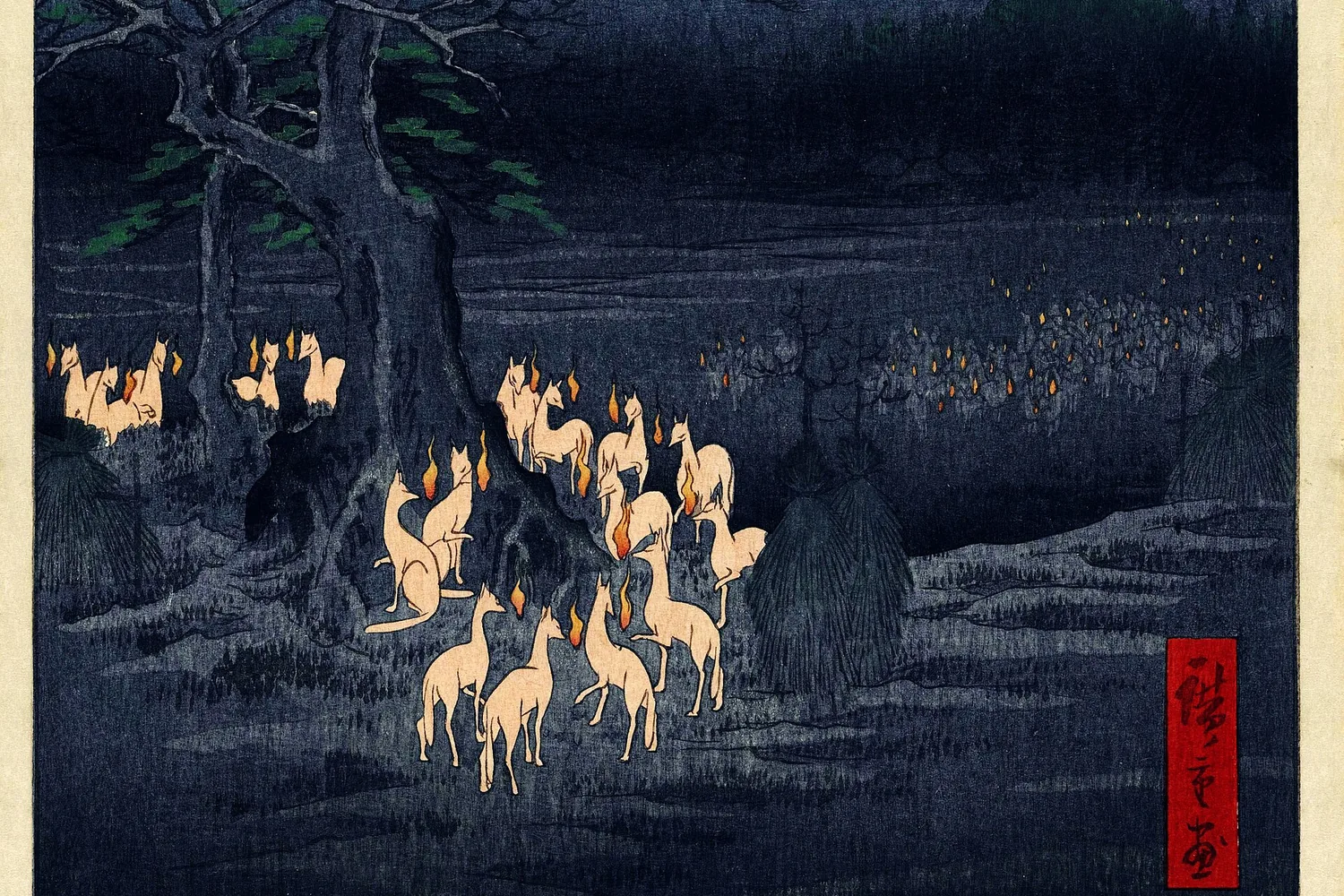
Fox Fires on New Year's Eve at the Changing Tree in Ōji, by Utagawa Hiroshige, 1857. Foxes gather under a big tree near Ōji Inari Shrine in Edo, the old name for Tokyo. Each one carries a small flame. The Art Institute of Chicago, public domain.
Why would a fox know about rice? Go back to the first section. The fox is the messenger of Inari, the rice god. So the foxes were heading to the rice god's shrine at the turn of the year. That is why farmers read their lights as news about the rice.
A line of lights in the hills, where no road runs, had another name. It was kitsune no yomeiri, "the fox's wedding." The phrase is still used in Japan today. It means a sun shower: rain that falls while the sun is out. Old stories said rain always falls at a fox wedding. Both are things that should not happen together. Lanterns glow where no road runs, and rain falls under a bright sun. More on our kitsunebi page.
Foxes with flames on skin are the rice god's messengers, lighting the way to a full year.
Why is the fox both holy and a trickster?
Because the same animal lived at the edge of the rice fields. It served the rice god at the shrine. It was also the one you blamed when things went wrong on the road.
What does the trickster fox do? Japanese dictionaries say a fox "bewitches people." It fools them, the way a spell would. In the old tales, it leads a traveler in circles all night. It serves a fine dinner that turns out to be leaves and mud. It takes the shape of a beautiful young woman. There are tells, though. Her shadow keeps a fox's shape, or a tail slips out from under her kimono.
The worst trick was kitsune-tsuki, fox possession. People believed a fox spirit could enter a person's body. It caused strange behavior, illness, or a terrible hunger.
Why did one animal get both jobs? The real fox lived where the village met the wild. People saw it often, but never for long. An animal you only half see is an easy one to blame. When a light floated in the dark, or a man lost his way, the fox got the blame. So the fox had two jobs from the start. At the shrine, it was the rice god's helper. On the dark road, it was the reason things went wrong.
Why the fox and not the tanuki? Part of the answer is in Chinese books. As the tails section showed, they said an old fox could become a woman. The fox arrived in Japanese books already able to change shape.
Was the fear real? Yes. In Izumo, in western Japan, some families were said to keep invisible foxes. A writer named Yamane Yoemon recorded the belief in 1786. Neighbors would not marry into those families. Our hitogitsune page tells that story. The fear has long faded.
A half-holy, half-wild fox is honest. It is one animal with two faces, the way people have two sides.
The meaning at a glance
| What you see | What it means |
|---|---|
| A white fox | Inari's messenger. The shrine calls them "white foxes." |
| A fox with a key in its mouth | The key to the rice storehouse: a full harvest, and wealth |
| A fox with a round jewel | A jewel that grants wishes |
| A fox with many tails | An old, powerful fox. Nine is the most there can be. |
| A fox in a woman's shape | The trickster, or the fox wife who loved a man |
| A fox carrying a flame | Fox fire: lights in the dark, with a fox behind them |
| A fox mask | The fox of shrine dances, plays and festivals |
The fox mask
Many fox tattoos show a mask, not an animal. In Japanese, it is 狐面, kitsune-men: "fox" plus "mask."
Dancers at shrine festivals wore fox masks to pray for a good harvest, because the fox was Inari's messenger. The Philadelphia Museum of Art has one made for these dances, from about 1725. Comic plays called kyōgen use fox masks too. And on New Year's Eve, about 300 people walk through Ōji in fox masks, acting out Hiroshige's print. That walk began in 1993.
We found no rule that a mask's color has a meaning. Our kitsune mask page has the details.
What it looks like as a tattoo
Here is how a shrine fox can look on skin.
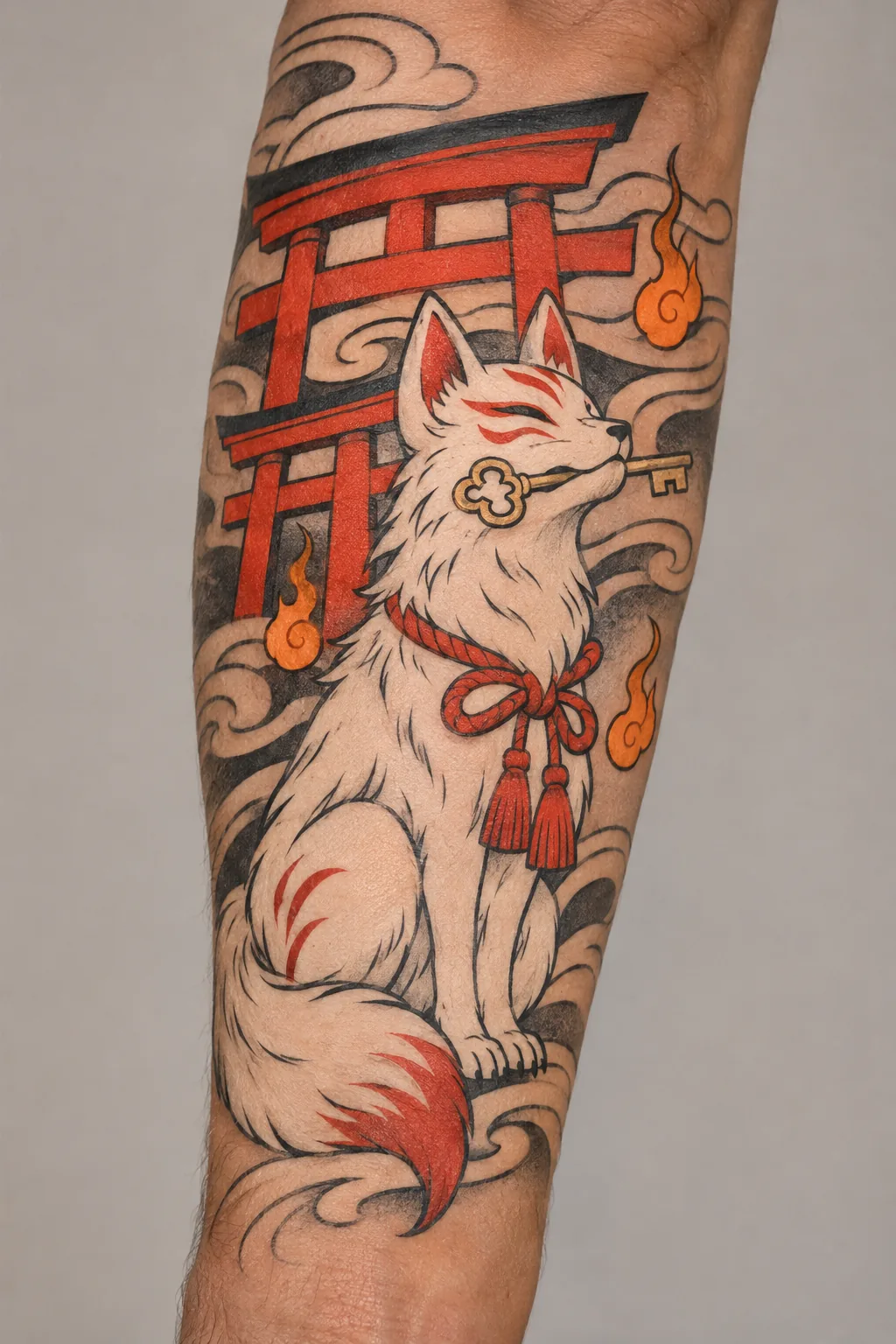
A white fox, Inari's messenger, with the key to the rice storehouse in its mouth. Behind it are shrine gates and fox fires. This image was made with AI to show how the tattoo can look. It is not a photo of a real person.
The name: 狐 and "kitsune"
The character 狐 has two parts. On the left, 犭 is the "animal" side, a narrow form of 犬, "dog." On the right, 瓜 means "melon." The melon is only there for the sound. Many Chinese characters work this way: one part gives the meaning, one part gives the sound. In old Chinese, 瓜 sounded close to the word for fox. In Japanese, 狐 is read ko or kitsune.
The word kitsune has its own old story, the fox wife who was told "come and sleep." You met her in the fox mother section above.
How a fox tattoo is seen in Japan
In everyday Japan, you meet the fox mostly at Inari shrines. There are stone foxes at the gates, fox masks at festivals, and kitsune udon, noodles topped with fried tofu, the fox's favorite food in folklore. We found no old record that gives the fox one fixed meaning as a tattoo.
Tattoos in general are another matter. Many people in Japan with tattoos still hide them at work. For a long time, a tattoo here meant crime. From 1720, courts tattooed criminals as a punishment. A ban on tattooing began in Tokyo in 1872, covered all of Japan from 1908, and ended in 1948.
Why ban it in 1872? Japan had just opened its doors, and foreign visitors arrived in large numbers. Their travel writings noticed men walking through town with full-body tattoos. The government feared tattoos would make Japan look "backward" to them, writes the cultural anthropologist Yamamoto Yoshimi. The ban was about how Japan looked to outsiders.
All of this is about how Japanese people see tattoos on other Japanese people. A foreign visitor is a different case. I, the editor of this site, live in Japan with tattoos myself. I think most Japanese people see a foreigner's tattoo as part of that person's culture. To reject the tattoo would be to reject the culture. So people treat it with respect. Some places still have rules, though, mostly where people bathe or swim. At some hot springs, bathhouses and pools, you may be asked to cover a tattoo. At others, you may not be let in.
Baths are where the rules still matter. People bathe together, naked, so there is nowhere to hide a tattoo.
| Kind of bath | Tattoos? |
|---|---|
| Neighborhood bathhouse (sento) | Usually fine. In 2017, the national sento association said its members do not turn people away for tattoos. |
| Hotel or inn bath | About half say no. In a 2015 government survey of 581 hotels and inns, 56% refused guests with tattoos. |
| Private bath (kashikiri) | Fine. You book the bath only for yourself. |
In 2017, Japan's government said the public bath law has no rule against people with tattoos. A year earlier, the national tourism agency asked baths not to refuse guests only for a tattoo. So check the rules before you go. Our hannya tattoo page has more on baths.
Why tattoos carry this weight in Japan at all, from the punishment marks of 1720 to today's bath signs, is in our guide: Why Are Tattoos Taboo in Japan?
Frequently asked questions
Is a kitsune tattoo good luck or bad luck?
It depends on the fox. The white shrine fox, with a key or a jewel, stands for the harvest, wealth and protection. The trickster fox stands for cleverness and danger. The fox wife stands for love that cannot stay.
Is the kitsune a god?
No. The head Inari shrine says so plainly: Inari is not a fox. The fox is the god's messenger.
Does a nine-tailed fox mean evil?
Not always. In Japan it was first a lucky sign, listed in 927. It became a villain only with the Edo-period novels about Tamamo-no-Mae.
What does a white fox mean?
Inari's messenger. The head shrine calls the messengers "white foxes" because, like the god, they cannot be seen.
What we can say, and what we can't
- We can say: the fox became Inari's messenger partly through the spelling 三狐神, and partly through the goddess Dakiniten.
- We can say: Japan listed the nine-tailed fox as a lucky sign in 927, long before it was a villain.
- We can't say: why "cannot be seen" became "white." The shrine links the two but does not explain the step.
- We can't say: who first said a fox grows one tail every hundred years. No old book we found says it.
- We can't say: that the fox had one fixed meaning in old Japanese tattooing. We found no record of one.