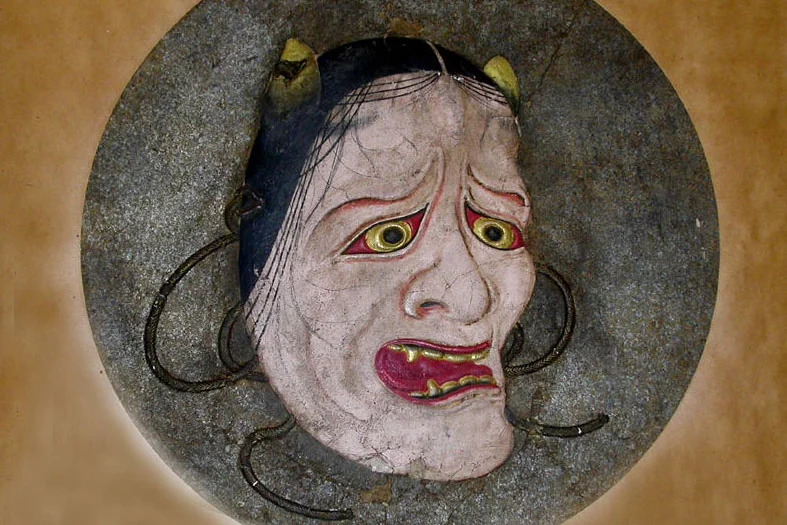
A hannya tattoo shows a woman who turned into a demon. Jealousy changed her. The face comes from Noh, a classical Japanese theater, where a carved mask shows her at the worst moment of her life. And her name, hannya, is a Buddhist word for wisdom.
Many tattoo pages say the hannya brings luck or protection. The old plays say something else. In them, the demon woman never wins. Monks pray over her, and she is calmed or driven away. The hannya is the face of pain at its peak, just before it breaks.
The meaning at a glance
| Part of the face | What it shows |
|---|---|
| Two horns | She has become a demon. The change is complete. |
| Gold metal eyes | They make her fierce and no longer human. |
| Open mouth, gold teeth, fangs | Rage. In the plays, she attacks. |
| Heavy brows over the eyes | Grief. The top half of the face looks sad. |
| White, red, or black skin | Which woman she is (see the next section). |
The top half is sad for a simple reason: a mask cannot move. One carved face must last the whole play, so the carver put two feelings into it. The actor picks one by moving his head. (Noh actors were traditionally men.) When he tips the mask down, the brows shade the eyes and the face looks sad. When he tips it up, the open mouth and fangs come forward. A good hannya tattoo keeps both feelings.
Whose face is it?
The hannya is worn in four plays. A Japanese art dictionary lists them: Aoi no Ue, Dōjōji, Kurozuka and Momijigari. Three of them are known in Noh as the "three demon women," and the color of the mask tells you which woman it is.
| Color | Play | The woman |
|---|---|---|
| White | Aoi no Ue | Lady Rokujō, a noblewoman of high rank |
| Red | Dōjōji | A young woman who falls for a traveling monk. He hides from her under a temple bell, and she becomes a giant snake. |
| Black | Kurozuka | An old woman alone in a mountain hut. Travelers find out she is a demon. |
A Japanese encyclopedia of Noh masks says the white hannya keeps her dignity. In old Japan, pale skin was the mark of a lady who never worked in the sun, so even as a demon, Lady Rokujō stays a lady. Red is the color of an angry face, and the snake woman burns hottest of the three. Black marks the darkness of the demon in the hills.
The red woman's full story is on our Kiyohime page.
What it looks like as a tattoo
Here is how the white and the red hannya can look on skin.
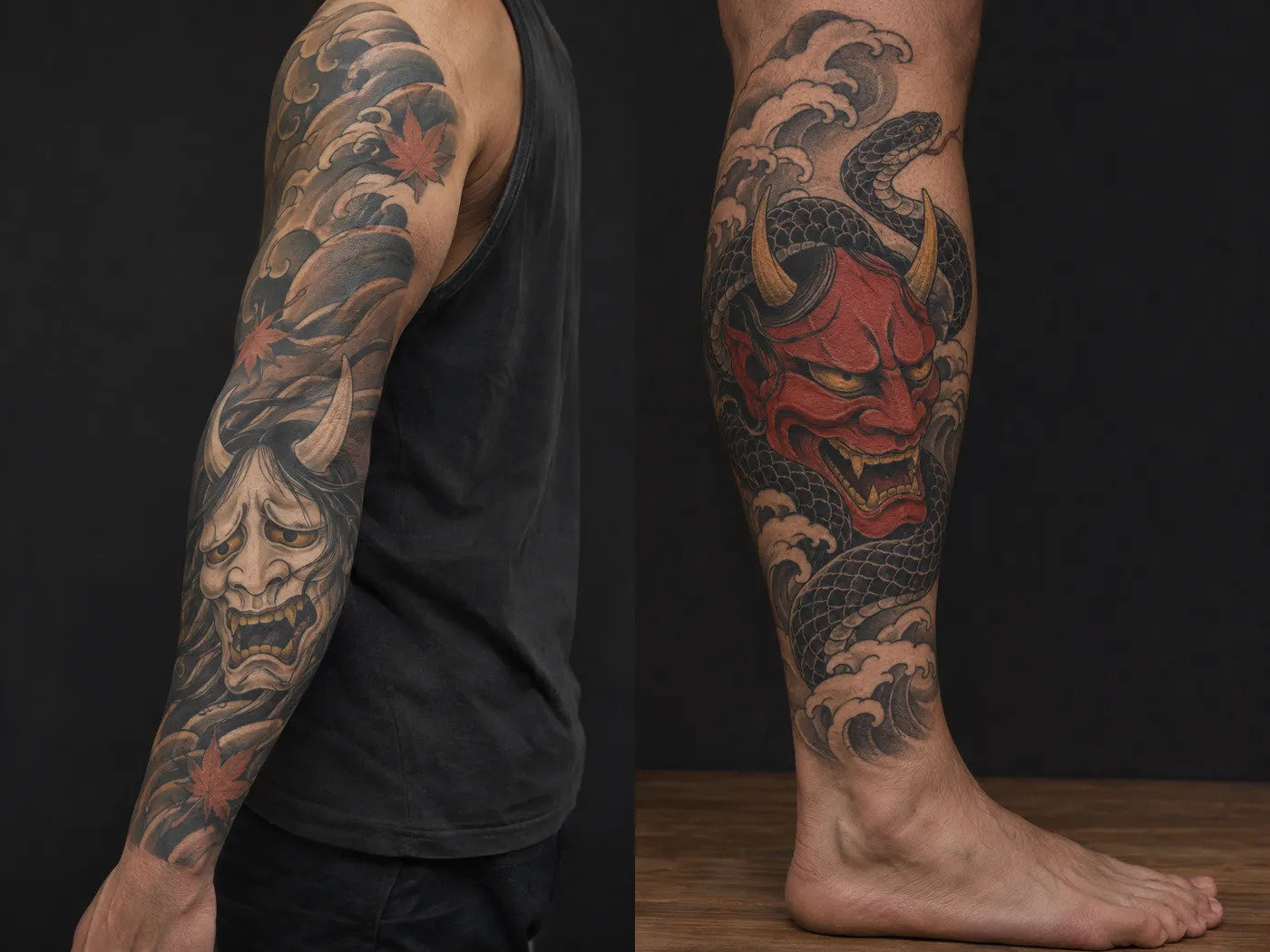
Left: a white hannya on the arm, with red maple leaves. Maples fit Momijigari*, "Maple Viewing," a play where a demon, dressed as a noblewoman, holds an autumn party in the hills. Right: a red hannya with a snake on the calf, the* Dōjōji pair, with river waves behind. These images were made with AI to show how the tattoos can look. They are not photos of real people.
Is a hannya tattoo good or bad?
Neither, if you go by the old plays. She is not a curse. She is a person in pain, and the plays show how her pain ends.
Aoi no Ue comes from The Tale of Genji, a Japanese novel from around the year 1000. Lady Rokujō loves Prince Genji, the hero. She is still alive, but her jealousy leaves her body as a spirit. It attacks Lady Aoi, Genji's wife. A priest who trains in the mountains prays against her. Her anger breaks, she grows calm, and the play says she can now become a Buddha. In Buddhism, that means being free of all pain. She is the only one of the three who is set free.
In Dōjōji, she does not get that ending. Years after the monk dies, her spirit returns to the temple as a dancer. She leaps under its new bell and comes out as a snake. On stage she wears a hannya, or sometimes an even fiercer snake mask called ja. The monks pray and shake their prayer beads. She is driven away and disappears into the Hidaka River.
Today, hannya masks are also sold in Japan as charms against bad luck. But the plays never use her that way. If you want the old meaning, it is this: strong feeling, and the hope of being free of it.
Why is the hannya such a popular tattoo?
Because Japanese tattooing grew out of pictures where she already starred. No old record gives one single reason, but the timing lines up in two ways.
Prints started the tattoo craze. In the 1820s, the artist Utagawa Kuniyoshi drew Chinese outlaw heroes covered in tattoos, and the prints were a hit. The cultural anthropologist Yamamoto Yoshimi traces the Edo tattoo boom to prints and kabuki like these. In the same years, print artists drew the hannya too. Hokusai, the artist of The Great Wave, made a print called Laughing Hannya around 1831.
Kabuki made her famous. Noh was mostly watched by samurai and nobles. Kabuki was for everyone in town, and by the 1770s its stars were dancing the Dōjōji woman. Woodblock prints of those dances sold to the same people who got tattooed.
Why do men wear a female demon? Because the feeling is the point, not the woman. Anyone can feel jealousy, rage and grief.
Why is a demon named "wisdom"?
般若, hannya, is a word from Buddhism. It comes from Sanskrit, the old language of Indian Buddhism, where the word is prajñā. Japan writes with characters borrowed from China, and these two characters spell that sound. The word means a deep kind of wisdom: the wisdom that sees what is real.
Japanese dictionaries give the most likely reason the angry demon carries it: a person. The mask is said to have been first made by a carver called Hannya-bō, in the late 15th or early 16th century. His name stayed on the mask, the way a maker's name stays on a product.
The carver's own name came from Buddhism. "-bō" was a common ending for a monk's name, and monks often took Buddhist words as names. Some Christian families name a child Grace or Faith in the same way.
The two characters only carry the sound. 般 is "han." 若 is "nya." But the old play Aoi no Ue uses the word in its own way. As the priest's prayer beats her, the demon in the hannya mask cries out: "How frightening, this voice of hannya!" In that line, hannya means the holy words being chanted against her. The woman in the hannya mask is defeated by hannya.
Hannya or oni: how to tell
People mix these up all the time. Ask one question: whose face is it?
| Hannya | Oni | |
|---|---|---|
| Who | A woman who became a demon | A demon from the start |
| Where from | Noh masks | Folk tales, and Setsubun, a February holiday when people throw beans at a demon |
| Horns | Two, from the sides of the forehead | Often an ox's horns |
| Feeling | Rage and grief together | Strength and danger |
More on the second face is on our oni mask page. The full Noh history of the hannya is on our hannya mask page.
If your hannya comes with a snake
Some hannya tattoos come with a snake. The two belong together. In Dōjōji, the woman's jealousy turns her into a snake, and on stage she wears the hannya. A snake wraps around something and does not let go, the way jealousy does.
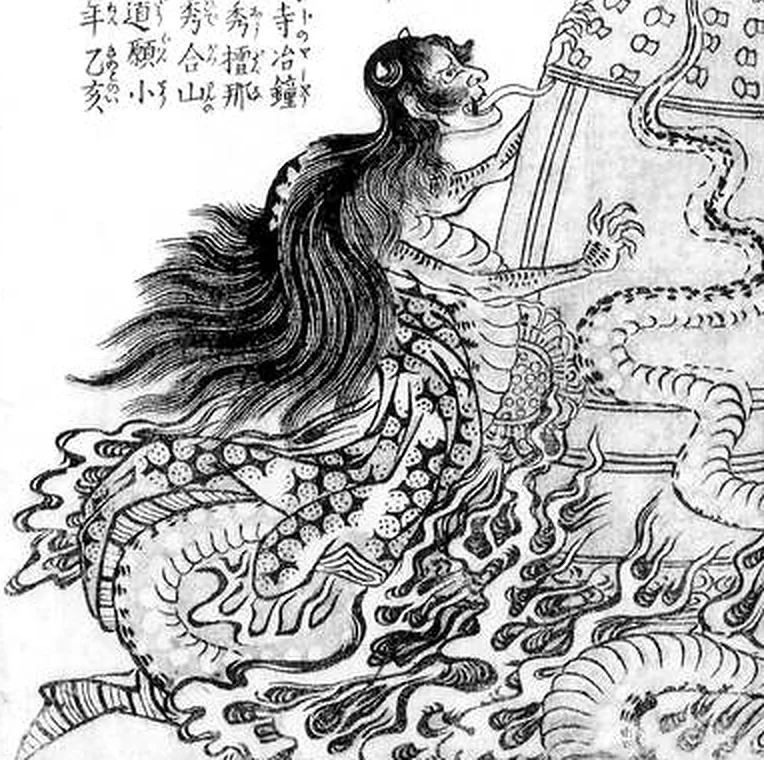
"The Bell of Dōjōji," drawn by Toriyama Sekien in his yokai book Konjaku Hyakki Shūi (around 1781). Look at her: a woman's face with two horns, like a hannya, and below the waist, a snake's coils wrapped around the burning bell. Public domain, via Wikimedia Commons.
The story is older than the play. A Buddhist book of tales from the 1040s, the Hokke Kenki, already tells of a woman who turns into a snake and burns a monk inside a temple bell.
How a hannya tattoo is seen in Japan
Most people in Japan with tattoos still hide them at work. For a long time, a tattoo here meant crime. From 1720, courts tattooed criminals as a punishment. A ban on tattooing began in Tokyo in 1872, covered all of Japan from 1908, and ended in 1948.
A foreign visitor is a different case. I, the editor of this site, live in Japan with tattoos myself. In daily life, I think Japanese people do not mind a foreigner's tattoo much. On you, it reads as fashion, not as a sign of crime.
Baths are where the rules still matter. People bathe together, naked, so there is nowhere to hide a tattoo. The rules depend on the kind of bath:
| Kind of bath | Tattoos? |
|---|---|
| Neighborhood bathhouse (sento) | Usually fine. In 2017, the national sento association told a Japanese news site that its members do not turn people away for tattoos. |
| Hotel or inn bath, day spa | About half say no. In a 2015 government survey of 581 hotels and inns, 56% refused guests with tattoos, 31% let them in, and 13% let them in if covered. |
| Private bath (kashikiri) | Fine. You book the bath only for yourself. |
The law does not stop you either. In 2017, Japan's government said the public bath law has no rule against people with tattoos. A year earlier, the national tourism agency asked baths not to refuse guests only for a tattoo. It suggested cover stickers, set bathing times, and private baths.
So check the bath's rules before you go. If it says no tattoos, cover yours with a sticker if allowed, or book a private bath. That is what I do myself.
Frequently asked questions
Is there a male hannya?
No. The hannya is always a woman. Male demons and gods in Noh wear other masks, such as the scowling shikami or the bulging-eyed tobide.
Does the color of a hannya tattoo matter?
On skin, there is no fixed rule. Choose the woman whose story you want: white for Lady Rokujō, who is set free, or red for the snake woman of Dōjōji.
Does the hannya mean you are jealous?
Not exactly. In the plays, she is someone who was hurt, not someone who hurts others for fun.