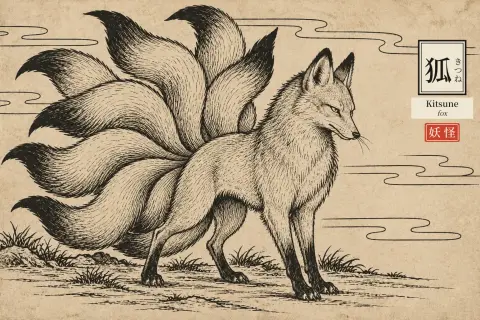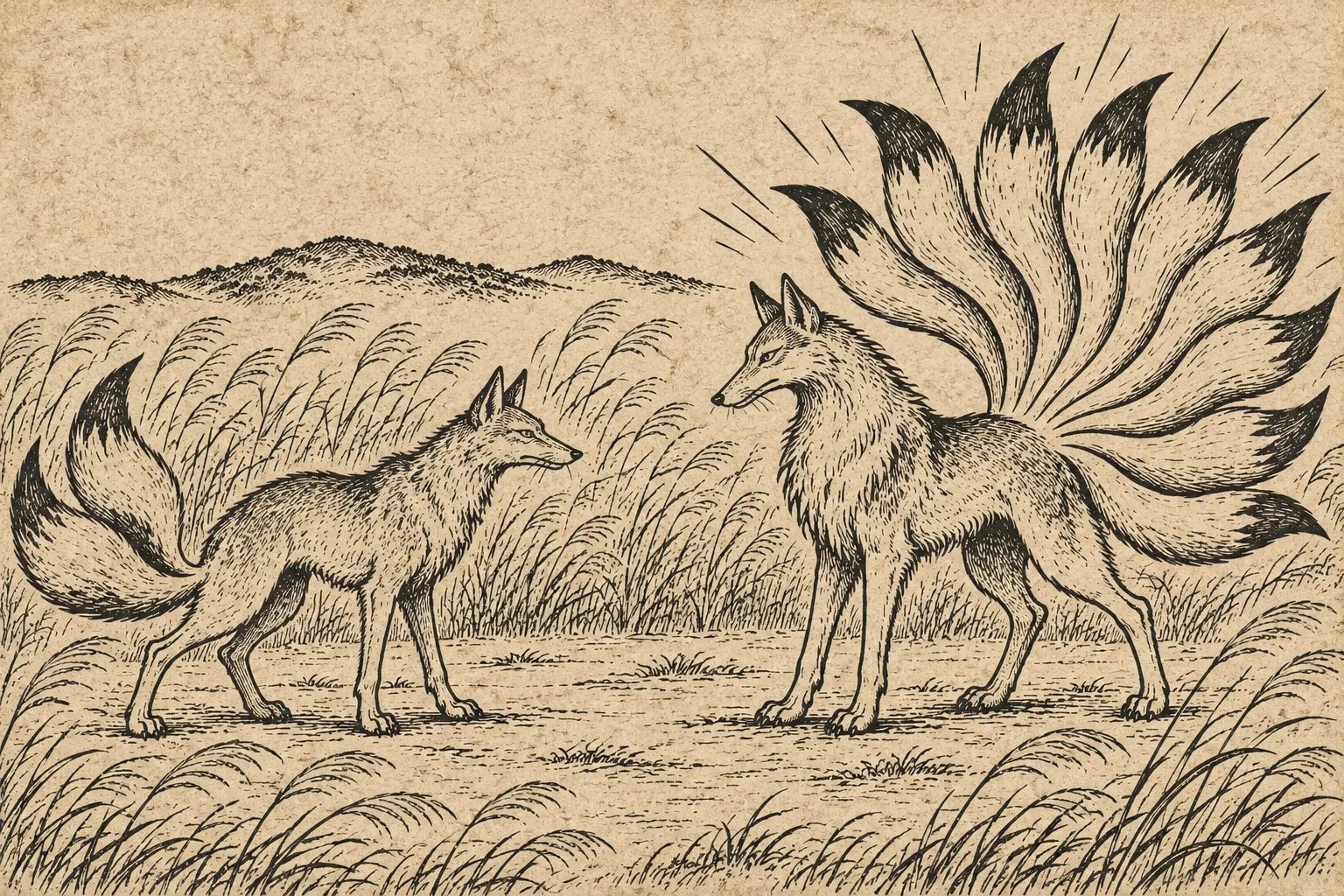
A kitsune can have up to nine tails. A fox starts with one, and grows more as it gets older and stronger. Nine is the top, and that fox is the most powerful of all.
But there are two twists. In the medieval telling of Japan's most famous fox villain, she has two tails. And in Japan, a fox with nine tails was first a lucky sign.
The short answer
| Tails | What it means in the stories |
|---|---|
| One | An ordinary fox, or a young fox spirit |
| More than one | An older, stronger fox |
| Nine | The greatest fox of all, very old and very dangerous |
Modern retellings often say a fox grows one tail every hundred years. We found no old record of that rule (more below).
Japan's most famous fox spirit
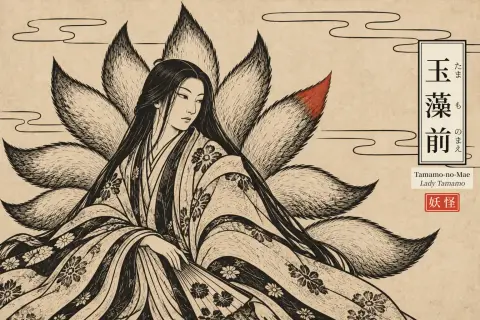
The best-known many-tailed fox in Japan is Tamamo-no-Mae. In the legend, she is a court lady of the twelfth century. She is beautiful and knows everything. Then the emperor falls ill.
A diviner finds the cause. She is not a woman at all, but a fox. She runs away, and warriors hunt her down. Her spirit passes into a boulder, the Sesshō-seki, the "Killing Stone." It poisons anything that comes too close.
Pictures of her true form show nine tails fanned out behind her.
In the medieval telling, she has two tails
The famous fox once had only two tails. A book from the Muromachi period (about 1336–1573), Tamamo no Sōshi, tells the same legend. One version describes the fox as "seven shaku long, with two tails." That is about two meters.
So where did the other seven come from? Not from a monster story. They came from a lucky sign.
In Japan, nine tails began as a good omen
In Japan, the nine-tailed fox was first a lucky sign, not a villain. Japan knew it centuries before the famous fox villain did. The Engishiki, a book of court rules finished in 927, has a list of lucky signs. The nine-tailed fox is on it, as a divine beast whose cry sounds like a baby.
The idea came from China, and it is very old there. The ancient Classic of Mountains and Seas (Shanhaijing) describes such a fox. It eats people, the book says, but whoever eats it is safe from evil magic. Later Chinese texts treat its arrival as a sign of good rule.
Then Chinese fiction turned it into a villain. The best known is the Ming-period novel Investiture of the Gods. There, Daji, the wicked wife of an ancient king, is a fox spirit who helps bring his kingdom down.
Why nine, and not seven or ten?
Because in China, nine is the biggest single number. It means "the most there can be." So the greatest fox has nine tails.
Count from one to nine, and nine is the top. In Chinese tradition it is the highest number, and it was linked with the emperor. Its sound, jiǔ, is also the same as the word for "long-lasting." So nine is a lucky number, and a fox with nine tails is a fox with as many as a fox can have.
That is why such a fox was a good sign. In old China, people believed heaven sent rare animals when a ruler governed well: the phoenix, the qilin (a gentle, deer-like beast of Chinese legend), and the fox with nine tails.
Later scholars gave the number a court meaning too. The Baihu tong, a first-century book of court debates, says the nine tails stand for the ruler's nine wives in good order, and for many descendants. A first-century history, the Wu Yue Chunqiu, tells of Yu the Great, a legendary king, who saw a white fox with nine tails before he married and took it as a blessing.
In these early books, the nine tails did not measure age. They meant full, complete, the best.
How the lucky fox became Tamamo-no-Mae
Edo writers gave her the extra tails by joining her story to China's fox consort, Daji. The two stories had the same plot: a beautiful fox-wife who ruins a ruler. That made them easy to join.
The medieval story already gave Tamamo-no-Mae past lives. In Sesshōseki, a Noh play (Japan's classical masked theater), she was once the spirit of a prince's tomb in India, and then a queen in China. In the Edo period (1603–1868), writers went one step further. They made Daji one of her past lives, and with Daji came the nine tails.
| When | What happened |
|---|---|
| Muromachi period | Tamamo no Sōshi: the fox has two tails |
| 1766 | Kanke Byakko Tsū retells the fox's past lives, with Daji among them |
| 1779 | Toriyama Sekien, the great Edo painter of yokai, draws her with nine tails |
| 1803–1805 | Ehon Sangoku Yōfu Den tells the full story, from India to China to Japan |
That novel, and Okada Gyokuzan's Ehon Tamamo-tan (1805), fixed the nine-tailed version that lasted.
From two tails to nine took a few hundred years. And the fox that had been a lucky sign in 927 became the villain of the age. That is the picture people still know. When Naruto seals a giant fox inside its hero, it uses that image. So does Pokémon's Ninetales.
Our reading: the sign turned upside down
The nine tails ended up meaning the opposite of what they first meant. Put the two facts side by side.
In the Baihu tong, nine tails meant a full, blessed house: wives in their proper place, and a royal line that grows.
In Japan, the same fox became Tamamo-no-Mae. She is a consort who wins the ruler's favour, makes him ill, and nearly kills him.
The same nine tails now stand for the opposite story. A sign of a safe court became the face of the danger inside it. We have not found a writer of the time who says this on purpose. It is our reading of the two texts.
Why would a fox grow more tails?
The short answer: we found no old book that says it does. Two older ideas were later read together, and the tails became a clock.
One idea is old. A Chinese book from around the fourth century, the Xuanzhong ji, says a fox gains power as it ages. At fifty it can become a woman. At a hundred it becomes a beautiful woman or a shaman. At a thousand it reaches heaven and becomes a heavenly fox. The book itself is lost; we know it only from later quotations.
A second idea is also old: nine tails as the highest lucky sign, from the Baihu tong.
But neither Chinese book joins the two ideas. Neither says a fox grows one tail at a time. The neat rule, one tail for every hundred years, appears in modern retellings. We found no old record of it.
So the most likely story is this. Two separate ideas, "older means stronger" and "nine means the best", were later read together. The tails became a clock. When that happened, and who did it first, we could not find.
Japanese foxes with other numbers
Nine is not the only number in Japan. Local fox spirits sometimes carry their own count.
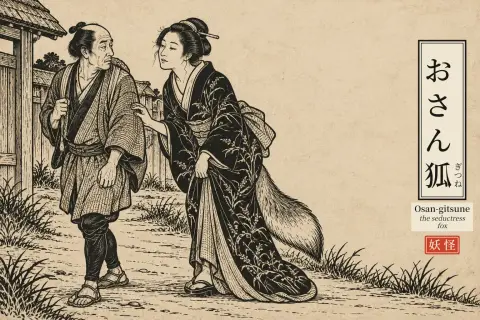
In Yuki, in Hiroshima, the fox spirit Osan-gitsune is written with the characters 尾三, "three tails." The name itself records the count. In another Hiroshima tale, she frightens people with a fire on her tail.
What the tail does in older stories
In the village tales, the tail matters for a different reason. It gives the fox away.
A fox in disguise is often a beautiful young woman. But there are tells. Her shadow keeps an animal's shape. Her reflection shows fur. Or a tail slips out from under her kimono. In these stories, nobody counts the tails. One is enough to be caught.
What we can say, and what we can't
- We can say: her nine-tailed form is an Edo-period version. One medieval version gives her two tails.
- We can say: Japan listed this fox as a lucky omen by 927, centuries before it became her true form.
- We can say: nine is China's "most there can be" number, and a first-century book reads the tails as the emperor's consorts and heirs.
- We can't say: who first made the tails a measure of age. The old books we found do not.
- We can't say: why Chinese fiction turned the lucky fox into a villain. We did not find a clear answer.
- We can't say: how many tails ordinary village foxes "should" have. The old tales rarely give a number at all.
If you know an older record of Tamamo-no-Mae with nine tails, tell us. We will check it and update this page.
Read more about the fox itself in our kitsune entry, or see why the fox turns up in so many other yokai stories in Why Is the Fox Everywhere?