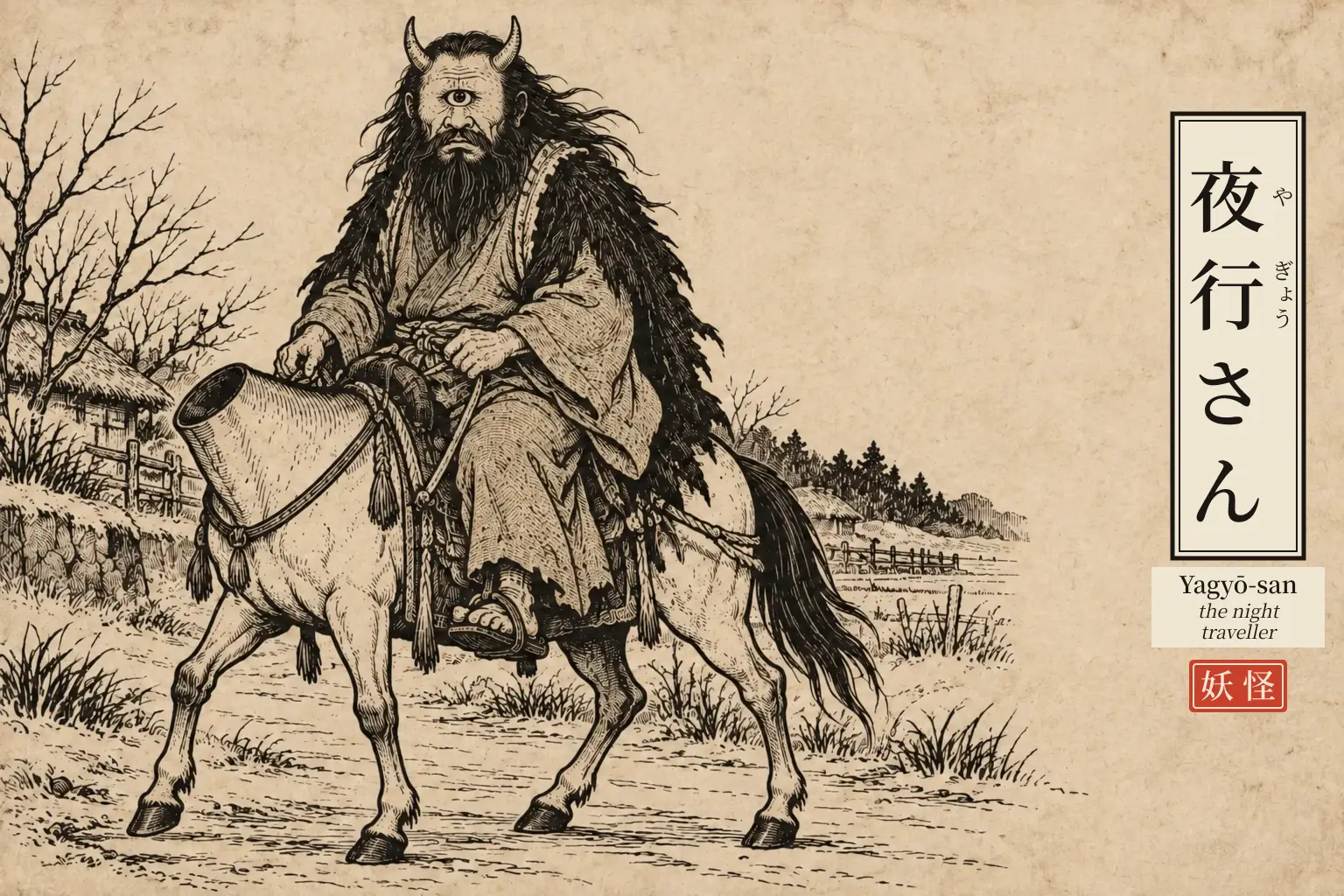
In old Tokushima, certain nights were simply not for walking. Setsubun, New Year's Eve, and a scattering of other dates belonged to Yagyō-san — a rider on a headless horse who patrolled the dark roads and would throw or kick anyone unlucky enough to be out. The name itself is the warning: 夜 (ya, "night") and 行 (gyō, "to go"), with the polite suffix -san tacked on, as if even a monster this dangerous deserved some manners.
What does Yagyō-san look like?
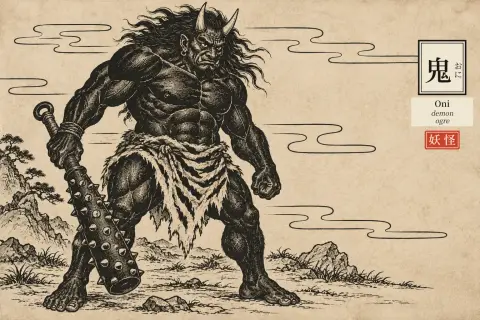
Most tellings put an oni in the saddle of a kubikire-uma, a headless horse. In one specific account from old Miyoshi-gun, that oni is bearded and has only one eye. Elsewhere the description thins out or changes entirely. Near Tokoroyama in Kōchi, people spoke of something called simply "Yagyō" that walked the mountain roads at night, ringing a shakujō — a ringed staff carried by wandering monks. The sound was all that got passed down there; its shape never did.
In fact, stories of the headless horse riding alone, with no oni on its back, are more common overall than the paired version. Along the lower Yoshino River and in eastern Kagawa, the name Yagyō-san means the headless horse itself. There, the horse itself is what people call Yagyō-san.
The nights it rides
Yagyō-san was said to appear on Ōmisoka (New Year's Eve), the night of Setsubun, the night of Kōshin, and on "yagyō-bi" — a set of dates fixed by old onmyōdō calendar reckoning, different combinations of month and zodiac day. Anyone out on one of those nights risked being thrown from the road or kicked by the horse. For generations, that was reason enough to stay inside after dark.
In the Miyoshi telling, the danger could reach indoors too. If a family sat talking about what was in that night's dinner, Yagyō-san would hold out a hairy hand toward them.
How to survive meeting it
Folklore gave one defense for a meeting on the road. If you met Yagyō-san on the road, you were to take off a straw sandal — a zōri — set it on top of your head, and lie face-down on the ground. Yagyō-san would pass by without harming you. The sources do not say why a sandal on the head works. It simply had to be done.
A separate Yagyō-san, far away in Tokyo
Confusingly, Hachiōji, a city on the far western edge of Tokyo, has its own Yagyō-san, and one yokai writer suggests it may be a different being from Tokushima's Yagyō-san. The Hachiōji story traces back to Takatsuki Castle, which once stood on the hills above the town. When the castle fell under attack, its princess fled on horseback. Enemy soldiers caught up and beheaded the horse as it ran. The headless horse kept running and carried the princess up into the sky, and the two have wandered Hachiōji on full-moon nights ever since. Seeing them is said to bring misfortune.
More recent sightings in Hachiōji describe less: just a hollow "kapo kapo" of hooves on asphalt behind a lone walker, with nothing there when they turn around. One account from a crossroads describes something closer to a centaur — a woman's upper body on a horse's lower body — sprinting past at speed. One theory links this Hachiōji figure instead to Oshira-sama, rather than to Tokushima's Yagyō-san at all.
Where it comes from
One theory ties Yagyō-san directly to the meaning of "yagyō-bi." Those dates, it holds, were originally the nights a shrine's sacred object (goshintai) was carried from place to place during a festival. Anyone with no role in the rite was expected to stay home and keep ritual stillness, called monoimi. Breaking that rule and intruding on the ceremony was said to bring a curse — and that curse, over time, got a name and a shape of its own: Yagyō.
Read this way, Yagyō-san is not a monster that came first and acquired rules. The rule came first — stay home on these nights — and the monster is what people pictured breaking it.
Go deeper
Books worth owning if this world pulls you in.
- The Book of Yokai →Michael Dylan FosterThe most readable scholarly introduction to yokai — where they come from, what they mean, and the major creatures.
- Japandemonium Illustrated: The Yokai Encyclopedias of Toriyama Sekien →trans. Hiroko Yoda & Matt AltThe complete Edo-period bestiaries that so many of these entries trace back to, in full English translation.
Some links are affiliate links; if you buy through them we may earn a small commission at no extra cost to you.
Yagyō-san today
Its clearest modern trace is a bronze statue standing on Mizuki Shigeru Road, the yokai-themed street of statues in Sakaiminato, Tottori. Most visitors walk past without a story to attach to it — which is, in its own way, close to how Yagyō-san always worked: a shape on the road at night, rarely explained, best not looked at too closely.