A farmer in northern Tokushima opens the shed at dawn and finds a cow dead. There is almost no wound on it, just a tiny cut. In Edo-period Awa Province, that was enough. The blame went straight to Ushiuchi-bō, the "ox-striking priest," 牛 (ushi, ox) + 打ち (uchi, strike) + 坊 (bō, a word for a priest or monk). Everything else about it — what it looks like, why it kills — varies by source.
What does it look like?
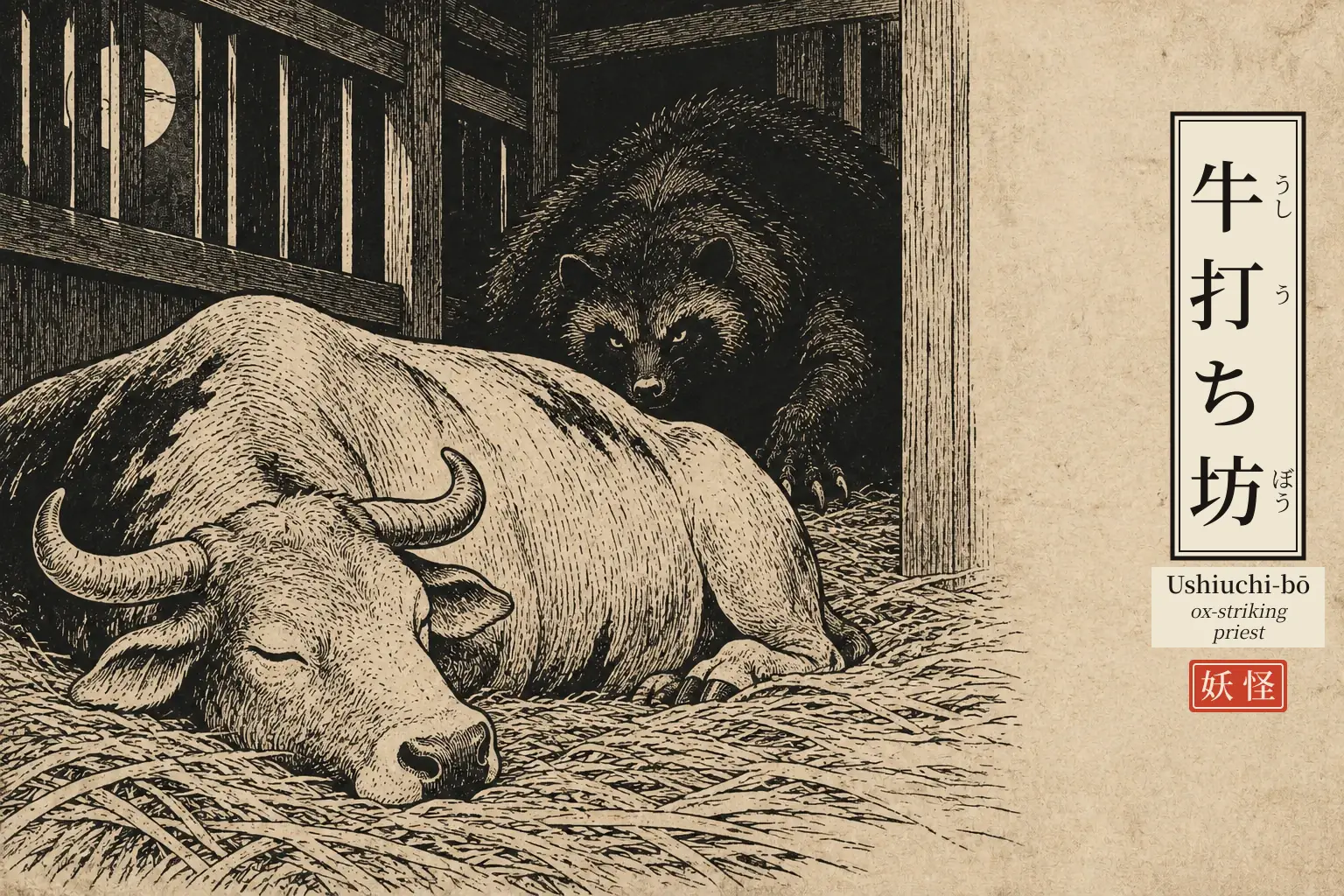
No one claims to have seen it clearly. The old record on it, a book called Ashū Kiji Zatsuwa, written in the Kansei era (1789–1801), calls it a black beast that looks something like a tanuki. A separate village folktale skips the description almost entirely, calling it only "a strangely-shaped monster." Later writers added one grim detail: the animals it killed were said to always carry two fang-like marks, as if something had bitten them to drink their blood.
That is the entire physical record. A shape in the dark, tanuki-ish, with teeth.
A death with almost no mark
The older accounts agree on the method more than the monster. Ushiuchi-bō enters a cattle shed late at night. It leaves only a tiny wound on a cow or a horse. The animal dies anyway. Ashū Kiji Zatsuwa also says an animal it fixed on could fall sick. Sometimes that animal died.
In Sakae, a village in Itano District now part of Itano town, people said Ushiuchi-bō carried a powerful poison. Some also said it made the wound to drink the animal's blood. A later book adds that two fang marks were always left.
Either way, the result for a farming family was the same. A healthy animal, dead by morning for no visible reason.
Burning it out every summer
Villages in the Itano, Myōdō, Myōzai, and Kaifu districts didn't just fear Ushiuchi-bō. They held an annual ritual against it. On the old-calendar 13th night of the seventh month, people built a small hut from bamboo and straw, called a bon-koya. Before dawn the next morning, after chanting sutras, they burned it to the ground. The idea was to trap Ushiuchi-bō inside the hut and burn it along with the straw.
Boys in their early teens ran the collection beforehand, going house to house for bamboo, straw, or money to build the hut. Skipping the donation was not a quiet option. The boys would jeer at that house with a chant — "Ushiushi-bō wo oikake, okaiko bettari miso bettari," roughly "chase off Ushiushi-bō, sticky with silkworms, sticky with miso" — and at burning time, throw a scorched eggplant from the fire into that house. A family hit by the eggplant was expected to lose a cow or a horse within three days. Nobody, apparently, risked testing it.
The one village it never touched again
A folktale from Sanagōchi village, in Myōdō District, tells of a traveling priest who arrived after Ushiuchi-bō had killed cattle there for some time. He offered to deal with it. One night the creature appeared, and the priest drove it off with nothing but fierce words, warning it never to come back. It even spoke to him, saying, "I am Ushiuchi-bō." After that night, the creature's attacks kept happening everywhere else in the region — but never again in Sanagōchi.
A related version of the story adds a second ending. Ushiuchi-bō wrote out a pledge never to return, and a priest at Ōmiya Hachiman Shrine buried that pledge on the mountain behind the shrine. One retelling even names the priest, Ōoka of Hata village, and has him wrestle the creature to the ground before it begs for mercy, instead of just being scolded off. Either way, the mountain where the pledge went into the ground picked up a new name: Jōgamaru, written 状が丸, later respelled 上が丸 with the same sound.
Where it comes from
Ushiuchi-bō reads less like a creature anyone met and more like an answer to a question farmers kept having to ask: why did a healthy cow die overnight, with no mark worth mentioning? A yokai with teeth and poison gave the loss a cause. The yearly bonfire gave the fear a yearly outlet, with the added job of making sure every household in the district paid into it.
None of the sources we found show Ushiuchi-bō leaving Tokushima. It survives in Tokushima folklore books and in Japanese folklore dictionaries. In Sanagōchi, the hill behind Ōmiya Hachiman Shrine came to be called Jōgamaru. The name comes from the pledge it was forced to write.
Go deeper
Books worth owning if this world pulls you in.
- The Book of Yokai →Michael Dylan FosterThe most readable scholarly introduction to yokai — where they come from, what they mean, and the major creatures.
- Japandemonium Illustrated: The Yokai Encyclopedias of Toriyama Sekien →trans. Hiroko Yoda & Matt AltThe complete Edo-period bestiaries that so many of these entries trace back to, in full English translation.
Some links are affiliate links; if you buy through them we may earn a small commission at no extra cost to you.