Most yokai start as a story: a sighting, a scare, a tale told at a well. Kyokotsu may have started as a word instead.
In Edo Japan, kyōkotsu was a common word for "way too much." Sekien's picture may be a pun on it: he wrote the word with the characters for "mad" and "bones," and drew the bones.
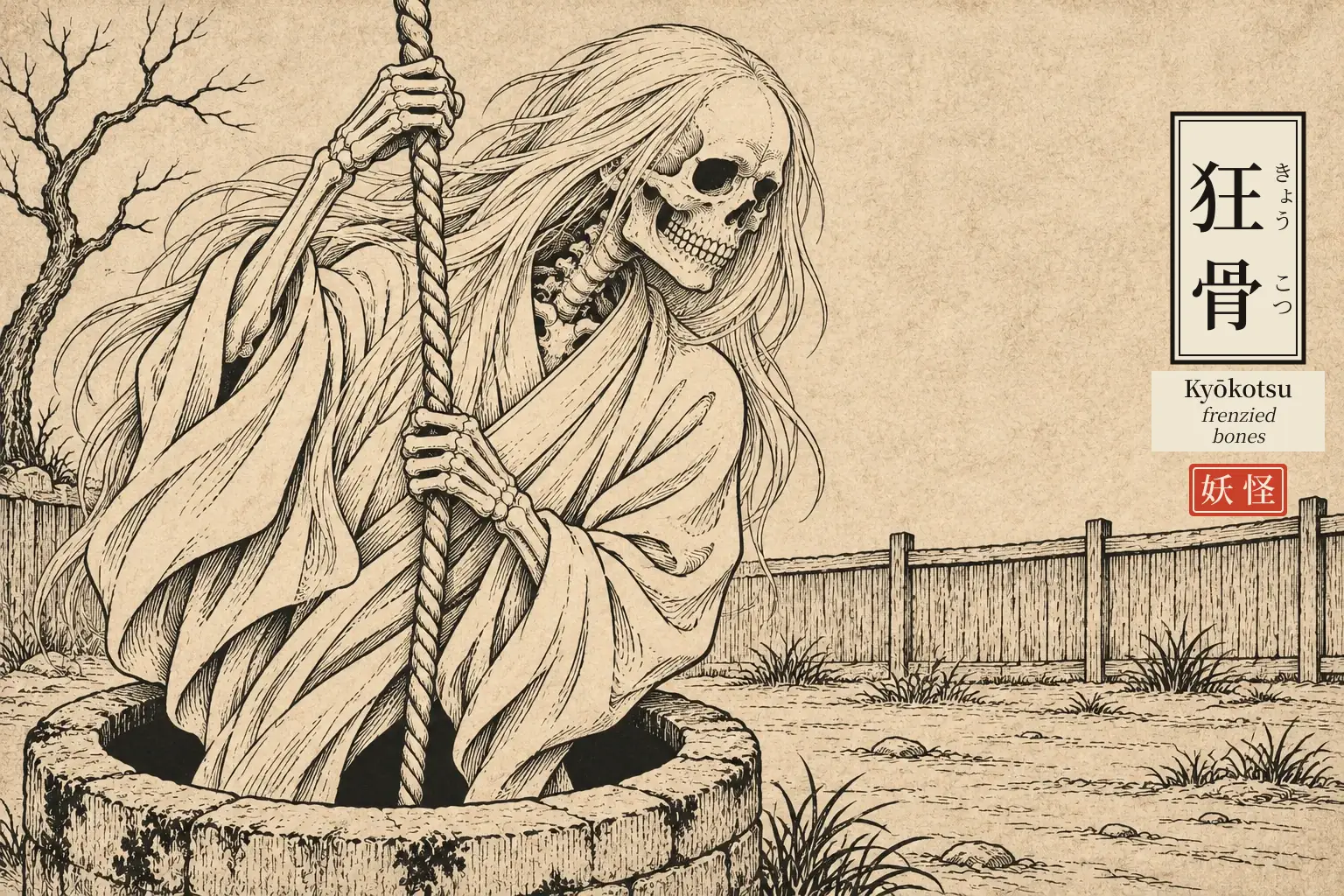
Toriyama Sekien, the Edo-period artist whose picture books gave many yokai their look, drew it in 1781, in his Konjaku Hyakki Shūi. His picture shows a skeleton. White hair still grows on its bare skull. It wears a plain white robe. It rises out of a well, riding up on the well's own bucket rope. Sekien's caption names it 狂骨 (Kyōkotsu): 狂 (kyō, "mad, frenzied") plus 骨 (kotsu, "bones"). What the caption never does is explain where the story came from. That gap is the real mystery here.
Riding Up on the Well's Own Rope
Most drawn ghosts in this period float free, with no legs under them. Kyokotsu is different. Sekien drew it hanging from a tsurube, a well's rope-and-bucket pulley. It rises the way the bucket does, bones and all.
The white hair is the only soft thing about it. Everything else is bare bone. A plain white robe covers the bones, the way artists of the time drew a yūrei, a ghost. Sekien's text describes nothing beyond that: the hair, the robe, the well, the rope.
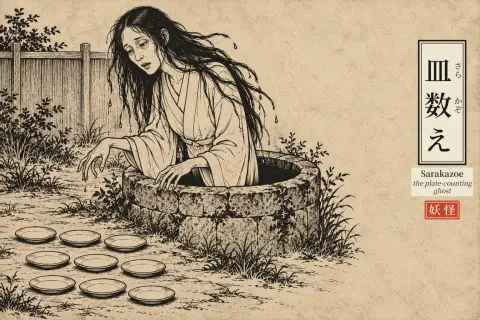
Compare it to Okiku, the well-ghost who counts plates in the sarakazoe story. Her legend runs for pages, names, and rival castles. Kyokotsu's runs for two lines.
Two Sentences, No More
Sekien's own words beside the picture are short. They say: "Kyokotsu is the white bone in a well." They add one more line. A common saying calls something extreme "kyōkotsu." That, Sekien writes, must come from how extreme this bone's grudge is.
That is the whole explanation. It says the thing comes from a well. It says it carries a fierce grudge. It says nothing about whose bones they were, or how they got there. Later writers call this gap exactly what it is: nobody has settled what kind of yokai this picture was even meant to show.
Maybe the Word Came First
Here is the part that makes Kyokotsu unlike most yokai on this site. The name itself may not be old at all.
Kanagawa Prefecture's former Tsukui District has a dialect word, "kyōkotsunai," for something boisterous or wild. Sekien's caption points at a word just like it, the one meaning "extreme." There is also a separate kanji word, 髐骨, also read kyōkotsu, meaning bone with the flesh stripped away.
The sources we found show no older story using the name "Kyokotsu" for a well-ghost. Because of that gap, later researchers read the order backward. Sekien likely built this yokai out of a dialect word and a word for bare bone, as wordplay, rather than drawing a monster people already told stories about. The ghost may have been invented to fit the name, not the other way round.
Two More Guesses at the Name
Other writers read the name in other ways.
One modern yokai researcher reads it as a pun. The name sounds like sokotsu, "careless," and that word holds soko, "bottom." A grudge you can never draw dry belongs in a well with no bottom.
Another points to Edo slang from the 1740s, or to the skeleton paintings popular at the time. Accounts differ, and none of the three guesses has won out over the others.
What Later Books Added
Books written after 1989 fill in a backstory Sekien never gave. In these retellings, Kyokotsu is a skeleton discarded in a well, turned vengeful by its own grudge, or a person who fell in, died, and came back changed. It rises to show where it was thrown away. It curses whoever draws water from that well.
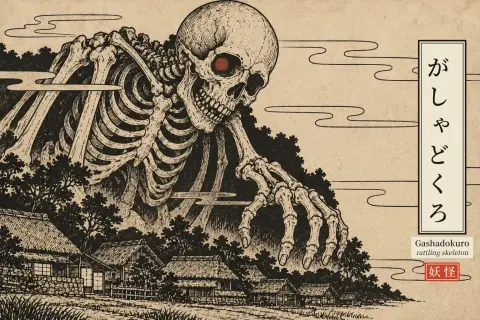
Neither detail is old. The giant skeleton gashadokuro got its own backstory the same way: bones of the unburied dead, fused by grief into one huge body, first written down in 1966, about 120 years after the print that made it famous. Kyokotsu's post-1989 backstory runs on the same convention, just for one body instead of many. Both are 20th-century yokai books filling a gap the original prints left open, not an old shared belief.
A separate strand of writing describes a similar idea, undated against Kyokotsu itself. The literary scholar Sawada Mizuho, in his book Nozarashi Monogatari, collected a different tale: bones left out in the open, dishonored, that take revenge on whoever wronged them. It isn't told as Kyokotsu's own story. It's a different telling of the same basic shape: wronged bones that get even.
Maybe Not a Ghost at All
One more reading pulls the other way. Skeleton yokai often look far more frightening than their stories back up. Some writers think Kyokotsu is exactly that: a striking picture with no real spirit behind it. Other modern books call it a death-spirit outright, the one that curses the well above. Sources disagree on which kind of thing it is.
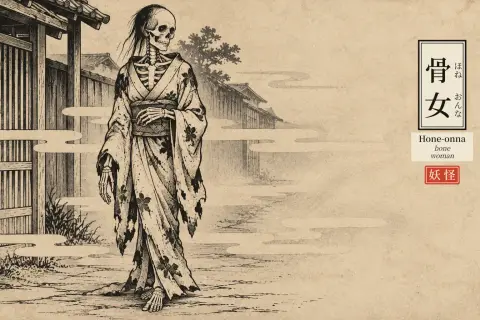
Unlike hone-onna, the skeleton woman whose lover alone sees her as beautiful, no source we found describes anyone loving or claiming Kyokotsu. It has a grudge, a well, and a rope. Whether anything is actually haunting that well is the one question Sekien's two sentences never answer.
Kyokotsu Today
In 1995, the novelist Natsuhiko Kyōgoku, known for mysteries built around old yokai lore, titled a book Kyōkotsu no Yume, "Dream of Kyokotsu." That novel is the name's best-known modern appearance.
Outside it, and outside Sekien's own print, the skeleton in the well has mostly stayed where he left it: hanging on its rope, caption unfinished.