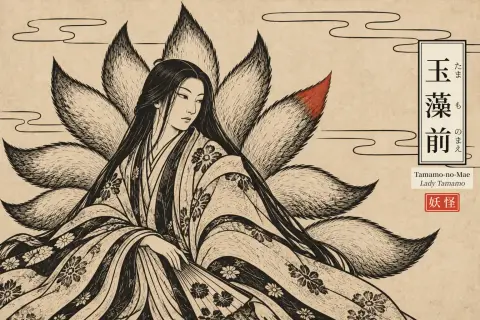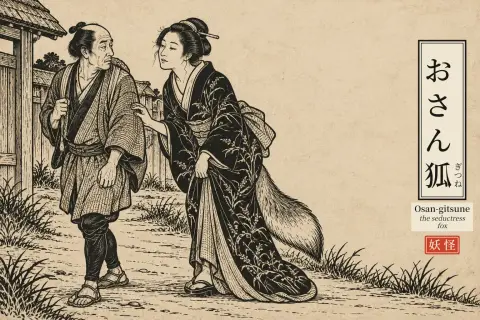
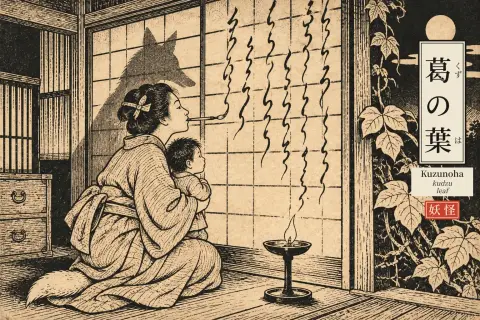
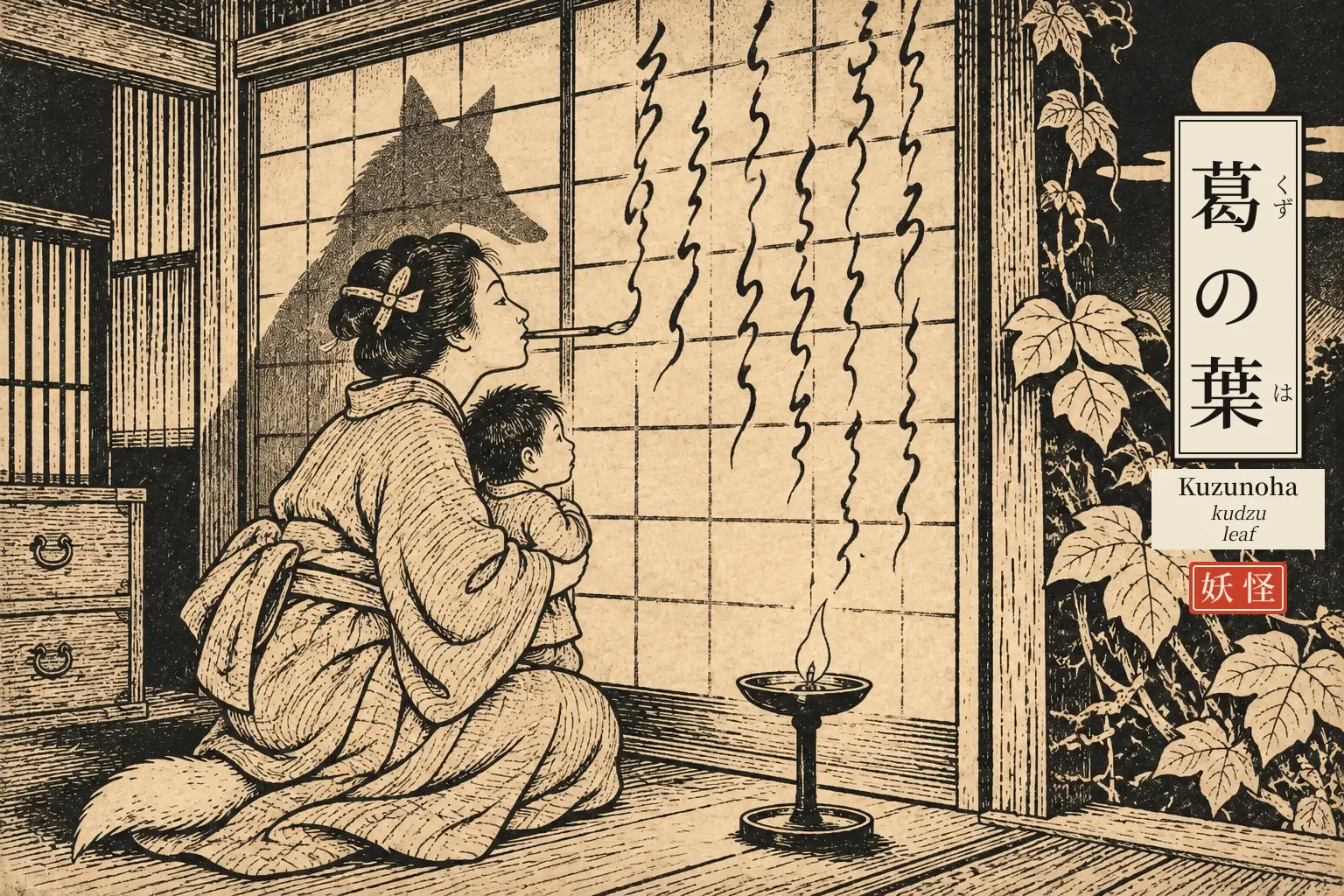
A mother is found out. She is not a woman at all, but a white fox from the forest. She cannot stay. Before she goes, she writes a poem on the paper door of the house, and she leaves her small son behind. That boy, the legend says, grew up to be Abe no Seimei, Japan's most famous onmyōji (court diviner) of legend.
Seimei was a real man. He is thought to have lived from 921 to 1005. The fox mother is legend, and she arrived late. She first appears in a book written centuries after his death. Her name came later still. She was first called Kuzunoha in 1699, in a play for kabuki, Japan's popular stage drama.
The poem on the paper door
This is the poem, the best-remembered line of the story:
恋しくば尋ね来て見よ 和泉なる信太の森のうらみ葛の葉
Koishiku ba / tazune kite miyo / Izumi naru / Shinoda no mori no / urami kuzunoha
In our own English:
If you miss me, come and look for me in Izumi, in the forest of Shinoda, where the kudzu leaves turn over in grief.
The last two words, kuzu no ha, mean "kudzu leaf." Kudzu is a climbing vine. Its leaves are green on top and white underneath. When the wind blows, they flip over and flash their white backs.
Readers hear two words in urami. Written one way, it means "seeing the back." One country name for kudzu is urami-gusa, "see-the-back grass." Written another way, urami means bitterness, or reproach.
The pairing is old. The Kokinshū, a poetry collection presented to the emperor in 905, has a poem by Taira no Sadafun. The autumn wind flips the kudzu leaves to show their backs, and that sound leads into urami, the poet's bitterness in a love poem. Kuzunoha's poem uses the same sound trick.
Whose bitterness is it? The poem does not say. One kabuki writer reads it as her wish that they will not resent her for leaving.
A white fox wearing another woman's face
The story changes from telling to telling. Most versions run roughly like this.
In the reign of Emperor Murakami (946 to 967), a villain named Akuemon wants a fox's living liver. His brother, the diviner Ashiya Dōman, has told him it will cure his sick wife. He leads hunters into the forest of Shinoda.
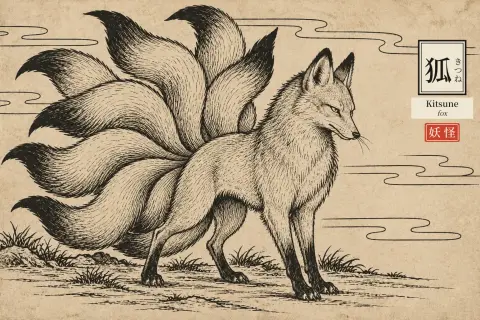
A man named Abe no Yasuna is visiting the shrine of Shinoda Myōjin. He sees a fox fleeing the hunters and saves it. He is hurt and captured for it. Later a woman comes and leads him to her house. Like many kitsune, Japan's shape-shifting foxes, this one has taken a woman's form. In time they marry and have a son.
Then the wife is found out. In some tellings, her own son sees her true shape. She is the fox Yasuna saved. She leaves the poem and returns to the forest. Yasuna and the boy follow her there. She appears to them once more and gives them a golden box and a crystal ball. With their power, the boy later cures the emperor and becomes a great diviner.
A version still staged today is a puppet play by Takeda Izumo I, Ashiya Dōman Ōuchi Kagami (1734). It adds a strange twist. There is a real woman named Kuzunoha, whom Yasuna hopes to marry. The old white fox takes her exact shape and lives as his wife for six years. When the real Kuzunoha finally arrives, she says she cannot tell which one is herself.
Accounts differ on how old the boy is when his mother leaves. One summary of the old story says seven. A summary of the 1734 play says five, though in the play the couple have lived together six years.
A real diviner, a borrowed mother
Here the line between history and legend matters.
The historical Seimei was an onmyōji, an expert in the stars, calendars and signs at the Heian court. He rose to become the court's doctor of astronomy. Old family trees say his father was Abe no Masuki, a mid-ranking noble. No reliable record of his childhood survives.
The fox mother comes from a different kind of book. The earliest known text to give Seimei a fox for a mother is the Hoki-shō. It is a commentary on a handbook of divination, written at the end of the medieval period. The Shinoda wife legend took shape in the middle of the Muromachi period (1336 to 1573), as tales about Seimei grew.
Who told it first? Scholars think it began among shōmonji, low-ranking folk diviners treated as outcasts. They used Seimei's fame to sell their own trade. Some scholars add that these diviners could not marry outside their group. They see that life in the story: a wife is loved, her origin is discovered, and she must leave.
There is another way to read the plot. Other scholars think it was built from older stories: a comic stage play about a fox and a trap, and a tale of a crane who becomes a wife.
Not everyone believed it, even then. A guide to Izumi Province printed in 1700 calls the idea that Seimei's mother was a Shinoda fox a strange tale.
By 1841, the story was so well known that the picture book Ehon Hyaku Monogatari gave Kuzunoha a picture and then declined to tell her story. Even small children know it, the book says, so there is no need.
Writing with a brush in her mouth
On the kabuki stage, the poem became a show of skill. The fox is holding her baby, so she cannot use her writing hand. That is the usual explanation. A theater review of 1891 said to watch it knowing this is an excuse for tricks.
The tricks grew over time. At the first kabuki staging in 1735, the script shows no writing tricks. The stage notes only say the poem appears on the paper door. By 1802, an actor was writing it with the brush held in his mouth. Later actors piled on more. Today an actor often writes with each hand, writes from the bottom up, writes in mirror letters, and finishes with the brush in the mouth.
Audiences came to expect it. The novelist Tanizaki Jun'ichirō remembered going as a child to see the great actor Ichikawa Danjūrō IX play Kuzunoha. His mother had told him the fox writes with the brush in her mouth. Danjūrō wrote it by hand. The boy was a little disappointed.
The scene even left the theater. In 1831, a show in Edo turned it into a foot-juggling act. A performer lies on his back and balances a paper door and a person on his feet. The person on top writes the poem with a brush. The Kinoshita Circus still performs it.
Shinoda forest today
The forest of Shinoda is real. It sits in today's Izumi City, south of Osaka. Long before Kuzunoha, the court writer Sei Shōnagon named it in The Pillow Book. What is left of it survives as the woods around two shrines.
One is Hijiri Shrine, also called Shinoda Myōjin, the shrine Yasuna visits in the story. The other is Shinoda-no-mori Kuzunoha Inari Shrine. It took the Kuzunoha name around 1740, and it is said the kabuki plays inspired it.
That second shrine keeps the legend close. A stone there is carved with the poem and with Kuzunoha back in fox form. A well is said to be where the fox checked her human shape, using the water as a mirror. Inside the main hall is a stone she is said to have turned into, in her sorrow. A great camphor tree, split in two from the root, is where she is said to have appeared.
The legend reached the train map, too. Two nearby stations, now Takaishi and Kita-Shinoda, first opened under the names Kuzunoha and Kuzunoha Inari.
And it reached the menu. Udon noodles topped with fried tofu are called kitsune udon, "fox udon." In Kyoto and Osaka they may also be called shinoda, after the forest where Kuzunoha went home.