In January 1905, near Higashiyoshino, in the mountains of Nara, a local hunter had a dead wolf to sell. An American animal collector, Malcolm Playfair Anderson, bought its body for eight yen and fifty sen. No wild Japanese wolf has been confirmed alive since. Japan's Ministry of the Environment lists the species as extinct. But in October 1996, someone photographed a wolf-like animal on a forest road near Chichibu, in Saitama. Experts still disagree about what the camera caught.
Short legs, short ears, long fur
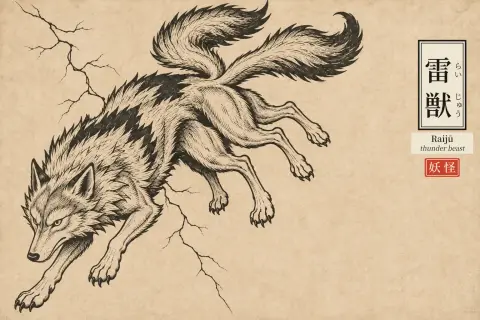
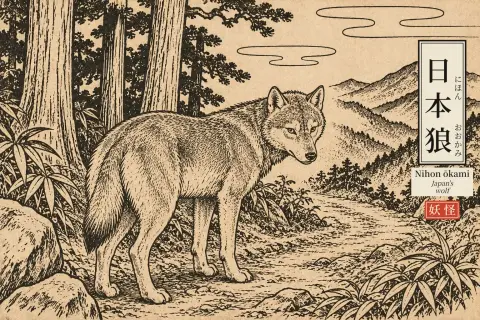
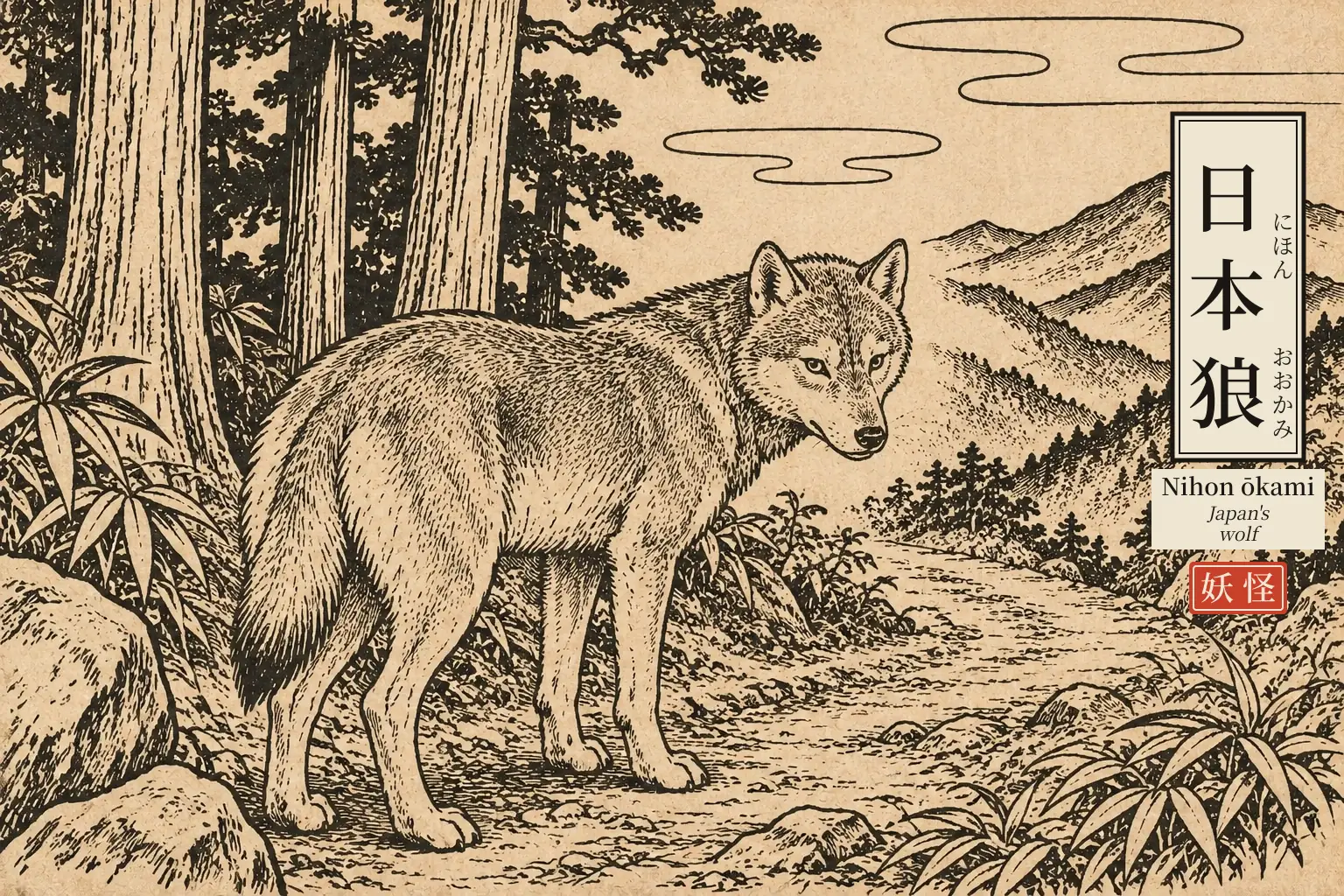
The Japanese wolf, Nihon ōkami (日本狼) in Japanese, was one of the smallest wolf subspecies on record. Its legs and ears were unusually short for a wolf. Its fur ran long, in a pale beige. The tips of the hair on its chin, back, flanks and tail carried a touch of black. Its lips and cheeks were nearly white. The backs of its ears showed reddish-brown. A patch of dark brown fur covered the lower part of each front leg. Its skull was short and small, with a short, wide muzzle. Measured specimens show a body length of about 95 to 114 centimeters, not counting a tail near 30 centimeters.
Temminck, a Dutch naturalist, named it Canis lupus hodophilax in 1839. The second word means roughly "guardian of the road."
Also called yamainu, and worshipped as a true god
Old Japanese writers often spoke of two different animals: the ōkami (wolf) and the yamainu (山犬), "mountain dog." Some records claimed the yamainu was smaller and was never worshipped, while the ōkami was larger, had webbed feet it used for swimming, and was treated as sacred. Most researchers today think they were the same animal, described two different ways. At shrines such as Musashi Mitake, in the Okutama mountains of Tokyo, and Mitsumine, in Chichibu, the wolf was venerated as a guardian against evil, possession and crop-raiding animals.
Small packs, short howls, hidden dens
Japanese wolves were active at dawn and dusk. Unlike the Ezo wolf of Hokkaido, they rarely formed big packs. Groups ran from two or three animals to about ten. They hunted mainly sika deer, wild boar and Japanese macaques, though they sometimes took dogs and horses. Horse-breeding regions such as Morioka reported heavy losses. They howled loudly enough, at close range, to rattle paper shoji screens. Packs denned in rock hollows hidden among silvergrass on mountain ridges, raising about three pups at a time.
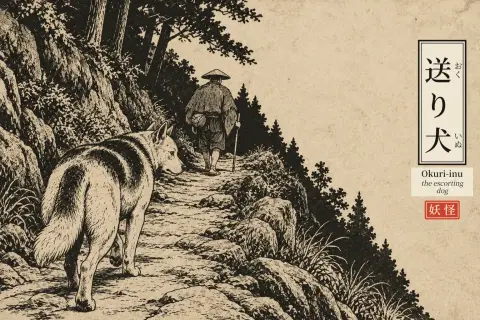
If a person walked into a wolf's territory, it reportedly grew wary. It would follow behind them, watching, until they left. Some writers think people read this habit kindly, and that it grew into the legend of the okuri-inu, the mountain-path "escort dog."
The flute that saved a court musician
Not every old story about the wolf ends badly. A print by the ukiyo-e artist Tsukioka Yoshitoshi, from his 1886 series One Hundred Aspects of the Moon, shows the Muromachi-era court musician Toyohara no Sumiaki meeting a wolf on a mountain road. According to the legend behind the print, Sumiaki escaped by playing the shō, a Japanese reed mouth organ, and came away unharmed.
Most old accounts are not so gentle. A 1702 diary from the Takashima domain records sixteen men and women killed by wolves over two months. An Owari domain record from 1709 counts twenty-four people attacked in a single March, sixteen of them dead. A 1799 account from the Lake Suwa area in Shinano describes a wolf attack. It had already seized a man's companion. Jirobei struck the wolf's back with a stone. The wolf tore the flesh under his eye instead. He collapsed, covered in blood. His friend's body was left with no head, skin or flesh.
How the trail went cold
No one is certain why the Japanese wolf disappeared. The naturalist Hiraiwa Yonekichi pointed to several likely causes together: rabies and other diseases spreading from domestic dogs, the rise of firearms making large-scale extermination possible, hunting that thinned out the deer wolves relied on, and the loss of wild habitat to development.
Ueno Zoo kept a Japanese wolf in captivity until June 1892. No photograph of it survives. By 1905, the species was gone from the wild in any confirmed sense. The skin and skull of that last animal from Nara now sit in the Natural History Museum in London.
A photograph that won't settle the argument
A man who has spent decades searching Japan for the wolf took nineteen photographs of a dog-like animal, about 80 to 90 centimeters long, on a forest road in the Chichibu mountains in October 1996. It became known as the "Chichibu feral dog." Imaizumi Yoshinori, a former head of zoology at Japan's National Museum of Nature and Science, compared the photographs to the type specimen held in the Netherlands. He listed twelve points of resemblance and said the animal might be a Japanese wolf. Other researchers argue it was simply a feral dog. Experts remain split, and no further photograph has settled the question.
The wolf today
In Kiyokawa, a village in Kanagawa, families had kept wolf skulls for generations, handed down as household charms. In 2025, genome analysis confirmed several of those skulls as genuine Japanese wolf bone. In 2011, news reports said researchers at RIKEN's Kobe institute had discussed trying to clone the species back into existence. A 2024 genome study found the Japanese wolf's closest living relative is not another wolf at all, but the domestic dog, both tracing back to a shared origin in East Asia.