A man could die far away, with no power left at all. Yet a Heian court worried about him for generations. An epidemic swept through the palace. Officials searched for who to blame. They settled on the dead. Their answer was not punishment. It was a shrine.
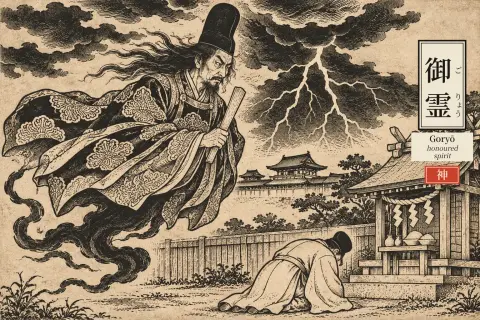
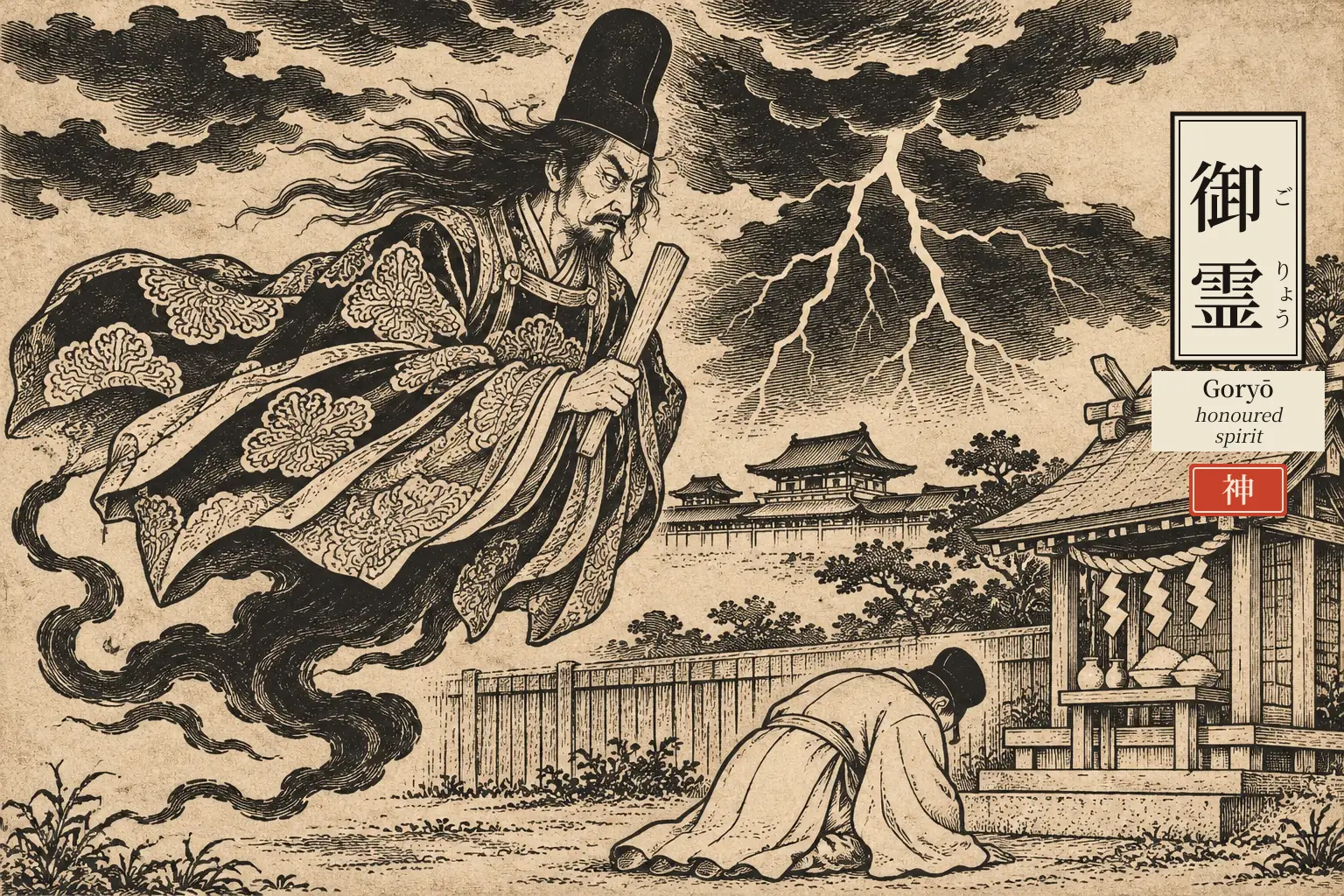
That spirit is called a goryo (御霊). The name pairs 御 (go), a respectful prefix, with 霊 (ryō), "spirit." A goryo is an angry ghost, formally pacified and enshrined as a god. Once pacified, it was treated as a protector instead of a danger.
From grudge to god
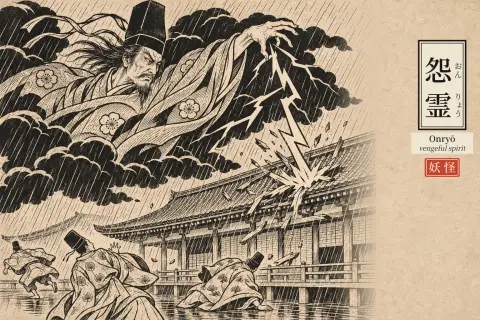
Most of Japan's angriest ghosts start under a different name: an onryo. An onryo is a vengeful spirit still working through its grudge. A goryo is what that onryo becomes once it gets a shrine. The ritual was meant to calm the grudge, not put it to work. Once calmed, the same spirit was treated as a protector instead of a threat.
Some of Japan's most feared onryo crossed this same line. Retired Emperor Sutoku is one. Retired Emperors Go-Toba and Juntoku are two more. The court and the shogunate built temples and shrines to pacify each of them. Their stories belong to the onryo they were. What changed was only the ending.
Six names at Shinsen-en
The first rite for a goryo on record happened in 863. It was held at Shinsen-en, a garden by the imperial palace in Kyoto. The Nihon Sandai Jitsuroku, a court history finished in 901, gives the reason plainly. The year before, a cough-and-fever epidemic had swept the court. Many ordinary people died too. Two of the dead were Major Counselors, and the emperor's own great-uncles. Prayers had not stopped the dying, so the court tried this instead.
Six spirits were named and pacified at the rite. One was a demoted emperor, once called Prince Sawara. One was a prince named Iyo, and one was his mother. Two were court officials. The sixth was a court inspector. Even the record does not say for certain who he was. Priests read Buddhist sutras aloud. Musicians played. Ordinary people could join the dancing too.
Six becomes eight
Kyoto still keeps two shrines from that same lineage: Kami-Goryō and Shimo-Goryō. Between them, they honor eight spirits, not six. Two of the original six dropped out of the list. Four new names came in. One is an empress, and one a prince, both deposed earlier in a succession dispute. One, Kibi-shōryō, is identified by different accounts as the courtier Kibi no Makibi, a princess, or no specific person at all. One is a fire-and-thunder god called Karai-jin.
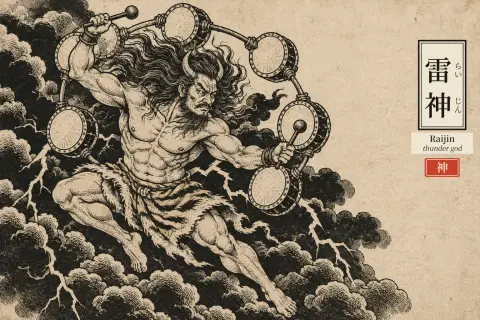
People today often call Karai-jin by a different name: Sugawara no Michizane. He was an exiled scholar whose own onryo became Japan's god of thunder and learning. That link was made only after the two shrines were already standing.
Other rites name still more goryo. A chant recited every spring at Tōdai-ji, a great temple in Nara, during its Omizutori water-drawing rite lists eleven of them. Several, among them Yashima Goryō and Saiji Goryō, are known only by place, not by person. For most of them, the place-name is all that survives.
A festival built the same way
In 869, the same logic produced something still running today: the Gion Festival. Kyoto had just lived through years of disaster. Mount Fuji had been erupting since 864. That same year, a huge earthquake and tsunami hit the Tōhoku region. The court ordered a rite on the same pattern as 863.
An official raised 66 halberds, one for each province of Japan. The idea was to pull each province's evil spirits into the halberds, away from its people. Three portable shrines were carried out. A plague god named Gozu Tennō was enshrined to keep the sickness away. In 2019, the shrine marked that rite's 1,150th anniversary.
For centuries, the deity was called Gozu Tennō. He was worshipped at a temple linked to Enryaku-ji, the great Buddhist monastery on Mount Hiei. In the 1870s, the Meiji government split Shinto from Buddhism. The shrine was renamed Yasaka. The Shinto god Susanoo took Gozu Tennō's place on the altar.
Not every goryo shrine is what it sounds like
"Gorō" is a common Japanese given name. It sounds almost like "Goryō." Several shrines keep the Goryō characters in their name. But their popular nicknames come from that pun, not from any real onryo story.
Kamakura's own Goryō Shrine is better known today as Kamakura Gongorō Shrine. The nickname comes from a Heian-period warrior, Kamakura Gongorō Kagemasa. A shrine festival on Kyushu's Ōsumi Peninsula is called the Yagorō-don Festival, for the same reason.
The folklorist Yanagita Kunio pushed the idea further. Graves scattered around Japan are often called the grave of "Soga Gorō," a hero from a separate revenge tale. Yanagita suggested some of these once marked ordinary goryo. Only later, he thought, did the same pun turn them into Soga Gorō's grave.
Accounts also differ on a smaller custom. When the Gion Festival's mikoshi passed near the palace, medieval emperors sometimes took a detour around it. One explanation says they feared the spirits inside the mikoshi. Another says they were only dodging the crowd.
How far back the fear goes
Many historians treat one case as the earliest anyone can confirm in writing. Fujiwara no Hirotsugu was a noble executed after a failed rebellion in 740. His onryo is named in the Shoku Nihongi, a court history finished in 797.
Some historians think the fear goes back further still. They point to Prince Shōtoku, or to the fall of the Soga clan in the 600s. The historian Hongō Masatsugu disagrees with those earlier guesses, and with Hirotsugu too. He notes that every one of those cases, Hirotsugu included, comes only from sources written generations later. He argues that no onryo before Prince Sawara can be confirmed. Sawara was the first of the six names honored at Shinsen-en in 863.
Goryo today
The habit never really stopped. Edo-period Japan deified its own wronged dead the same way. One example is the retainer Yamaga Seibei, now worshipped at Warei Shrine. Another is the farmer-leader Sakura Sōgo, enshrined at Sōgo Reidō. A war chronicle called the Taiheiki took the idea even further. It blamed an entire civil war, the Nanboku-chō conflict of the 1330s to the 1390s, on onryo alone.
The ritual itself came back in 2021. Kitano Tenmangū had not held its own goryo-e since the Ōnin War, a civil conflict of the 1460s-70s. That year, its Shinto priests and monks from Enryaku-ji performed it together again, to pray for an end to the Covid-19 pandemic.
The word has even reached a video game. Phasmophobia, a ghost-hunting horror game, names one of its ghost types Goryo. Its signature evidence shows up only through a video camera. No in-game lore ties the name to any one historical story.