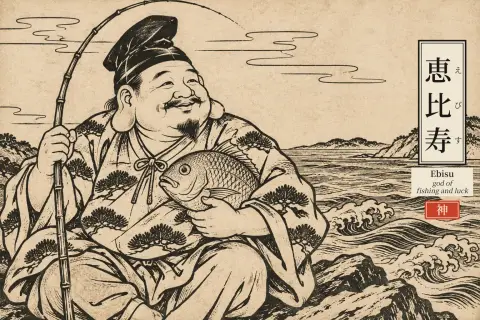
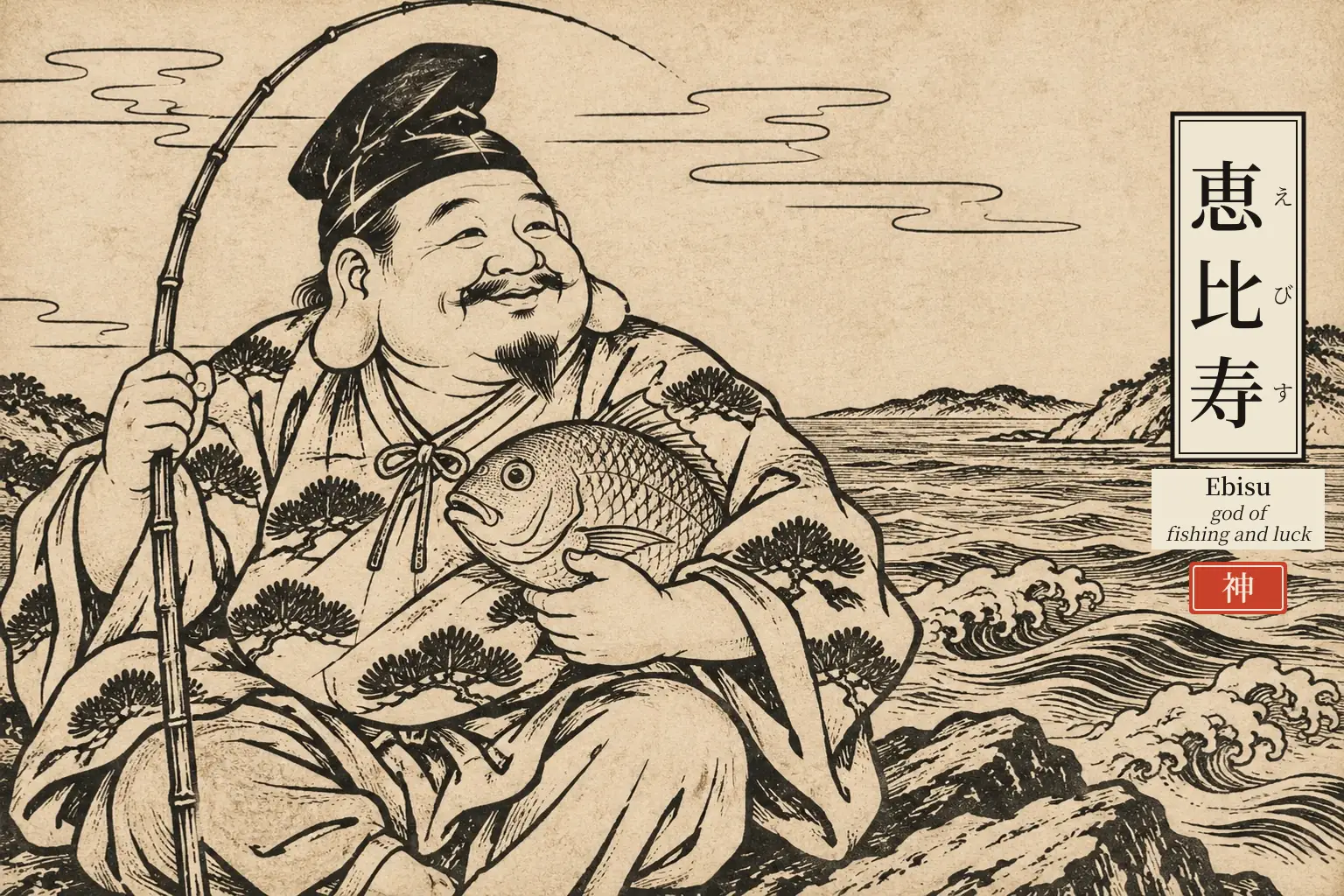
Ebisu (恵比寿) is the smiling god with a fishing rod and a sea bream under his arm. He is one of Japan's Seven Lucky Gods. He is also the only one of the seven of native Japanese origin; the others came from India or China. Ebisu is thought to have begun as a god of fishermen. The sea's gifts were his: stones, whales, even the drowned.
Whatever the tide brings
In many fishing villages, a round stone picked up from the sea becomes Ebisu. People place it in a small shrine. They hold festivals for it at the year's first catch and when they pray for a big one. In southern Kyushu, fishermen take a stone from the sea at the start of the season for the same purpose.
The name went further than stones. In some places, whales, sharks and dolphins are called ebisu. A whale stranded on the beach was a yorigami, a "god that comes close". An old saying runs: when a whale comes ashore, seven bays prosper.
Even the bodies of the drowned are called ebisu in some places. So are things that drift in. Where this is the custom, they are never treated carelessly.
The god was in the words of the work, too. In many places, fishermen say "Ebisu" as they set out, as they drop a line, and women divers say it before they dive. Around Uwajima in Shikoku and in the Oki Islands, net floats are called "ebisu-aba".
A visitor from beyond the sea
Nobody is sure where the word comes from. The usual explanation links it to 夷, an old word for outsiders. In old Japan, ebisu was the same word as emishi, or a variant of it: a name for foreign peoples and for people on the edges of the land.
That fits the god. Ebisu is a visitor from across the water. One scholar links him to fish: shoals travel, and fishers call his name to bring the catch.
A rod, a sea bream, a court cap
The usual picture of Ebisu today is easy to spot. He wears an eboshi cap and a loose hunting robe, the kariginu. He holds a fishing rod in his right hand. Under his left arm is a sea bream.
His face is round and laughing. In Japanese, a broad, happy smile is still called an "Ebisu face", ebisu-gao.
Two gods behind one name
The oldest record of the name is in the Iroha Jiruishō, a dictionary from the end of the Heian period. It lists ten small shrines belonging to Hirota Shrine, in today's Hyōgo. One is for 夷, Ebisu. Another is for Saburō. They are two separate gods.
A list from the early Kamakura period gives the same two shrines. Over time the pair blurred into one god, "Ebisu-Saburō". The merged shrine is thought to be the start of today's Nishinomiya Shrine. It is the oldest recorded shrine to a god named Ebisu, and it heads the Ebisu shrines today.
Which god is he?
Ebisu has no part in the Kojiki or the Nihon Shoki, Japan's oldest histories. So later writers searched those books for a god he might really be. Most Ebisu shrines settled on one of two.
| The god | His story | When the link appeared | Example shrine |
|---|---|---|---|
| Hiruko | A child of the creator gods who could not stand at three years old, and was set adrift | Around the Muromachi period | Nishinomiya Shrine |
| Kotoshironushi | A son of the great god Ōkuninushi, who was out fishing when a messenger came about handing over the land | The Edo period | Imamiya Ebisu Shrine, Osaka; Miho Shrine, Shimane |
Later writers picked both gods for a link to the sea. Hiruko was set adrift, and in the belief he washed ashore somewhere. Kotoshironushi was out fishing. The fishing rod and sea bream are said to come from his story.
The second link had a side effect. Kotoshironushi's father, Ōkuninushi, was merged with Daikokuten, another lucky god. So Ebisu and Daikoku are sometimes called father and son. The two are still worshipped side by side.
Some local beliefs say Ebisu has a disability. At Miho Shrine, parishioners say Kotoshironushi was left lame in one leg after a crocodile or a fish bit it. He is also said to be hard of hearing. At Imamiya Ebisu Shrine, people go round to the back of the main hall and strike a gong, so he will notice them.
From the beach to the market
Fishermen worshipped him first. Because seafood was bought and sold, Ebisu became a god of markets too. In the Kamakura period he was enshrined as a market god at the great Hachiman shrine in Kamakura. Farmers and merchants followed.
Puppeteers helped. Performers based at Nishinomiya Shrine, the ebisu-kaki, carried Ebisu puppets around the country and put on shows. Through them he became a god of good business across the country.
Two names for the drowned
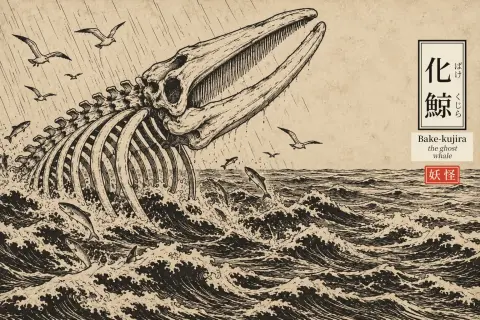
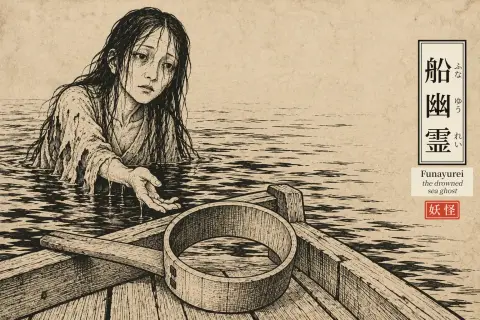
The sea sends other things to the shore of Japanese folklore. Funayurei are the drowned as ghosts. They rise beside boats at night and ask for a ladle to sink them. Bake-kujira is a whale made of bare bones.
In some places, the drowned are also called ebisu. Where this is the custom, they are never treated carelessly.
Ebisu today
In January, big shrines in the Kansai region hold Tōka Ebisu, "Tenth-day Ebisu". At Imamiya Ebisu Shrine in Osaka, it runs from January 9 to 11. Crowds pray for good fortune and carry home lucky bamboo branches, fukuzasa. Many shrines in western Japan hold similar festivals in January and February.
Farm families set sea bream on an Ebisu shelf on the 20th of the first and tenth months of the old calendar. They prayed for the harvest and gave thanks for it. Merchants hold their own autumn Ebisu-kō. Some call it seimon-barai, a day to be cleansed of the sin of cheating customers in bargaining. Some shops hold big sales for it.