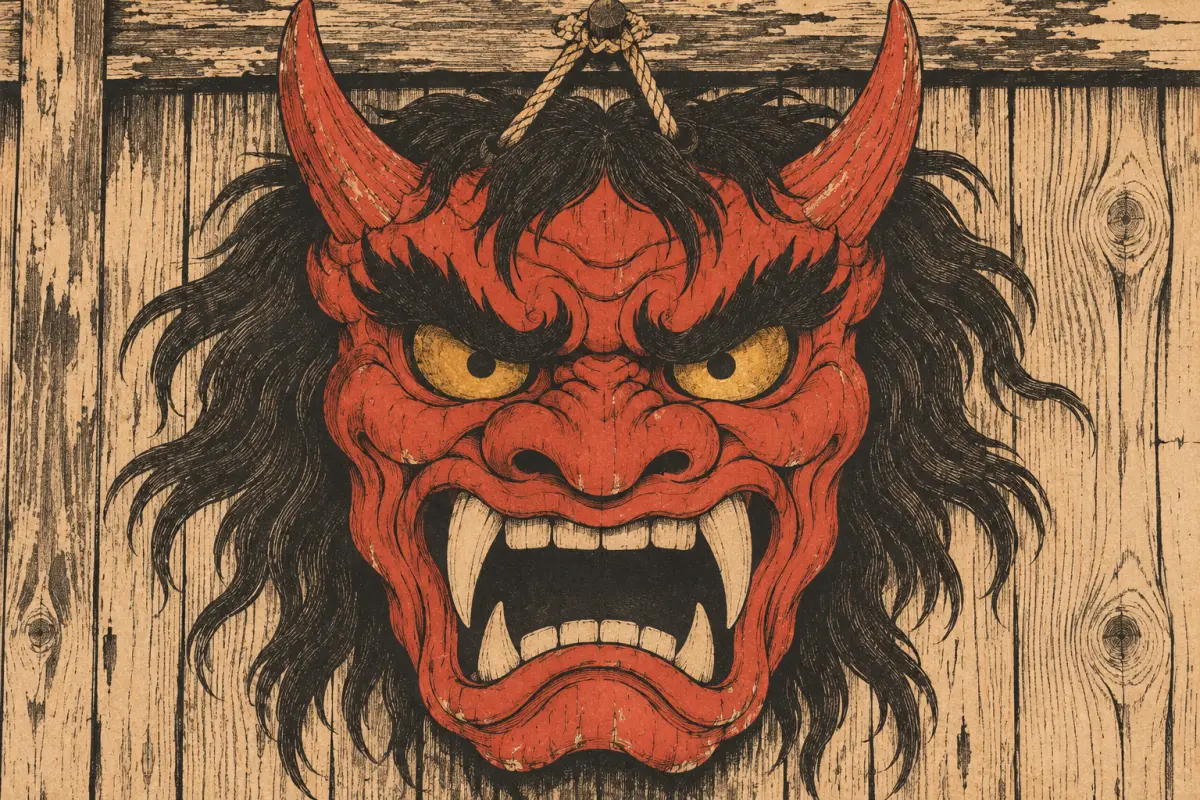
An oni mask tattoo shows the face of an oni, a Japanese demon. It stands for raw strength and danger.
But Japan uses this face in two opposite ways. Every February, families throw beans at the oni to drive it out of the house. And for about 1,300 years, builders have put the same face on the roof, to guard the house. The oni is the monster, and it is also the guard.
What do people put into an oni tattoo?
An oni tattoo is not only "a scary demon." In Japan's own stories, the oni carries several wishes. Pick the one you mean, and the design follows.
| If you want it to say | Draw | The story behind it |
|---|---|---|
| "I guard my people." | The mask facing out, like a roof guard | Japan has put oni faces on its roofs for about 1,300 years, to keep evil away. |
| "I give everything to what I do." | A fierce, focused face | Shigoto no oni, "an oni of work," is praise for someone who works harder than anyone. |
| "Strong, and stronger still." | An oni with an iron club | "A club for an oni" means making the strong even stronger. |
| "I changed." | The kanji 鬼 without its top stroke | A demon mother changed her heart and became a guard of children. Her hall writes 鬼 without its "horn." |
Each wish raises a question. Why would a demon guard a house? Why is "oni" praise? The answers are below, one wish at a time.
Why does an oni face guard a house?
Because a scary face scares off other scary things. Think of a fierce dog at the gate. It is frightening, but it frightens strangers, not you. The oni on the roof works the same way.
That face has a name. An onigawara, "oni tile," is a large tile at the end of a roof ridge. Japanese dictionaries say its demon face was used to keep evil away.
What kind of evil? Japan's old court rites give a clue. There, sickness came in the shape of demons. And the way to drive a demon out was a face even more frightening.
You can see this in one old rite. Setsubun, the bean night, grew out of tsuina, a court rite to drive out disease. It was first recorded in 706. A man in a golden mask with four eyes led the chase against the disease demons.
Then something strange happened. His mask was so frightening that people forgot whose side he was on. A Japanese encyclopedia says the crowd began to chase the masked man himself as the oni. The guard turned into the monster.
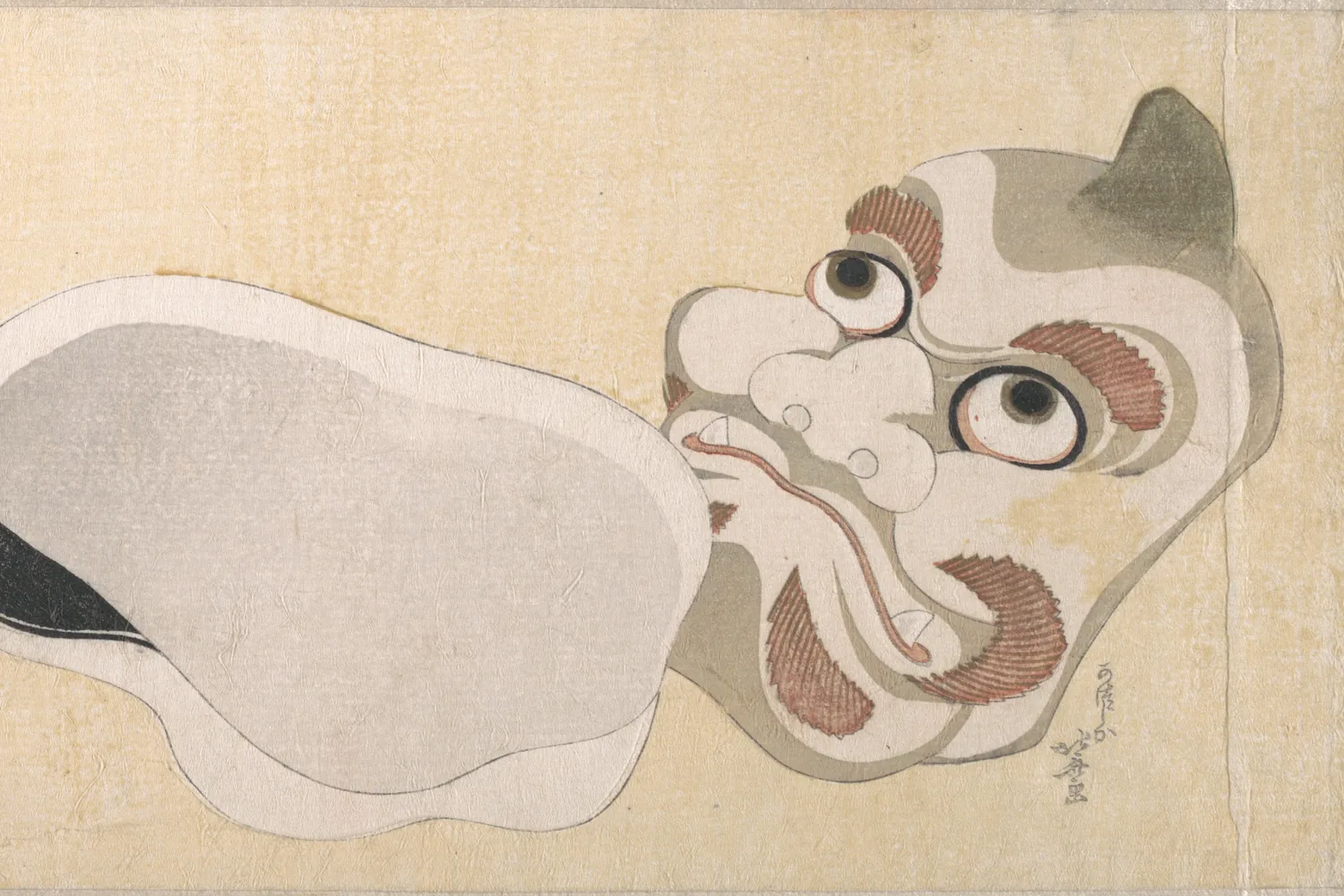
An oni mask and a mask of Uzume, a goddess of good luck, in a woodblock print by Katsushika Hokusai, probably 1807. Hokusai is the artist of The Great Wave. The Metropolitan Museum of Art, public domain (CC0).
Today, Setsubun falls around February 3, the day before spring starts. In the old calendar, spring also began the new year. People believed sickness came in at that turn of the year. Beans were thought to hold the power of life. So families throw roasted beans and shout, "Oni wa soto! Fuku wa uchi!" That means "Demons out! Luck in!"
The roof face has a long road behind it too. The oldest roof-end tiles, from the 600s, had lotus flowers on them. From the 700s, demon faces took over. Horned faces came later, and spread in the 1300s. A Japanese encyclopedia says the design was probably a Chinese influence. But clear Chinese demon tiles are not known. The tiles that lead straight to Japan's are from Silla, an old kingdom in Korea. One Edo-period notebook, the Matsunoya Hikki, even says the face showed Kahaku, a river god. The roof's demon may have started life as a god.
Some fierce faces still are gods. On New Year's Eve in Akita, in northern Japan, men in fierce masks walk from house to house. They roar at lazy people and crying children. These are the namahage. In 2018, UNESCO, the United Nations' culture agency, listed them as "visiting deities."
So the same face can stand on either side. It depends on which way it faces: toward your house, or away from it. So on your arm, draw the mask looking out, at the world. Its fear is aimed at whatever comes for your people.
Why is "oni" praise for hard work?
Because an oni does not stop. In the oldest Japanese tales, oni eat people. They are power with no brake.
Now picture a person with that same power, aimed at one job. Japanese has a word for them. A Japanese dictionary gives one meaning of oni as "a person who gives everything to one thing." A shigoto no oni, "an oni of work," is someone who works harder than anyone.
English does the same thing. It calls a strong player "a beast," and it means it kindly. In casual Japanese, oni in front of a word just means "very." The word kept its force but lost its fear.
So on your arm, a fierce, focused oni face says: I do not hold back.
Why give an oni a club?
Because the oni is already the strongest thing in the story. The iron club makes the strongest even stronger.
Japanese turned that picture into a saying: oni ni kanabō, "a club for an oni." It means making the strong even stronger. Someone already strong gets one more advantage.
The club fits the oni's whole meaning. The oni stands for brute force. The club is brute force you can hold in your hand. Put them together, and you get strength on top of strength.
So on your arm, an oni with a club does not say "I am strong." It says "I am strong, and I came ready."
Why would an oni lose its horn?
Because it stopped being a demon. That is the answer one Tokyo hall gives, and it writes the answer into the kanji.
Start with the story. At Zōshigaya, a neighborhood in Tokyo, there is a hall for Kishimojin. In the Buddhist story, she was a demon mother who ate other people's children. Then the Buddha hid her youngest child. Now she knew how the other parents felt. She changed her heart, and she became a guard of children.
Now look at the kanji for oni, 鬼. Find the small slanted stroke at the very top. At this hall, that stroke is called the oni's "horn." And the hall writes 鬼 without it. Tokyo's official tourism site notes this. A TV Tokyo show gave the reason, and it is simple: she changed her heart, so she lost her horn.
Why the horn? The horn is what marks an oni. Take it away, and what is left is the guard.
So on your arm, a hornless 鬼 says: I was once the danger, and I chose to become the guard.
The meaning at a glance
| Part of the face | What it shows |
|---|---|
| Horns | An ox's horns. The usual reason given is the name of an unlucky direction (see below). |
| Wide mouth and fangs | It eats people. In the oldest Japanese tales, that is what oni do. |
| Red or blue skin | Red oni and blue oni live in hell, says a Japanese dictionary. There is no fixed meaning for each color. |
| Iron club (on a full oni) | Brute force, and strength on top of strength. |
Why do oni have horns and tiger-skin loincloths?
Because of the name of a compass direction. In old China and Japan, the northeast was the unlucky "demon gate." It is the corner where the old year turns into the new one, when sickness was thought to come in. Its old name was ushitora, "ox-tiger." Demons come in through the ox-tiger gate. So the oni wears an ox's horns and a tiger's skin.
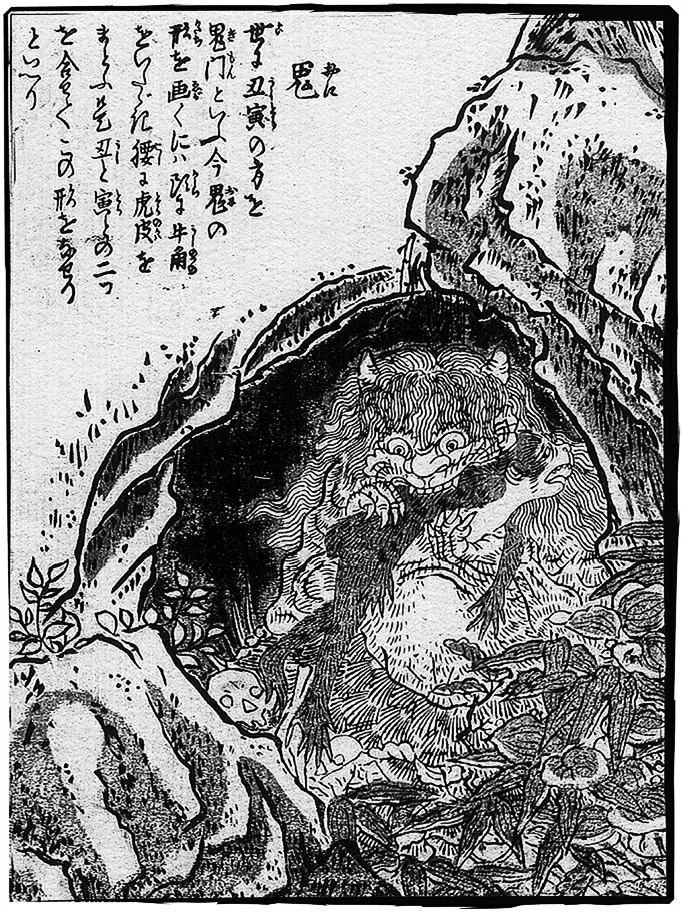
The oni drawn by Toriyama Sekien in his yokai book Konjaku Gazu Zoku Hyakki (1779). Sekien was an artist of the Edo period (1603–1868) whose books gave many yokai the faces they still have. In this same entry, he wrote down the ox-tiger reason, as something "people say." Public domain, via Wikimedia Commons.
That reason was written down late, in 1779. The oldest oni in Japanese books had no horns at all. The full story is in our guide, Why Do Oni Have Horns and Tiger-Skin Loincloths?
What the kanji 鬼 says
The character for oni is 鬼. Japanese reads it oni, or ki in words borrowed from Chinese.
鬼 is a picture. The bottom is a person. The top is a large, strange head, the head of a ghost. That is how the oldest Chinese dictionary of characters, from around the year 100, explains it. In China, 鬼 meant the spirit of a dead person, not a horned brute.
The Japanese word oni may mean "hidden." A Japanese dictionary from the 930s links it to on (隠), something that hides and will not show itself.
Do red and blue oni mean different things?
There is no fixed rule. The color meanings we found belong to one temple or one theory.
Red and blue oni started out as the guards of hell. A large Japanese dictionary defines both as demons that torment sinners there. Its oldest example of a "red oni" is from a book of tales from around 1250. Blue and red oni walk side by side in the Genpei Seisuiki, a war tale from the 1300s or earlier. The dictionaries do not say why those two colors.
At Rozan-ji, a temple in Kyoto, three oni dance at the Setsubun rite. Kyoto Prefecture says each stands for a human weakness. The red oni is greed. The blue oni is anger. The black oni is not knowing the truth. Then the oni are driven out with a bow, beans and rice cakes.
So a red oni on your skin does not have to mean greed. It is one temple's reading, not a law.
Oni or hannya: how to tell
People mix these up all the time. Ask one question: whose face is it?
| Oni | Hannya | |
|---|---|---|
| Who | A demon from the start | A woman who became a demon through jealousy |
| Where from | Folk tales, Setsubun, roof tiles | Noh masks (Noh is a classical Japanese theater) |
| Horns | Often an ox's horns | Two, from the sides of the forehead |
| Feeling | Strength and danger | Rage and grief together |
The hannya's story is in our hannya mask tattoo article. More on the mask itself is on our oni mask page.
Want both faces in one tattoo? In one Noh play, the same demon can wear either mask. See why a hannya and an oni make a pair.
What it looks like as a tattoo
Here is how an oni mask can look on skin.
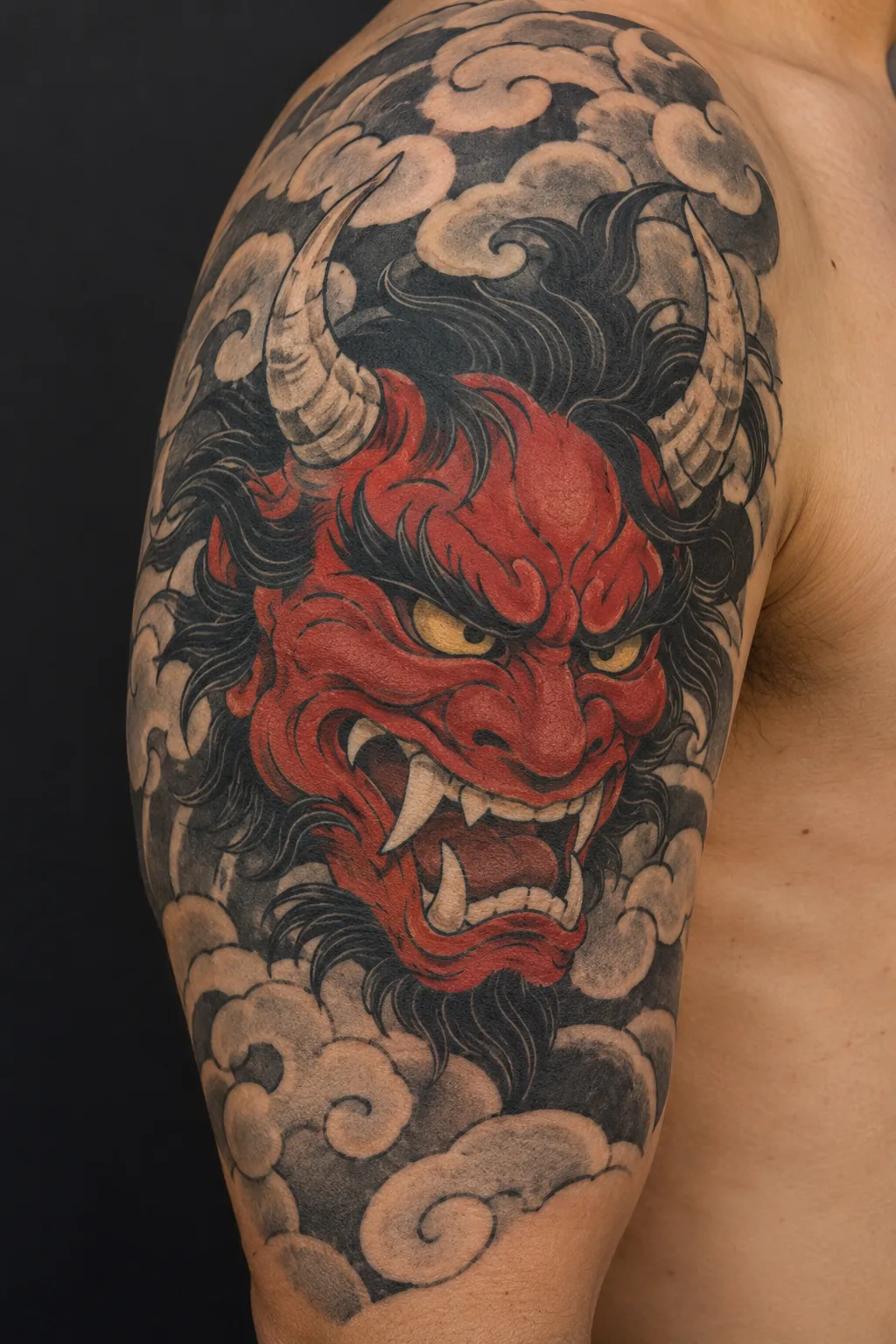
A red oni mask on the upper arm. This image was made with AI to show how the tattoo can look. It is not a photo of a real person.
How an oni tattoo is seen in Japan
Many people in Japan with tattoos still hide them at work. For a long time, a tattoo here meant crime. From 1720, courts tattooed criminals as a punishment. A ban on tattooing began in Tokyo in 1872, covered all of Japan from 1908, and ended in 1948.
Why ban it in 1872? Japan had just opened its doors, and foreign visitors arrived in large numbers. Their travel writings noticed men walking through town with full-body tattoos. The government feared tattoos would make Japan look "backward" to them, writes the cultural anthropologist Yamamoto Yoshimi. The ban was about how Japan looked to outsiders.
After the ban ended, films kept the bad image alive. In the 1970s, yakuza films, about Japan's organized crime groups, showed gangsters with large Japanese tattoos. In 2019, Temple University's Tokyo campus held a talk with Yamamoto. Its notice said this link "still lingers today." So in Japan, people may read any big, traditional-style tattoo that way. It is not about the oni in particular.
All of this is about how Japanese people see tattoos on other Japanese people. A foreign visitor is a different case. I, the editor of this site, live in Japan with tattoos myself. I think most Japanese people see a foreigner's tattoo as part of that person's culture. To reject the tattoo would be to reject the culture. So people treat it with respect. Some places still have rules, though, mostly where people bathe or swim. At some hot springs, bathhouses and pools, you may be asked to cover a tattoo. At others, you may not be let in.
Baths are where the rules still matter. People bathe together, naked, so there is nowhere to hide a tattoo.
| Kind of bath | Tattoos? |
|---|---|
| Neighborhood bathhouse (sento) | Usually fine. In 2017, the national sento association told a Japanese news site that its members do not turn people away for tattoos. |
| Hotel or inn bath | About half say no. In a 2015 government survey of 581 hotels and inns, 56% refused guests with tattoos, 31% let them in, and 13% let them in if covered. |
| Private bath (kashikiri) | Fine. You book the bath only for yourself. |
The law does not stop you either. In 2017, Japan's government said the public bath law has no rule against people with tattoos. A year earlier, the national tourism agency asked baths not to refuse guests only for a tattoo. It suggested cover stickers, set bathing times, and private baths.
So check the bath's rules before you go. If it says no tattoos, cover yours with a sticker if allowed, or book a private bath.
Why tattoos carry this weight in Japan at all, from the punishment marks of 1720 to today's bath signs, is in our guide: Why Are Tattoos Taboo in Japan?
Frequently asked questions
Is an oni mask tattoo bad luck?
No old rule says so. Japan puts the oni's face on roofs to keep evil away, and calls a hard worker "an oni of work." The bad luck is the oni that comes in uninvited at Setsubun.
Is an oni mask tattoo good or bad?
Neither, by itself. In Japan, the oni is feared, but the word "oni" is not only an insult. The old meaning is power that is dangerous, pointed the right way.
Does an oni tattoo mean yakuza?
Not by itself. The oni is a folk demon, not a gang symbol. But in Japan, large traditional tattoos of any design were linked to gangs by films in the 1970s.
Is there a female oni?
Yes. The hannya is a woman who became a demon, and Kishimojin was a demon mother.
Is an oni the same as a devil?
Not quite. A Christian devil works against God. An oni is closer to a wild, man-eating giant, and in hell it works as a guard who punishes the dead.