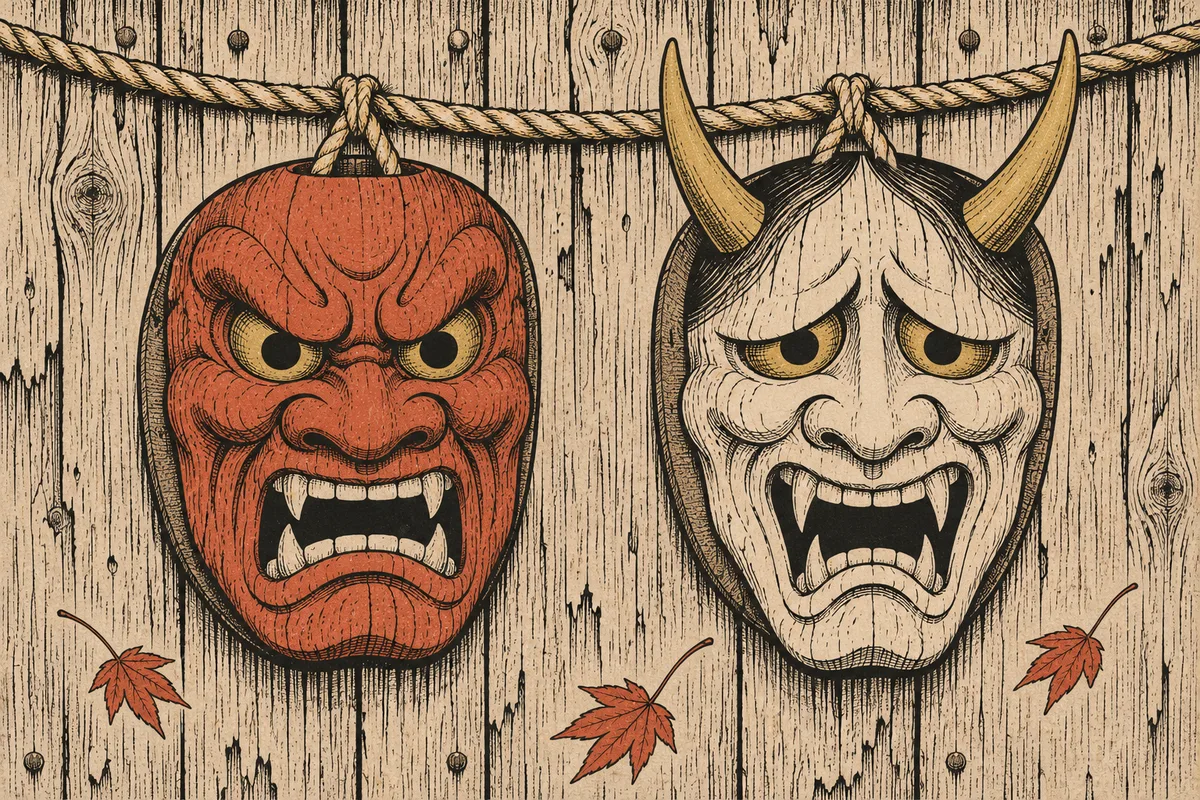
A hannya and an oni look like opposites. One is a grieving woman. The other is a horned brute. But Japanese dictionaries define the hannya as kijo no men, "the mask of a demon woman." The ki in kijo is the same character as oni, 鬼.
And in one old play, the two faces take turns. The same demon is played in an oni mask or in a hannya mask, depending on the performance. So a hannya and an oni together are not two strangers. They can be two faces of one demon.
We found no old rule for what the pair means. But the old plays give each face a clear place. Put them side by side, and they can say these things.
What a hannya and oni pair can say
| If you want it to say | Draw | The story behind it |
|---|---|---|
| "One demon, two faces." | An oni and a hannya side by side | In the play Momijigari, the same demon can wear either mask. |
| "I know where anger leads." | The hannya beside the oni | Noh shows a woman turning into a demon step by step. The hannya is the middle step. |
| "Danger from outside, and danger from inside." | The oni facing out, the hannya beside it | Japan throws beans to drive oni out of the house. The hannya's demon grew in a person's heart. |
Each wish raises a question. How can one demon wear both faces? Why is the hannya only halfway there? The answers are below.
How can one demon wear both faces?
Because the actors decide whether the demon is a man or a woman. The play is Momijigari, "Maple Viewing."
A warrior is hunting in the mountains in autumn. He meets a beautiful noblewoman having a party under the red maples. She gives him wine, and he falls asleep. Then she shows her true form: a demon. They fight, and the warrior cuts the demon down.
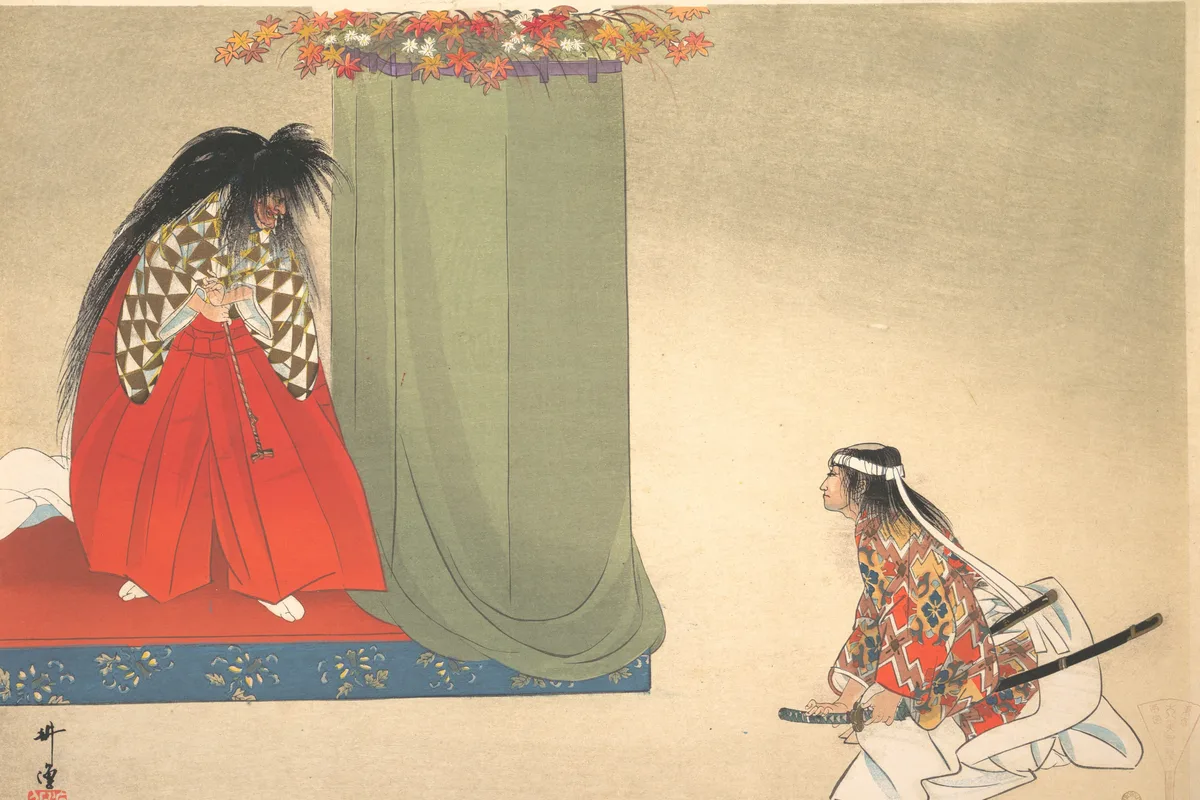
The Noh play Momijigari*, by Tsukioka Kōgyo, about 1910. The demon, in a wild black wig, faces the warrior under the red maples. The Metropolitan Museum of Art, public domain (CC0).*
Here is the twist. In Aoi no Ue and Dōjōji, the demon grows out of a woman's jealousy. In Momijigari, it is the other way around. The demon was the true form all along, and the woman was only a disguise.
So which mask should the demon wear? The answer has changed over time. Traditionally it wore the shikami, "the scowl," an oni mask. In recent years, the hannya is often used. Choose the shikami, and the demon is a male oni in a woman's shape. Choose the hannya, and the demon is a demon woman.
So the pair is not something tattoo artists made up. One Noh role already wears both faces.
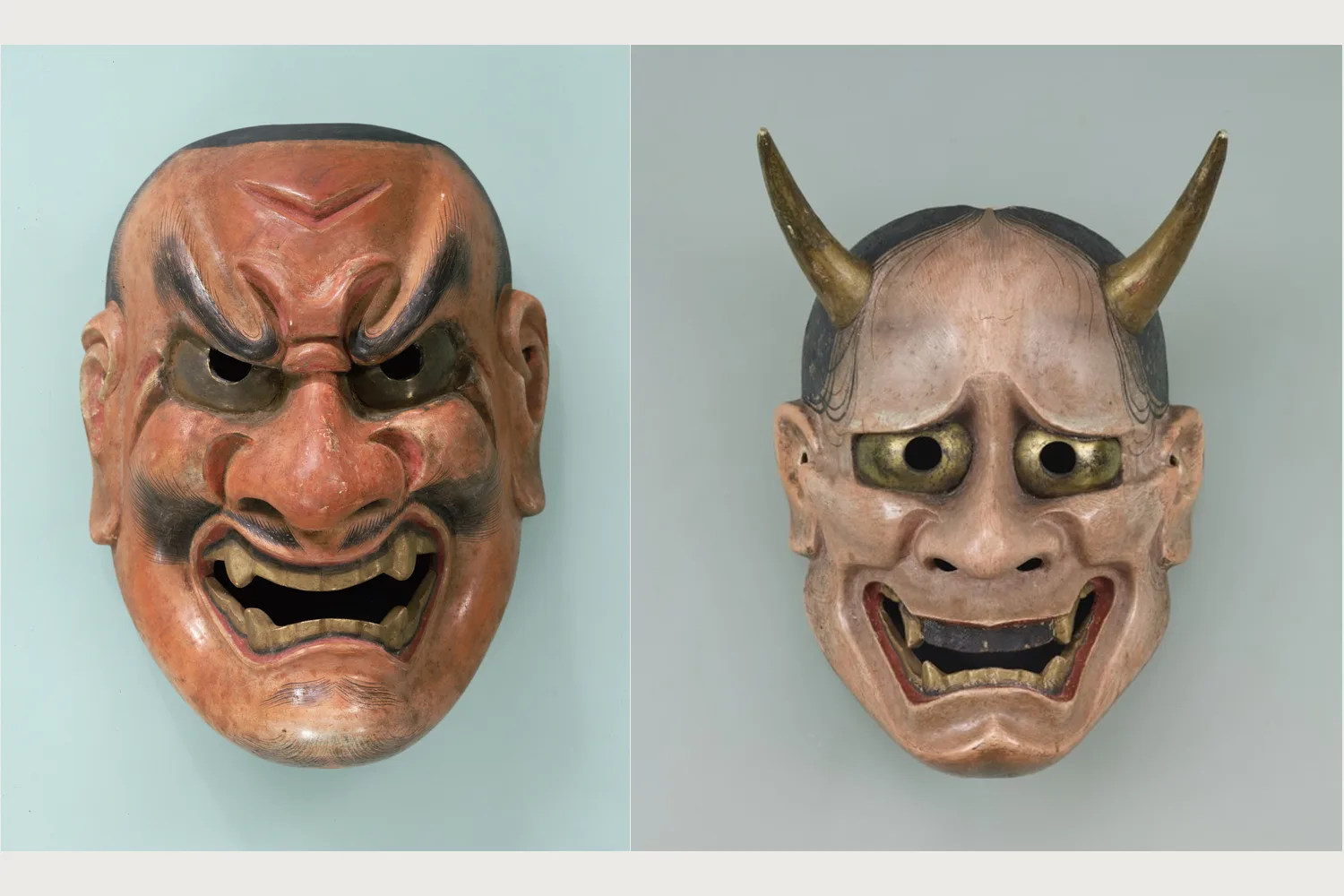
The two masks the Momijigari demon can wear. Left: a shikami, the scowling oni. Right: a hannya, the demon woman. Both are in the Tokyo National Museum. Shikami: public domain. Hannya (Edo period, 1600s–1700s): National Institutes for Cultural Heritage, ColBase, CC BY 4.0.
Why is the hannya only halfway there?
Because in Noh, she is a middle step. Noh masks can show a woman becoming a demon, step by step.
One Noh mask guide gives a row. First comes the namanari, "half-made." The guide says it lies "half way between the human and beast." Its horns are still small. "The next step is a hannya," the guide says, "and the final form is the serpent ja." The ja has a face closer to a snake than a person. Some Japanese sources call the hannya chūnari, "middle-made."
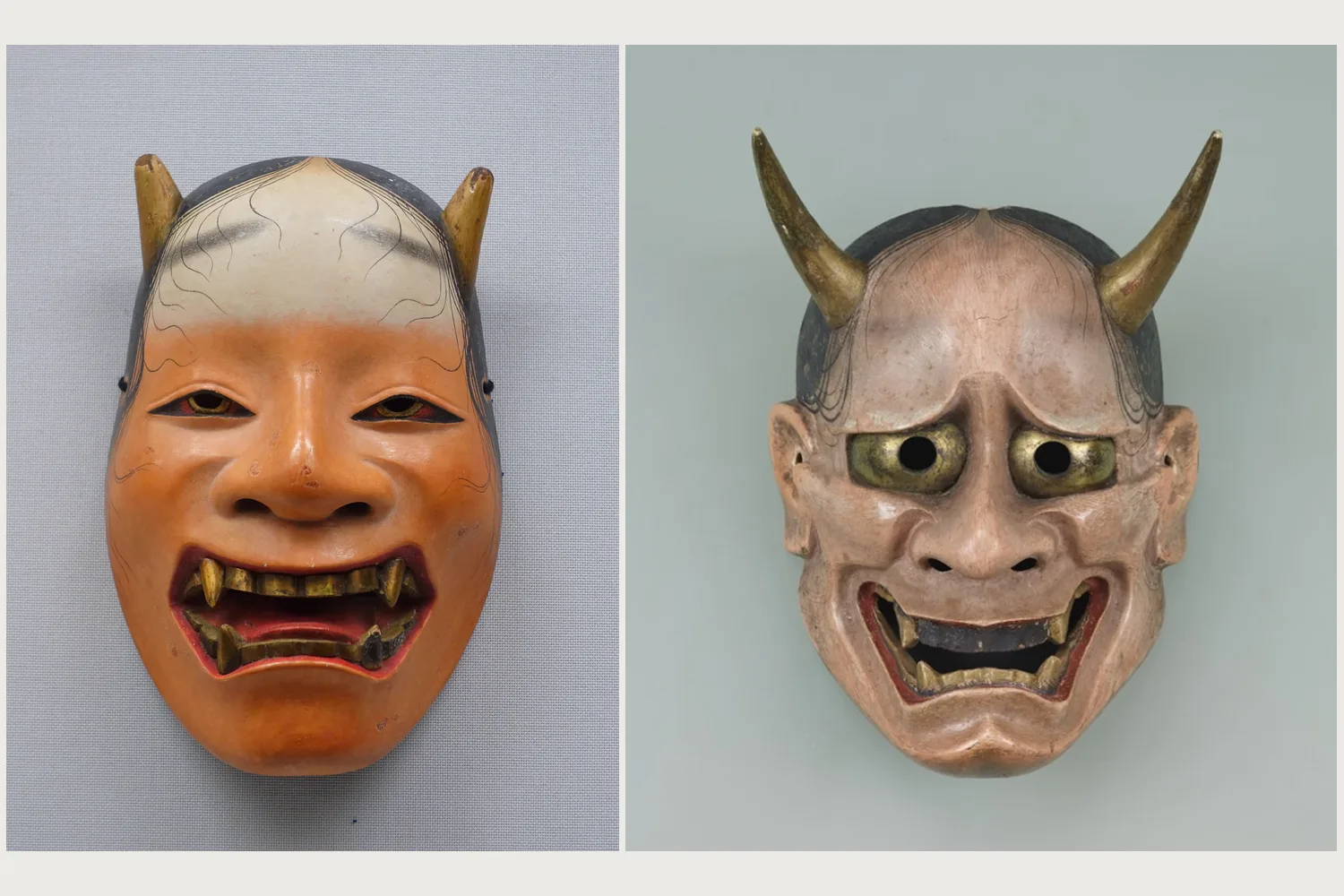
Left: a namanari, "half-made." Her horns have only begun to grow. Right: a hannya, the next step. Both are in the Tokyo National Museum. Namanari (Edo period, 1700s–1800s): photo by Daderot, public domain. Hannya: National Institutes for Cultural Heritage, ColBase, CC BY 4.0.
That is why the hannya's face is split. Look at a Noh hannya: the brows are sad, but the mouth is furious. She still feels like a person. She is not finished turning.
The oni face has no sad brows. It is power and hunger, with no grief in it.
People can become oni too. A Japanese encyclopedia says deep grudges turn people into oni. In one old legend, the Hashihime of Uji, "the lady of the bridge," became an oni while still alive. In Noh, that road ends in a snake. In folk tales like the Hashihime's, it ends in an oni. Either way, the hannya is not there yet. So the pair can say: I know where this road goes.
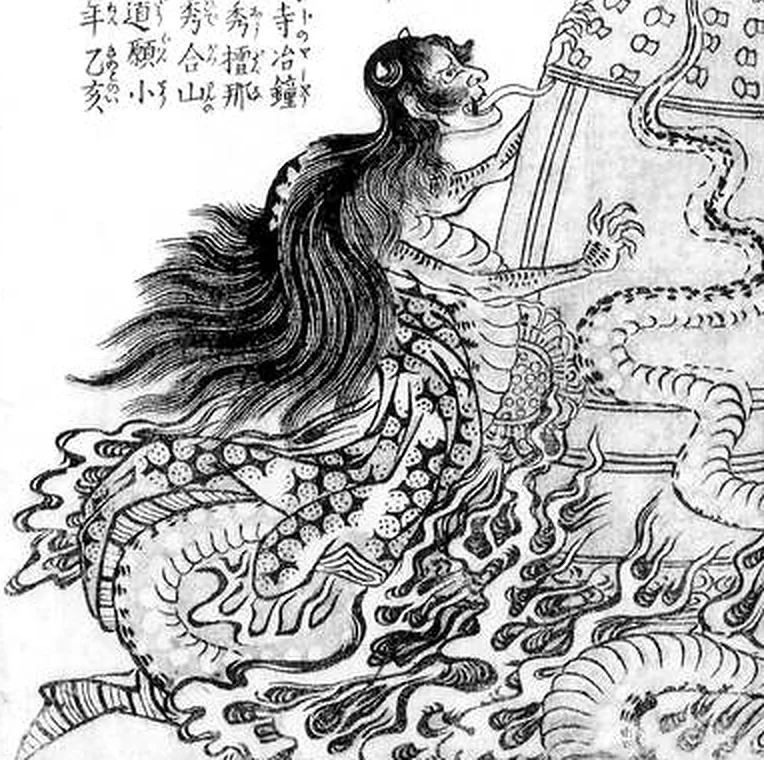
"The Bell of Dōjōji," by Toriyama Sekien (around 1781). A woman's face with two horns, like a hannya, and a snake's body below. Her body is turning into a snake, the step after the hannya. Public domain, via Wikimedia Commons.
Why outside and inside?
Because Japan pictured the two dangers as coming from different places.
The oni of Setsubun comes from outside. Every February, families throw roasted beans and shout, "Oni wa soto!" That means "Demons out!" The custom grew from an old court rite to chase away disease demons. That danger came in through the door.
The hannya's demon began inside a person. Japanese has an old phrase for an oni that lives in you: kokoro no oni, "the oni in the heart." A diary from around 974 uses it for suspicion and fear. Later writers used it for a guilty conscience, a wicked heart, and, in a poem from 1638, love that will not let go. The phrase is much older than the hannya mask. But the mask shows the same idea: something inside a person becomes a demon.
Her demon does not stay inside, though. In the play Aoi no Ue, Lady Rokujō is still alive. Her jealousy leaves her body as a spirit and attacks another woman. So the hannya is a demon born inside, that walks out.
So a pair can say: I know both kinds of danger. One comes at me from the world. One could come out of me.
How to tell them apart
| Oni | Hannya | |
|---|---|---|
| What it is | A demon, sometimes a person who became one | Usually a woman turning into a demon |
| Where from | Folk tales, Setsubun, roof tiles | Noh masks |
| Horns | Often an ox's horns | Two, from the sides of the forehead |
| Feeling | Strength and danger | Rage and grief together |
Each face has its own full article: the hannya mask tattoo and the oni mask tattoo. Both explain how tattoos are seen in Japan, and what to know about baths.
Frequently asked questions
Is the hannya the oni's wife?
No. No old story we know makes the hannya an oni's wife. Japan does have oni couples, though. Zenki and Goki were an oni husband and wife who served a mountain holy man.
Is it bad luck to get them together?
We found no old rule that says so. Japan even puts oni faces on roofs, to guard houses.
Which one goes on which side?
We found no fixed rule. That choice belongs to you and your tattoo artist.