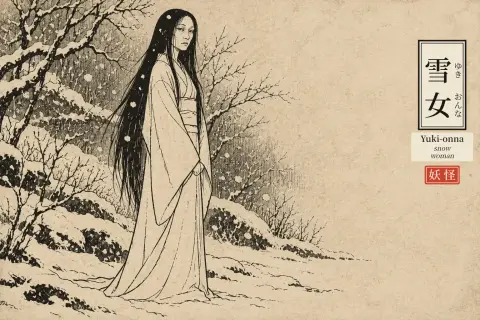
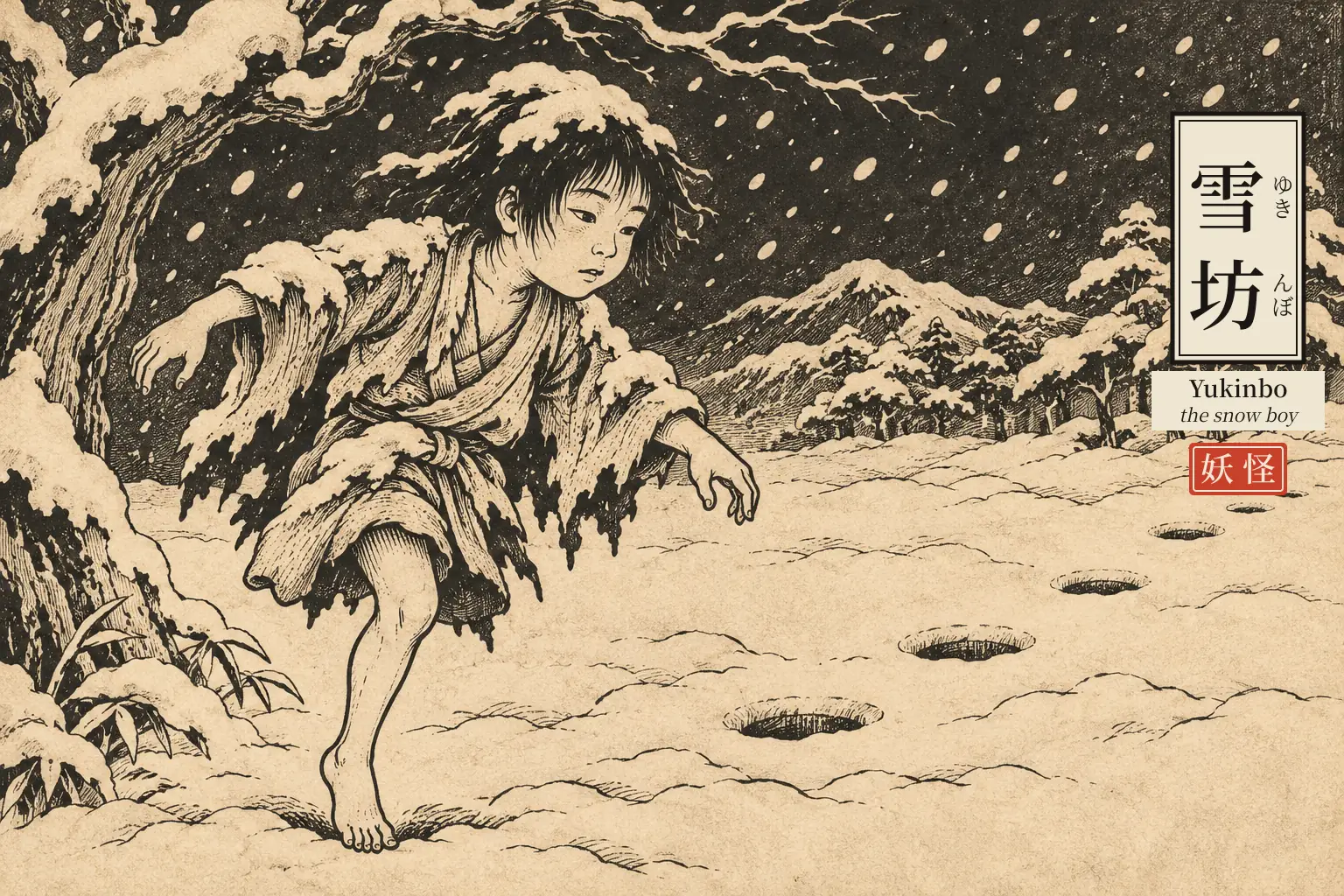
In many stories, the snow woman is a pale, beautiful woman. In Wakayama, she was something else. Encyclopedias say she was believed to come there as a child with one leg. In Ito District, in the north of the prefecture, people told of yukinbo, "the snow boy," a one-legged child who hops through the snow at night.
Round holes under the trees
The story is about tracks.
On the morning after a snowfall, round hollows sometimes appeared in the snow under the trees. In the old village of Miyoshi, now part of Katsuragi town, people had an answer for them. A yukinbo had been out in the night, hopping about on its one leg.
The sources describe it as being like a small child. One modern dictionary calls it a boy. It has a single leg, and it gets about by hopping. That is why its prints are round.
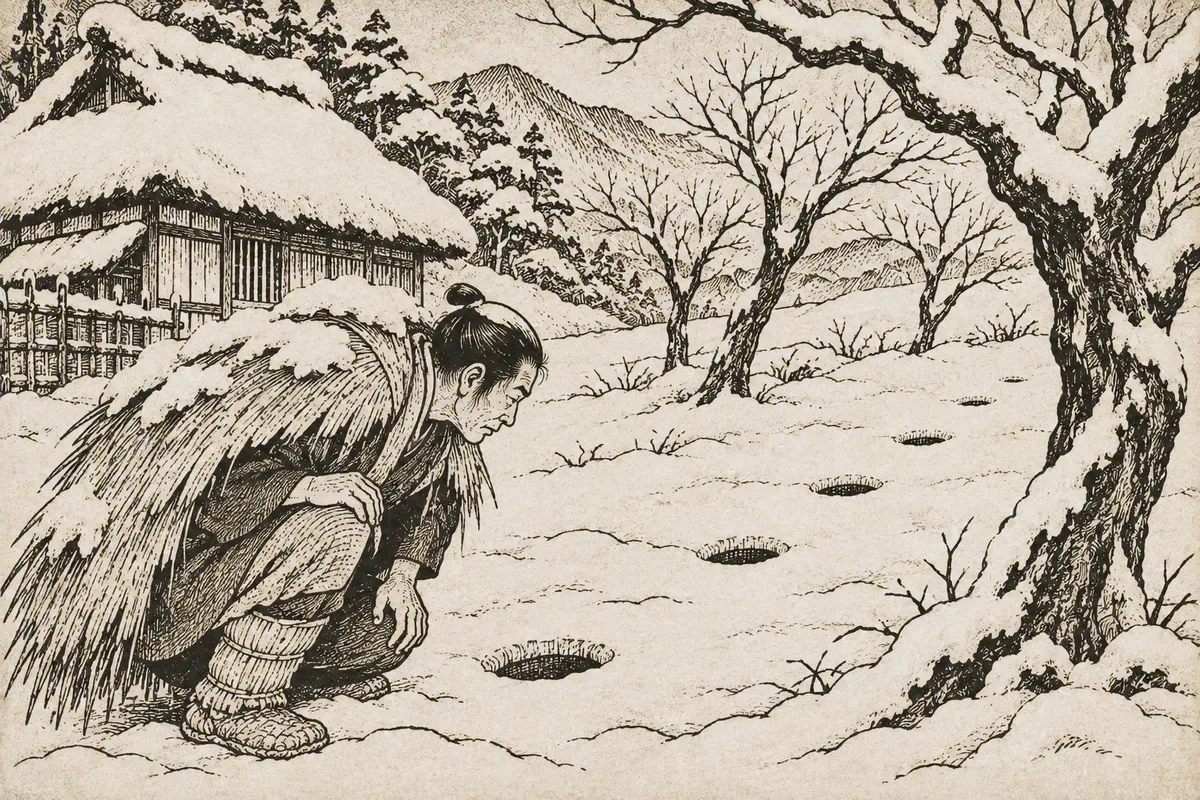 Our illustration, not a photo: the morning after snow, round hollows under the trees.
None of the sources we found say the Wakayama yukinbo harms anyone.
The snow woman as a child
Is the yukinbo the snow woman herself? Sources put it in different ways.
Two encyclopedia entries on yuki-onna, the snow woman, say that in Wakayama (one names the Ito area) she is believed to come as a one-legged child. They do not use the name yukinbo. Japanese Wikipedia's page on the snow woman joins the two. It lists the yukinbo among her kin. A third encyclopedia lists the yukinbo in its own snow-woman entry, but notes that it does not take a woman's form.
The Britannica entry shows how far the snow woman changes from place to place:
| Where | How the snow woman appears |
|---|---|
| Ito area, Wakayama | A child with one leg |
| Iwate | With many children, on Little New Year or a full-moon night |
| Western Aomori | She comes down on New Year's Day and leaves on the first day of the hare |
| Southern Nagano | As a mountain hag |
The famous version, a pale and beautiful woman, is only one of these.
One leg, one line of prints
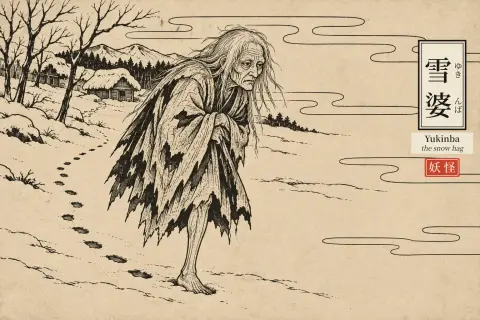
The yukinbo is not alone in having one leg. Japan has many one-legged yokai, grouped together as ippon-ashi, "one leg." Many of them are blamed for single footprints found in the snow after a snowfall.
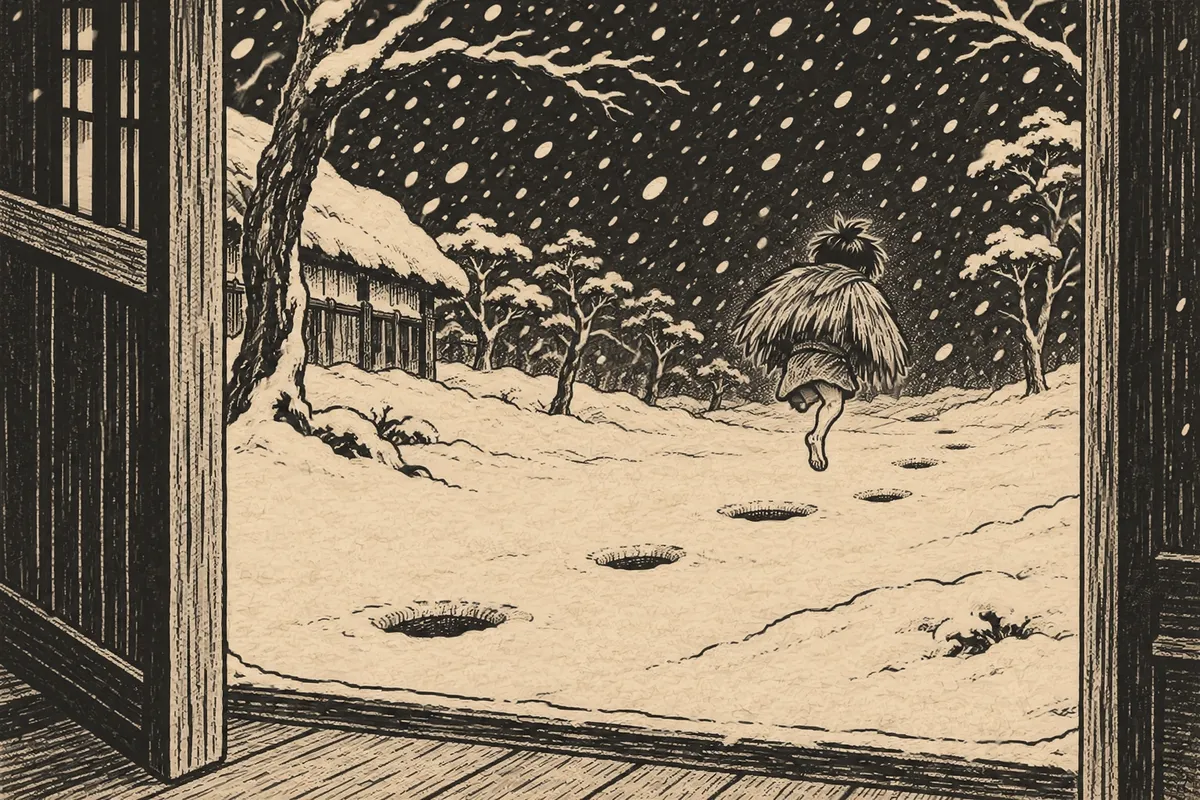 Our illustration, not a photo: a one-legged child hopping through the snow at night.
Some live close by. In the mountains on the Wakayama-Nara border, the ippon-datara is a one-legged creature said to appear only on the 20th of the twelfth month. Further west, in Ehime, the yukinba, "snow hag," leaves a one-legged trail in the snow.
Why one leg? The folklorist Inokuchi Shōji offered one reading in the Nihon Daihyakka Zensho, a large Japanese encyclopedia. He notes that the yukinbo and the snow giant yuki-nyūdō are not women. Both have one leg. In that, he writes, they resemble a one-legged god said to visit on the night of the 23rd of the eleventh month. They also resemble the mountain god. He does not say the yukinbo is that god.
The Britannica entry reads all these local forms, the one-legged child among them, as traces of a year god or a mountain god. In its view, they were left after belief in those gods faded.
How it was written down
The yukinbo comes from a dictionary, not a storybook. Its main source is the Sōgō Nihon Minzoku Goi (1956), a dictionary of folk words. Folklorists working under Yanagita Kunio, the founder of Japanese folklore studies, compiled it. We could not find when the Wakayama belief was first recorded.
Murakami Kenji included the yukinbo in his Nihon Yōkai Daijiten (2005), a large modern dictionary of yokai.
In kanji, the name is written two ways. One source spells it 雪坊. Another spells it 雪ん坊, with the linking sound written out. Both read as "snow" plus bō, a familiar word for a little boy.
The yukinbo today
Miyoshi village no longer exists. It merged into the new town of Katsuragi in 1958.
What the record keeps is the explanation. After a night of snow, a round hole under a tree is the place where a one-legged child landed.