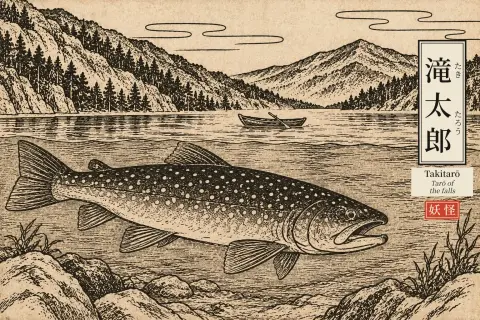
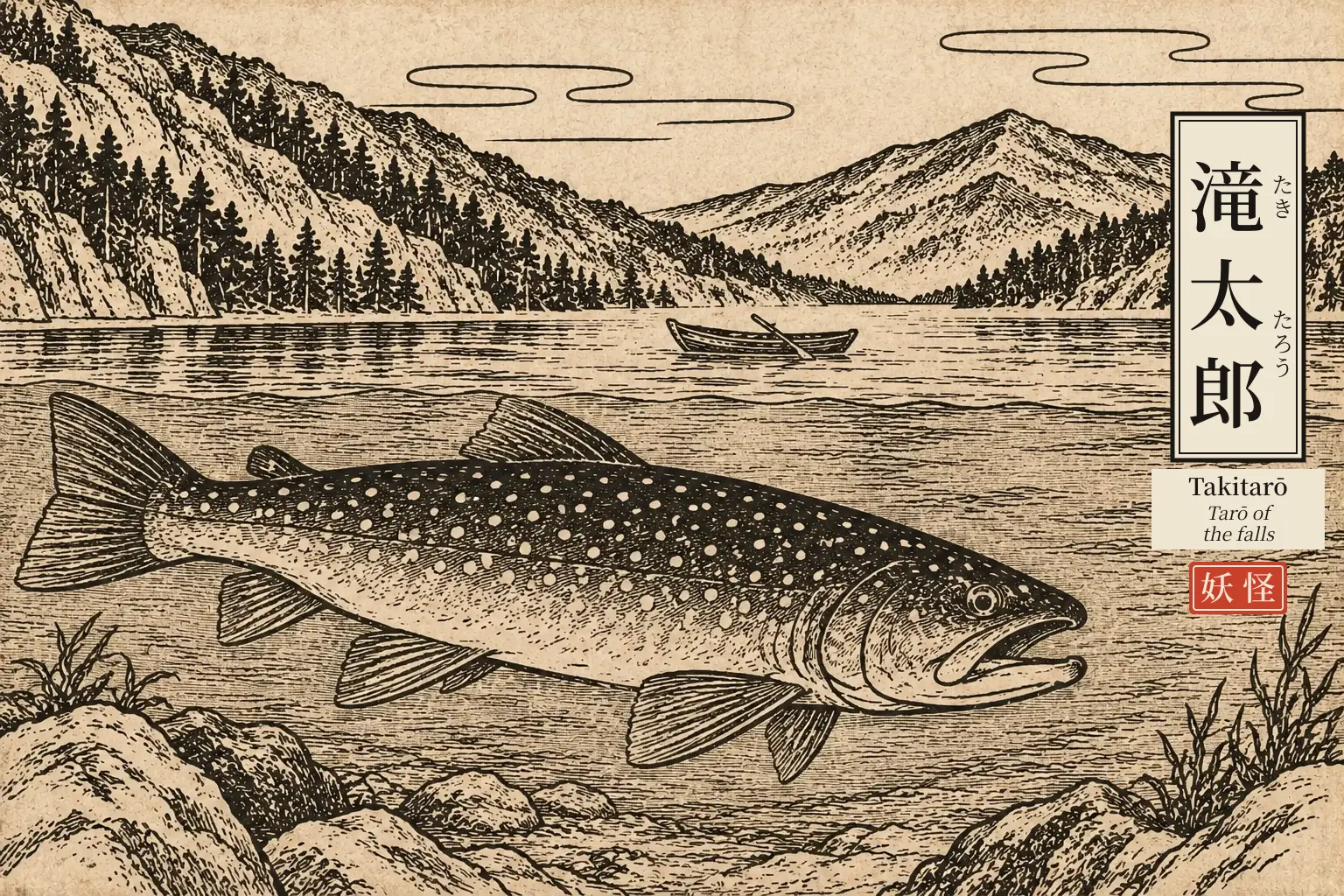
A giant fish is supposed to live at the bottom of a mountain lake in Yamagata Prefecture. Villagers have talked about it for over a century. Workers caught two in 1917, climbers spotted one in 1982, and in 1985 a survey team pulled one out of the water for study. Nobody has ever proven the creature is anything more than an oddly large fish. The lake has kept its secret anyway.
The fish is called Takitaro (滝太郎), written with the characters for "waterfall" (滝, taki) and an old-fashioned name for an eldest son (太郎, tarō). Locals sometimes wrote it a different way, 竹太郎, swapping in the character for "bamboo." Either way, the name reads like a person's name, not a monster's. It sounds more like a troublesome neighbor than a beast.
Too big, too long in the jaw
Accounts describe a fish about 2.1 to 3 meters long, roughly 7 shaku to 1 jo in the old units villagers used. One report puts it a little smaller, at 1.5 to 3 meters. Whatever the true range, that is far bigger than any trout or char that ordinary fishing turns up.
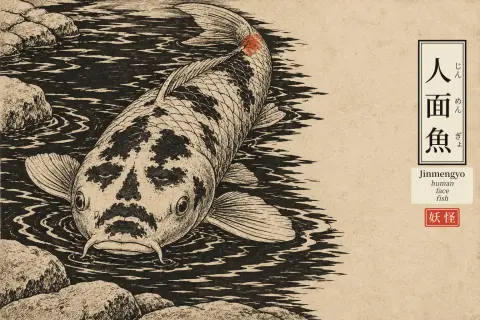
Its lower jaw is said to be unusually long, long enough to bite into its own upper jaw. Its body sits unusually tall for its length, a shape witnesses use to tell it apart from the char that share the lake. Its skin runs reddish-brown with spots, and its tail fin fans out wide. Under the skin lies a thick layer of fat. Grill the fish, the story goes, and that fat layer is the only part that burns; the meat underneath stays raw. The meat itself is said to be pink, mild, and good eating.
A lake that drowned anyone who tried
Lake Otori sits high in the Asahi Mountains, in what was once Asahi Village. Old village legend warned that trying to catch the giant fish would call down clouds and a storm, ruining the fields below. Two disasters were blamed on it. In 1615, villagers say, fishing at the lake was followed by a flood that harmed 48,000 people. In 1669, nine officials who climbed up to the lake are said to have died there on the spot.
Neither story survives in any old document. The folklorist Aramata Hiroshi searched and found no early text that names a "giant fish called Takitaro." What he did find is a living oral tradition: villagers from the Taisho era (1912-1926) into the early Showa years still told the story among themselves. Treat the 1615 flood and the 1669 deaths as legend passed by mouth, not settled history.
The oldest written trace is smaller and stranger. In 1885, a local scholar named Matsumori Taneyasu compiled an illustrated fish survey called Ryou Hakubutsu Zufu. Under his entry for ordinary char, he adds a note: big ones are called Takitaro, and fish of about five shaku are heard to come down the Otori River. In the very same entry, he denies that any char bigger than about a foot lives in the lake itself. The first record of the name is split. It allows for a big fish in the river. It denies one lives in the lake.
The catch that fed twenty workers
The clearest physical evidence dates to 1917. Workers building a sluice gate at the lake caught two large fish, each about 1.5 meters long and roughly 40 kilograms. Twenty of them ate the catch over four days. The surviving account says the raw meat tasted like fatty tuna, and the grilled meat stayed rich and delicious. Village elders later recalled that through about 1934, Takitaro of around a meter long were caught fairly often.
Then the sightings went quiet for decades, until a manga brought the name back.
From local legend to national name
In 1975, the cartoonist Yaguchi Takao put the fish in his fishing manga Tsurikichi Sanpei, under the name "the Takitaro of Lake O." The story reached a television anime in 1980. That was enough. A fish known mostly to one mountain village became a name people across Japan recognized.
Seven years after the manga, on 19 July 1982, four climbers looked down at Lake Otori from a ridge on nearby Mount Ito, about 1,250 meters up. By eye, they estimated a fish around two meters long moving in the water below. That one sighting pushed the village to organize its first scientific survey that September, using sonar to map the lake and track fish. No giant fish was confirmed, but the sonar did pick up large shapes in the water.
A bigger, three-year survey followed from 1983, backed by geologists and an NHK film crew. On 27 October 1985, the team finally caught something unusual: 70 centimeters long, 5.6 kilograms, with a 23-centimeter body height and a 50-centimeter girth. Two specialists examined it and disagreed on the exact subspecies, calling it either an amemasu-type char or one related to the oshorokoma char. Both readings put the fish in the same general family of char, just different branches of it. Its mounted body is still on display today, at a visitor hall called Takitaro-kan in the Otori area. One more fish, 72 centimeters long, was caught and reported in 2001.
Watching the dark for twenty more years
After 2001, no new fish turned up for over a decade. In September 2014, fourteen members of a local community group spent three days on the lake with a fish finder. They detected shapes 20 to 50 meters down, deeper than earlier surveys had assumed. A researcher from Keio University who joined them tested the water at that depth and found enough oxygen there for fish to survive.
Nobody has caught anything since the 2001 fish. The leading guesses for what Takitaro really is include an overgrown char, a sockeye salmon, a Sakhalin taimen, a grass carp, or a species nobody has identified yet. The overgrown-char theory runs into the same wall the 1985 catch did: body shape, color, and markings keep not matching ordinary char from elsewhere.
Takitaro today
Before Asahi Village merged into Tsuruoka City in 2005, it had already named Takitaro its official "village fish," a civic symbol voted onto the books. The merger erased the village's name from the map. The fish's name stayed on local signs, on the visitor hall, and in the lake it was never quite caught in.