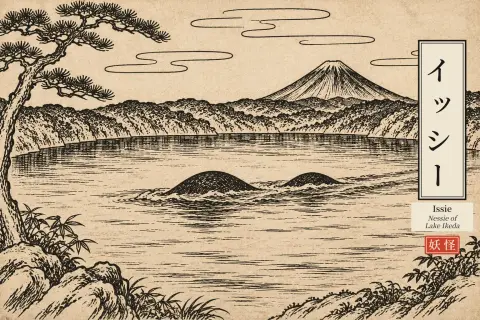
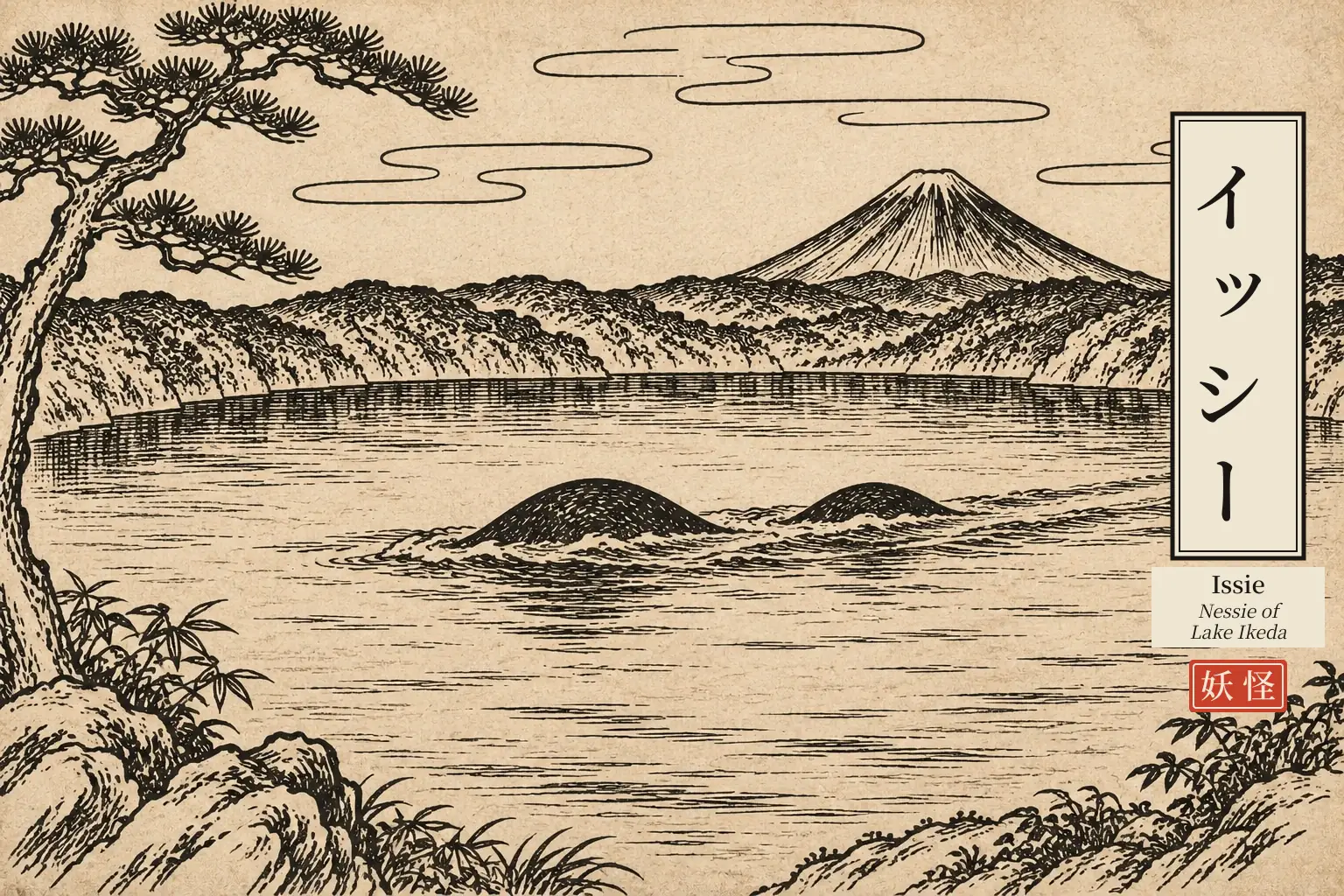
Lake Ikeda sits at the southern tip of Kagoshima Prefecture, on the Satsuma Peninsula. For decades, drivers on the Ibusuki Skyline nearby have watched the water for a creature nobody has ever caught. Locals call it Issie (イッシー), a name borrowed straight from Scotland's Loch Ness Monster. On one evening in 1978, more than twenty people watched it at the same time. What exactly it was remains unexplained.
A black hump, and not much else
Reports agree on very little, but they agree on this: something large and dark breaks the surface and moves. Witnesses describe a black hump, sometimes more than one, pushing through the water. Estimates of its length run from about 10 to 20 meters, several times longer than a car.
Beyond that, the record goes quiet. No witness account gives Issie a head, a tail, or any color besides black. No old print or scroll shows it either. Unlike most yokai on this site, Issie is a creature of the twentieth century, not the Edo period.
The evening twenty people watched the water
Around six in the evening on September 3, 1978, more than twenty people gathered at Lake Ikeda for a memorial service. Several later said they all saw the same thing at once: a dark shape crossing the surface of the lake. The writer Urushima Susumu recorded the sighting in his 1993 book on Japan's monsters and phantom beasts. It is this one evening that turned Issie from local gossip into a name recognized across Japan.
A photo, a prize, and a home video
Ibusuki's tourism board set up an "Issie Countermeasure Committee." On December 16, 1978, someone brought in a photograph said to show the creature, and the committee paid 100,000 yen for it.
More than a decade later, on January 4, 1991, a family from Fukuoka was driving the Ibusuki Skyline when they filmed something dark moving through the lake on a home video camera. The clip set off a fresh wave of local excitement. Neither the 1978 photo nor the 1991 video has ever been examined closely enough to settle anything.
Eels, carp, or neither
Nobody has confirmed what is actually in the lake. The strongest guess points to eels: Lake Ikeda is said to hold many giant mottled eels, some more than two meters long. A second guess blames large fish let loose in the lake around when the sightings began, with a school of silver carp mistaken for one dark shape. What the hump actually was remains unclear either way.
Television crews have tried fish-finder sonar more than once. The lake's water stays too murky for a clear picture every time. No attack on a person is recorded.
A dragon before there was an Issie
Long before anyone said the word Issie, Lake Ikeda already had a reputation. The Sangoku Meisho Zue, a three-province gazetteer compiled by 1843, says the lake's depth could never be measured. It says waves rose on it with no wind at all, and that its water level changed without warning. Those signs convinced people the lake was sacred, home to a water god and, somewhere inside it, a divine dragon.
That old passage says nothing about a humped monster. It is folklore about a dragon, written more than a century before anyone reported seeing anything like Issie. The name Issie instead comes from a wider boom. After Scotland's Nessie became world-famous, Japan gave several of its own lakes a matching nickname: Kussie at Lake Kussharo in Hokkaido, Mossie at Lake Motosu in Yamanashi, and Issie at Lake Ikeda.
Issie today
Issie has outlived every theory about it. In 1979, the manga artist Matsumoto Leiji visited Lake Ikeda with about twenty other artists. He said he wanted to draw something bigger than Nessie: five times the size, part ancient monster, part something cosmic. He sketched Issie as a red-and-white dragon and told a reporter, "Dreams matter most. You bet on your dreams and look at the water. Just thinking it might be there is fun." His drawing hung for years at a lakeside shop called Ikedako Paradise, which sold souvenirs and ran a restaurant. The shop closed at the end of August 2025.
The 2001 kaiju film Godzilla, Mothra and King Ghidorah: Giant Monsters All-Out Attack gives Lake Ikeda a monster of its own. In the film, Mothra rests in larval form beneath the lake for centuries before finally emerging from the water as an adult to fight Godzilla.
Not everyone wants the mystery solved. One writer who heard about the reward money once called Ibusuki City Hall to ask what he would get for actually catching Issie. A city employee told him, in complete seriousness, that he mustn't. It is the lake's guardian deity.