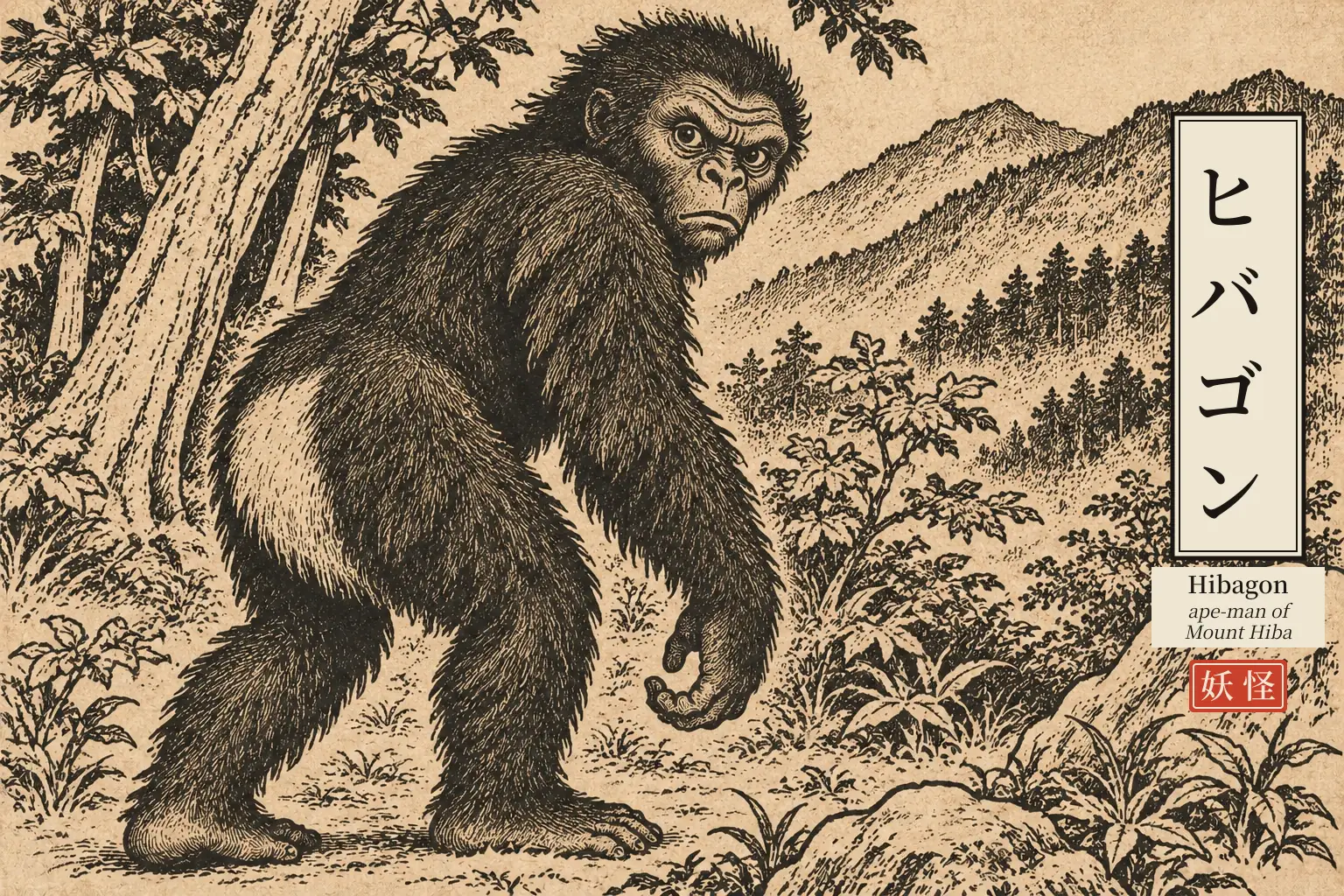
On July 20, 1970, a truck driver was crossing a mountain road in Hiroshima Prefecture at night. Something ran across in front of him. It looked like a gorilla, he said later, but about the size of a calf. It vanished into the trees. Over the next five years, dozens of people near the same mountains reported something similar. A dark, hairy shape, walking upright. A local reporter gave it a name. Miyao Hideo, the Chūgoku Shimbun's bureau chief in Shōbara, wrote up the sightings for his newspaper. He called the creature Hibagon (ヒバゴン), borrowing 比婆, Hiba, from the mountain range where it was seen.
A face shaped like an upside-down triangle
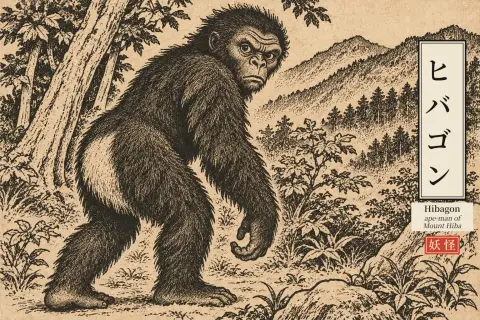
Witnesses mostly agreed on the shape. Hibagon stood upright, like a person, but moved like an ape. Its body was covered in black or dark brown fur, head to foot. Its head was nearly twice the size of a human head, topped with bristly dark hair standing about three centimeters tall.
The face drew the most detail. Witnesses described it as shaped like an upside-down triangle. Its eyes were round, large, and sharply slanted upward. Three deep wrinkles crossed its forehead. Its nose was flattened, almost pointing at the sky. Most people who saw it compared it to a gorilla, or a very large monkey.
Height estimates ran from 1.5 to 1.65 meters: short for an adult man, but thickset and stocky. From that build, people guessed its weight at around 85 kilograms. Its footprints measured about 27 centimeters. One detail set it apart from an ordinary monkey. Witnesses said the left half of its rear was pale-furred, with none of the bare, callused skin a real monkey has there.
A dam, a truck, and a panic that wouldn't stop
The sightings kept coming that summer. On July 23, a farmer cutting grass near his home watched a black-furred, human-faced shape rise up out of the grass to adult height. A week later, on July 30, a 47-year-old man tried to greet a figure on a footpath between rice paddies, thinking it was a relative. It was not. More sightings followed, all within about three kilometers of a dam nearby. A nearby recreation-park construction project was underway too, and some villagers blamed the mountain god of Mount Hiba. Others guessed a gorilla had escaped Hiroshima City's Asa Zoo, roughly 90 kilometers away. Local schools sent children home in groups.
By December, footprints turned up in snow on nearby Mount Azuma. That one month alone brought twelve reported sightings.
The attention became its own problem. Reporters and curious visitors swarmed the eyewitnesses' homes. So the town paid each one a 5,000-yen "nuisance fee." At the time, a new town-hall employee's starting monthly salary was 14,900 yen. The fee was real money. In April 1971, the former town of Saijō opened an "Ape-Man Consultation Section." Locals nicknamed it the Hibagon Section. It existed just to field the flood of calls.
Reports continued into 1974, including one blurry photograph. A local man said he saw the creature on a road. First it moved on all fours, then stood upright. It bolted up a persimmon tree as he drove closer. He caught that moment on film. Experts who saw the photo suspected a monkey or a bear. Even the people who said they had seen Hibagon themselves agreed. "That's not Hibagon," they said. "That's a monkey."
A 29th sighting that October was the last the town counted as official. In March 1975, Saijō's town office declared the "Hibagon disturbance" over, and closed its Ape-Man Section. Its former staff all left town-hall work afterward. One opened a restaurant and served a stew he called Hibagon nabe. It was wild boar.
Probably a bear. Maybe an old monkey. Maybe something else
Hibagon was never caught, and no body was ever produced. The simplest explanations point to animals that already live in the area. The zoologist Imaizumi Tadaaki argued that, except for its reported size, Hibagon matches a Japanese macaque. He guessed it might have been an old macaque, pushed out of its troop, wandering alone into a nearby village. Other guesses point to an Asian black bear, though locals interviewed over the years say bears in the area keep to deeper mountains, away from where Hibagon was seen.
Two nearby towns got sightings of their own, and copied the name. In 1980, in Fukuyama's Yamano area, a man driving home from farm work saw a similar gray-furred creature flee into a river and climb trees like a monkey. The area called its creature Yamagon. Some wondered whether it was the same animal, moved from the Hiba area. In 1982, near the town once called Kui, two boys said they saw a creature holding a stone axe in one hand. Locals named that one Kuigon.
Sightings have not entirely stopped. In 2024 and 2025, residents near Saijō again reported a large hairy animal, and once, a strange footprint in the snow. One researcher of the paranormal noted that these newer reports describe a round face, not the triangular one from the 1970s. He suggested they might be a different individual animal. Nothing has been confirmed either way.
Hibagon today
Hibagon never got identified, but it did get adopted. In 1999, the town's own hometown festival gave the creature a new look: a cute, charming cartoon, replacing an older costume built to look frightening. Shōbara City, which absorbed Saijō and Hiwa in a 2005 merger, now sells Hibagon-branded buns, miso, green onions, eggs, and a rice bowl dish. A tour bus runs wrapped in his image. A campsite built where sightings once happened is named Hibagon House.
The story crossed into fiction, too. The novelist Shigematsu Kiyoshi based his 2004 book, Itoshi no Hinagon, on the panic, renaming the creature Hinagon. A film version followed in 2005, starring Ihara Tsuyoshi and Igawa Haruka. A 2007 PlayStation 2 game, 48 (Kari), used Hibagon as Hiroshima Prefecture's own regional ghost story. Japanese gaming writers still call it a byword for a terrible game, and single out its Hibagon chapter as unusually thin.
Even science gave Hibagon a nod. In 2020, fifty years after the first sighting, an entomologist who had surveyed the Hiba mountains for insects named a newly discovered beetle species Lathrobium hibagon.
A local tourism group is now trying to put Hibagon in a movie. A 2025 crowdfunding drive, timed to the 55th anniversary of the first sighting, fell short of its goal. A second campaign in 2026 cleared its target with room to spare, with the magazine Mu on board. Filming was planned for the summer of 2026, with a finished screening set for the following spring. Half a century after it ran a town's reporters off their feet, the mountain monster still has people reaching for their wallets.