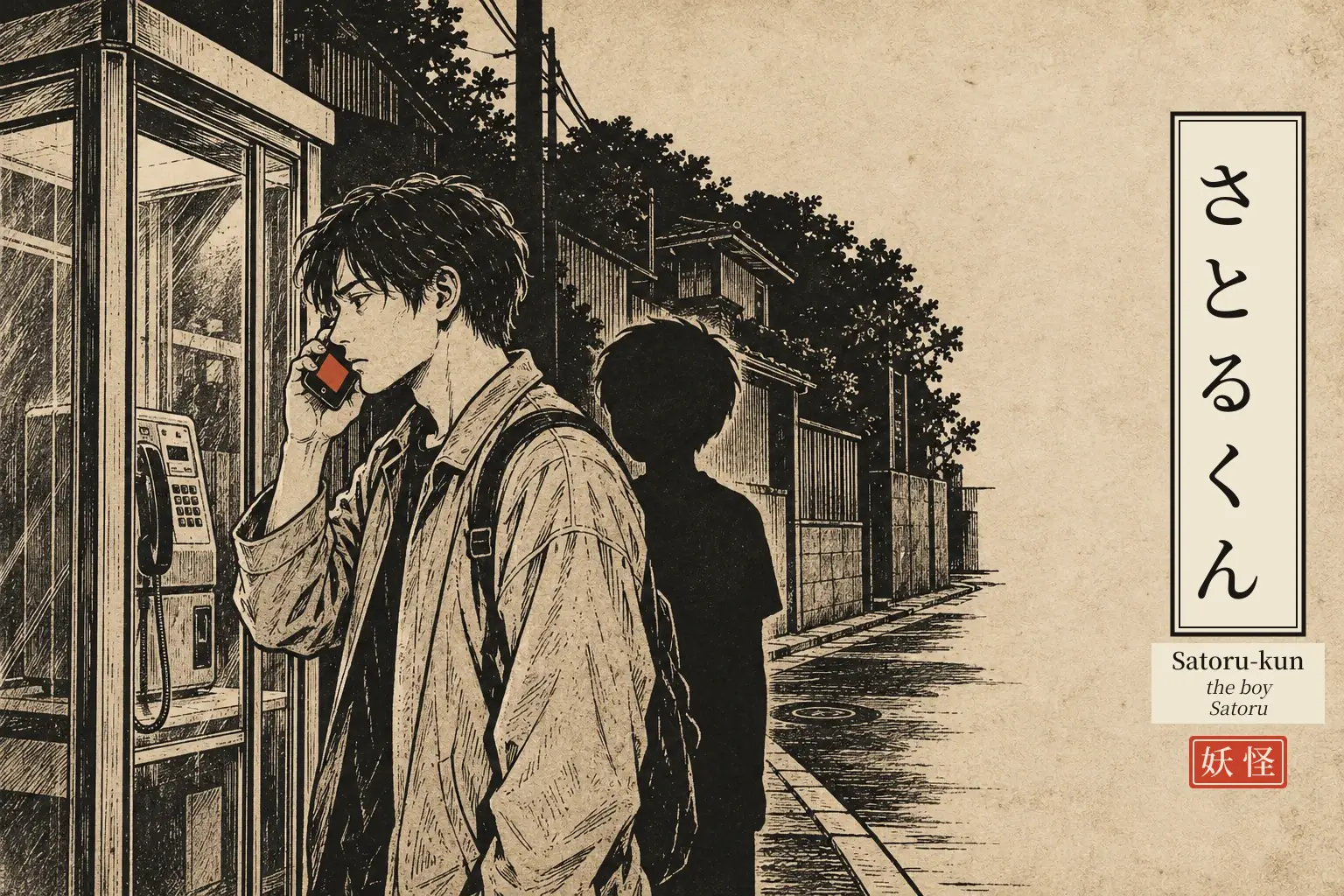
Satoru-kun does not live in a shrine or a riverbed. He lives in a payphone, waiting for a ten-yen coin. Call him the right way, and he calls back — not once, but again and again, each time a little closer, until he is standing right behind you. He has unsettled young people in Japan since the early 2000s, and in two decades of retelling, nobody has ever described his face.
What does Satoru-kun look like?
Nobody has ever seen him. None of the sources we found give him a face, an age, or a style of clothes. The one rule everyone keeps is the reason: when he finally arrives, you must never turn around to check. You only ever hear him. People who describe the call say his voice sounds young, like a boy's, speaking clear Japanese in a calm tone that never seems to show feeling. Each call, he tells you where he is right now. Each time, that place is closer than before.
How to call him
The ritual needs two phones and a coin. Find a public payphone. Drop in a ten-yen coin and dial your own mobile number. When the call connects, speak into the payphone receiver, toward your phone: "Satoru-kun, Satoru-kun, please come." Then hang up and wait.
Within twenty-four hours, Satoru-kun calls your mobile phone back. He reports where he currently is. The calls repeat several times. Each one places him nearer than the last. On the final call, he says he is standing right behind you. That is the moment he will answer any question you ask.
The rules
Several rules run through the retellings, and breaking any of them ends badly.
Never turn around once he is behind you. Turning around is said to get you taken somewhere; one version of the rumor says another world entirely.
Always have a real question ready. Freezing up with nothing to ask, or ignoring him once he arrives, is also said to get you taken away.
Never ask a question whose answer you already know. That is said to anger him, and anger, in most tellings, ends with the caller killed. Saying the answer yourself before he can give it is said to anger him the same way.
Where it comes from
Nobody can name an exact date or a first teller. Japanese Wikipedia places the craze in the early 2000s and nothing more precise than that. By 2003 the story was established enough that writer Matsuyama Hiroshi gave it three pages in Sanbon-ashi no Rika-chan Ningyo, his book on midnight urban legends. Yamaguchi Bintaro covered it again in his 2007 guide to modern yokai. Both books describe a legend that was already spreading by word of mouth, rather than inventing one.
Some tellers link the name to satori, a mountain yokai that speaks a person's unspoken thoughts aloud before they can. Toriyama Sekien drew satori in Konjaku Gazu Zoku Hyakki (1779). The two share only the name — sources say the abilities don't match. Satori reads minds face to face, in the mountains. Satoru-kun works over a phone line, in a world of payphones and mobile numbers. Japanese Wikipedia treats the link as a theory, not a settled fact.
The ritual itself borrows a shape used by other chain-call legends of the same years, such as the stories about Mary's phone or Kokkuri-san: a caller who is never seen, closing the distance call by call, counted out instead of shown.
Go deeper
Books worth owning if this world pulls you in.
- The Book of Yokai →Michael Dylan FosterThe most readable scholarly introduction to yokai — where they come from, what they mean, and the major creatures.
- Japandemonium Illustrated: The Yokai Encyclopedias of Toriyama Sekien →trans. Hiroko Yoda & Matt AltThe complete Edo-period bestiaries that so many of these entries trace back to, in full English translation.
Some links are affiliate links; if you buy through them we may earn a small commission at no extra cost to you.
Satoru-kun today
The legend reached television in 2014. Fuji TV's fifteenth-anniversary special of Honto ni Atta Kowai Hanashi ("Really True Scary Stories") aired a segment titled simply "Satoru-kun." The next year, the suspense film Satoru da yo wove three separate stories around the same premise; it only played in theaters between April and June 2015. Novelist Asazato Itsuki later wrote a short version of the legend into a collection of urban-legend fiction.
Satoru-kun is still retold today, in the same breath as Kokkuri-san and Hanako-san. No shrine keeps his name, no scroll was ever painted of him, and no one has ever described his face. He has outlasted plenty of yokai who have all three.