A woman appears on rainy days, when umbrellas make it easy not to look at anyone's face. She is far too tall. She grabs a child by the legs and drags them away at tremendous speed, down stairs and all, until they are gone. That is Hikiko-san, one of Japan's internet-born urban legends, and unlike most ghosts she comes with a reason attached: she says she was once a child too, and that someone dragged her first.
Born on a message board, not in a shrine
Hikiko-san is a 21st-century creation. She started as a post. On July 24, 2001, someone uploaded a short horror story to a site called Alpha-web Kowai Hanashi ("Alpha-web Scary Stories"). It described a boy, called only "A," who glimpsed a huge, wordless monster on a riverbank. Its eyes and mouth were torn open sideways. Days later, at his own school, it dragged him away.
Two days after that, on July 26, a second post appeared on the same site. It gave the monster a childhood, a family, and a name: Mori Hikiko. Internet-folklore researcher Asari Itsuki argues the two posts read like the work of different writers. The first gives a monster. The second explains it.
What does she look like?
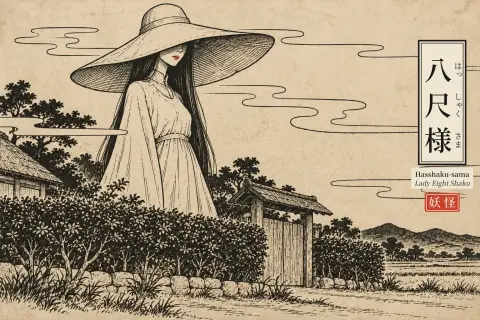
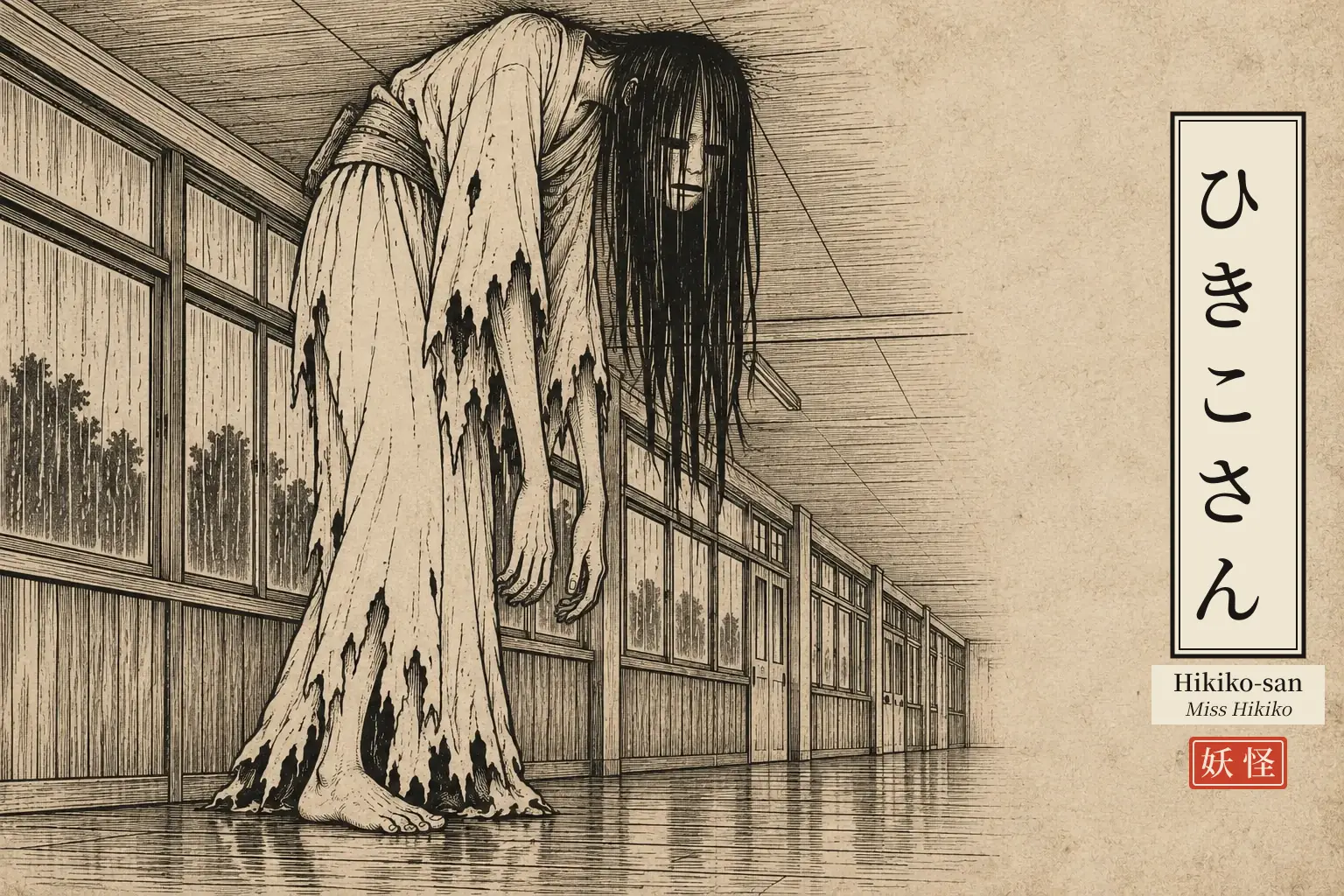
The first post never named her, but it already described her in full. She is extremely tall — tall enough, in that post, that her back brushes a school ceiling — and wears a tattered white kimono with long hair hanging over her face. Her eyes and mouth are split open, and her cry has no words. One version of the legend turns that cry into a question — "Is my face ugly?" — which echoes the stock line of Kuchisake-onna, the masked woman of a 1979 panic who asks strangers if she is pretty. Some tellings add a darker detail: she is said to keep a collection of children's bodies at home, and to carry a favorite one with her when she goes out.
The girl she is said to have been
According to the backstory, Mori Hikiko was once a lively, popular child. A teacher's open favoritism toward her made classmates resent her, and they decided her name sounded arrogant. The bullying escalated: a dead kitten turned up in her school bag, insects were put in her lunch, her shoes were slashed with a cutter. One day a group tied her hands and dragged her around the school grounds, tearing up her face. She never went back.
At home it got worse. Her father, drunk, beat her. She shut herself in her room, and her parents stopped feeding her, until her mother began quietly leaving rice balls and water outside the door once a day. She grew into an adult of unnatural height who left the house only on rainy days, when a scarred face is harder to make out. She began dragging children, the way she had once been dragged. Whenever her wounds started to heal, she is said to reopen them herself — which the story offers as the reason her mouth and eyes are still split.
The name is itself a small piece of wordplay. Written out, 森妃姫子 looks almost like a noble title — 妃 for "consort," 姫 for "princess." Asari reads it instead as built from a very different word: hikikomori, meaning a recluse who withdraws from the world. He suggests the backstory was composed around that word after the name "Hikiko-san" already existed, and connects it to two cases that dominated Japanese news in 2000 — a Niigata confinement case made public that January, and a bus hijacking in May blamed on a withdrawn young man. Reclusiveness itself had become a thing people feared.
Rules for surviving her
Like a lot of rumor-born yokai, Hikiko-san comes with stated outs. She is said not to attack a child who shares a name with one of her old bullies, and not to attack a child who is also being bullied. Answering her question by saying her face is beautiful is supposed to please her; calling it ugly only enrages her. Shouting "I'll drag you!" back at her is said to make her flinch, and holding up a mirror is said to make her flee outright.
Hikiko-san today
The legend spread through other message boards and magazines before television picked it up. On August 5, 2003, she was the subject of a segment on a TV Asahi variety program, which carried her past the schoolyards and forums she started in. She has had two screen adaptations since: a nearly one-person 3D-CG horror DVD, Toshi Densetsu Monogatari: Hikiko, released in 2008, and a 2014 theatrical horror film, Hi-ki-ko Kourin, which played a six-day limited run in Tokyo and follows a woman whose reunited friend group turns out to include someone who never existed.