Japan's oldest official history tells a strange story about Hida, a mountain province now part of Gifu. In the 65th year of Emperor Nintoku's reign, it says, a man called Sukuna lived there. He had two faces on one head, each looking the opposite way. He had four arms and four legs. He defied the emperor's commands, the chronicle says, and robbed the people for sport. So the court sent a warrior to put him down. Hida itself remembers him very differently — not as a bandit, but as the man it credits with founding some of its oldest temples.
What did he look like?
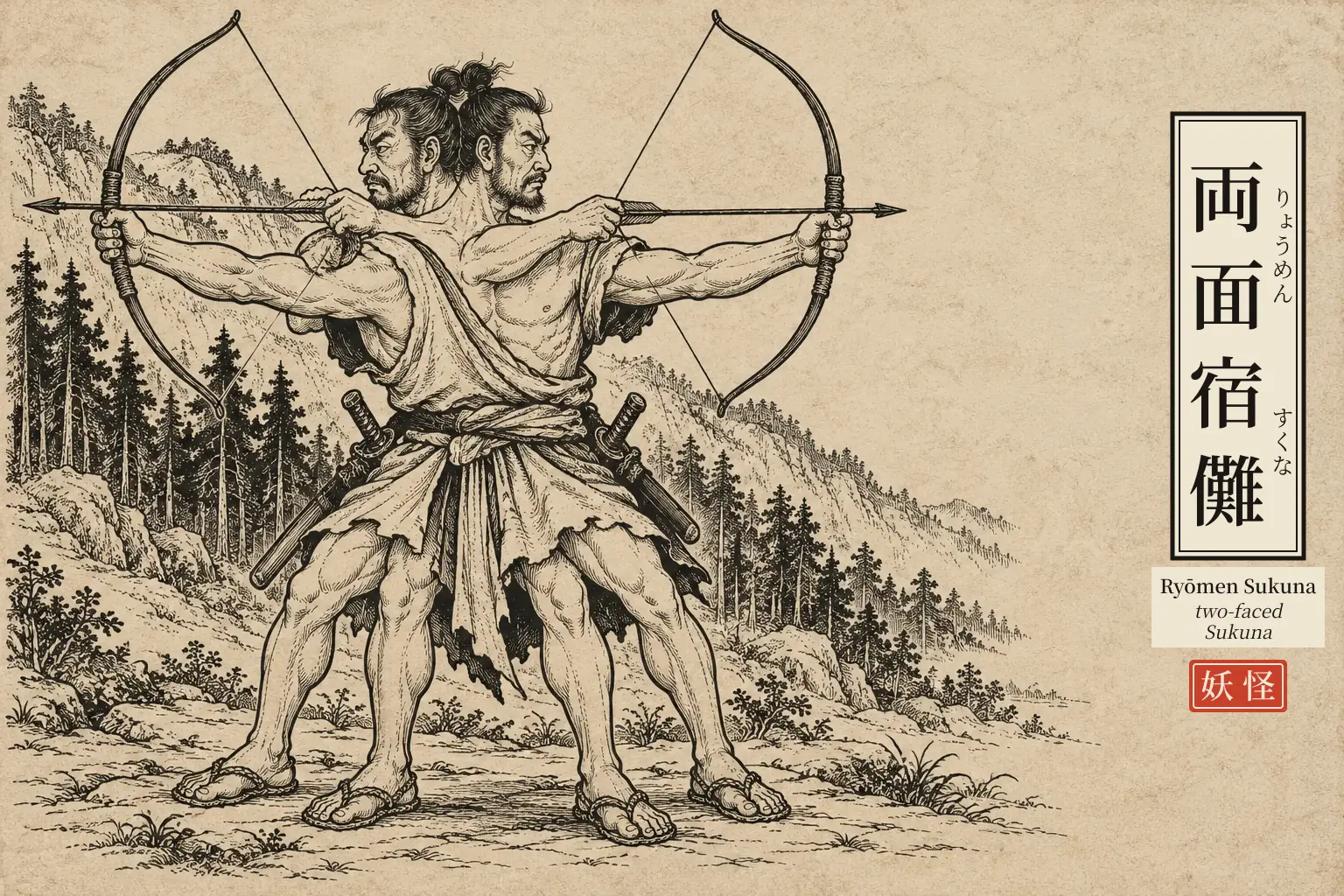
The Nihon Shoki, compiled in 720, gives the oldest description. Sukuna's one head carried two faces, set back to back. There was no nape of the neck between them. His body carried four arms and four legs. He had knees, the text says, but no backs-of-the-knee and no heels. He was strong and quick, and wore a sword on each hip. With his four hands he drew two bows at once.
One modern scholar reads that detail about the heels differently. He suggests it describes a real mountain dweller's gear — shin guards and a straw-sandal toe cover — rather than a monster's body.
Hida's own temples remember a different shape. Senkoji's 1621 temple record gives him one head, two faces, four arms, two legs, and a height of eighteen jō — a traditional unit equal to roughly fifty-four meters. Statues at Senkoji, Zenkyuji, and Nichiryuhoji all show the same two faces, front and back, in Chinese-style armor, with an axe and a sword at the waist. One statue, attributed to the monk-sculptor Enku, sets the second face at the shoulder instead of directly behind the first.
The court's story
The Nihon Shoki gives Sukuna no good qualities. He would not obey the throne. He took pleasure in plunder, it says. So Emperor Nintoku sent Naniwa no Nekotake Furukuma, ancestor of the Wani clan, to kill him. The chronicle ends there. It never calls Sukuna an oni — a horned demon. It calls him only a man who defied the court.
Hida's own stories
Along the old road between Hida and Mino, local temples tell it the other way around.
Senkoji's 1621 record says Sukuna was an incarnation of Kannon, a Buddhist deity of mercy. It says he stepped out of a rock cave and founded the temple himself. At that time, the record says, a stone chest was found buried at the mountaintop. Inside were a sutra scroll, a priest's robe, and a statue of Kannon.
Zenkyuji, nearby, tells its own founding story about him. Besides its main Buddha, it keeps a wooden statue of Sukuna. At Nichiryuhoji, temple history says a two-faced, four-armed being subdued a poisonous dragon on a nearby mountain. The monk Gyoki then built the temple there. The temple's sacred cypress, the Senbon-hinoki, is said to have grown from his staff.
Kanayama's own town history records two different endings for him, without choosing between them. In one, Sukuna hears the court's warrior is coming. He stays on a hill in Kanayama for thirty-seven days, then holds out on Takasawa-yama and is killed there. In the other, he spends those thirty-seven days praying for the nation's safety and a good harvest. That is why the hill is called Chinju-yama. Then he leaves for Takasawa-yama. Villagers built a Kannon hall there afterward, in this second version.
A separate local tradition, recorded in a 1982 folklore survey, has Sukuna fighting for the emperor rather than against him. In this telling, he kills a mountain oni called Nanana, on the emperor's own order. An eighteenth-century gazetteer lists a shrine relic nearby called "the hair of Nanana."
Where it comes from
Most historians read the court's account as reflecting a real clash. In the fifth century, they say, the Yamato court likely fought a real chieftain who ruled Hida. The court's chronicle recorded him as a criminal it had put down. How that fits with Hida's own hero legends is still debated. The court called him an enemy. His own province calls him a founder.
Go deeper
Books worth owning if this world pulls you in.
- The Book of Yokai →Michael Dylan FosterThe most readable scholarly introduction to yokai — where they come from, what they mean, and the major creatures.
- Japandemonium Illustrated: The Yokai Encyclopedias of Toriyama Sekien →trans. Hiroko Yoda & Matt AltThe complete Edo-period bestiaries that so many of these entries trace back to, in full English translation.
Some links are affiliate links; if you buy through them we may earn a small commission at no extra cost to you.
Ryōmen Sukuna today
The manga Jujutsu Kaisen (2018–2024) and its anime gave the name Sukuna a huge new audience as a cursed-spirit king. This Sukuna is not the figure of myth. He is a human who earned the name for how monstrous he looked.
Back in Takayama, the connection is smaller and stranger. A local squash, grown in the Niukawa area, is simply named Sukuna kabocha — after the man whose two faces made him a founder at home and a bandit to the court that hunted him.