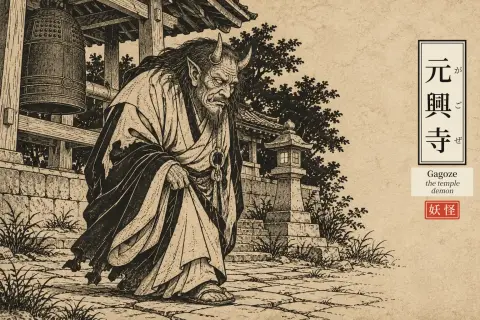
In the autumn of 1334, plague was moving through Kyoto, and people were dying faster than anyone could explain. Every night that season, a bird nobody could name appeared over the Shishinden, the imperial palace's main ceremonial hall, and called the same two words into the dark: itsumade, itsumade. Until when, until when. Eventually the court sent for an archer.
A face like a person, a body like a snake
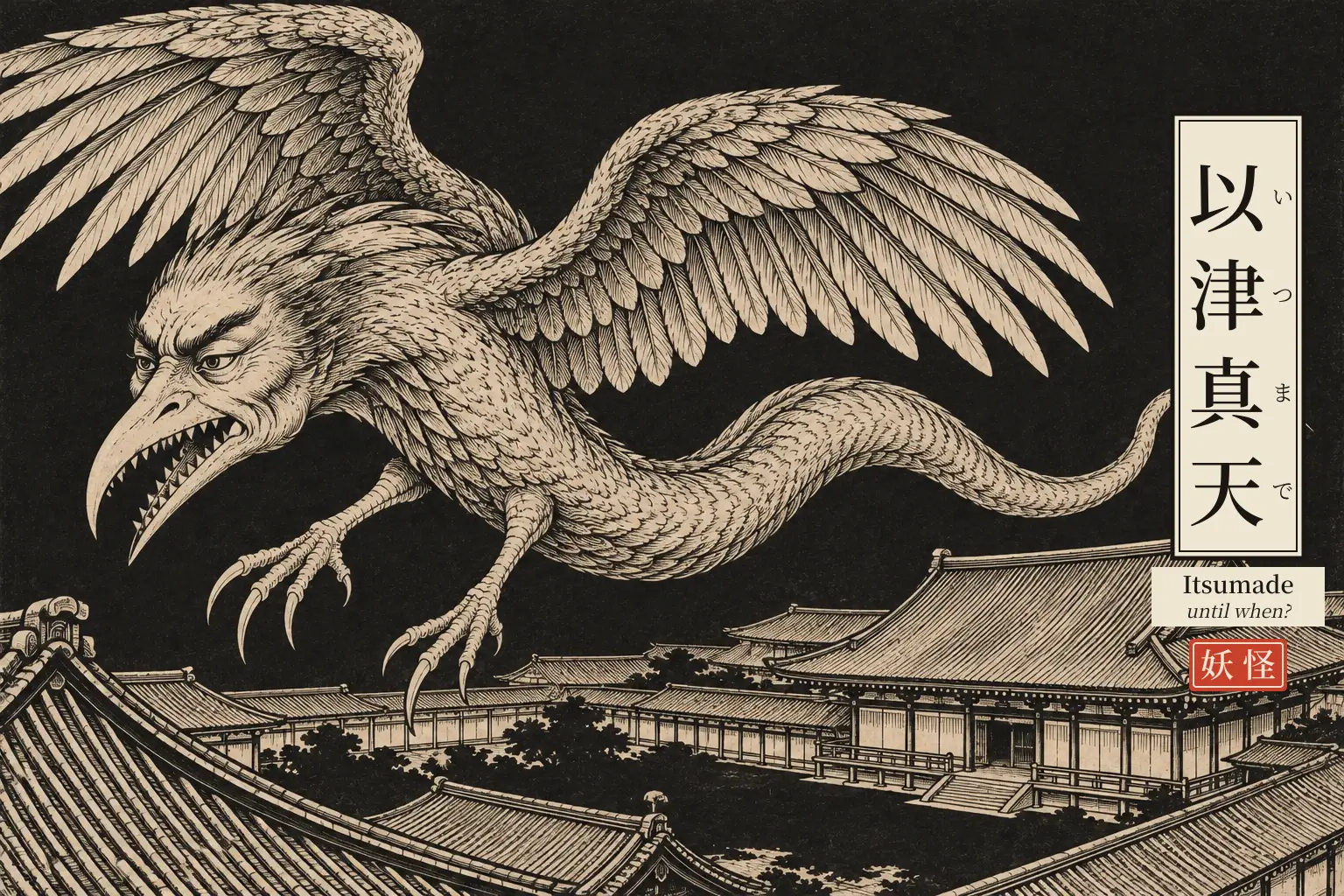
The Taiheiki, a war chronicle covering this period, records the hunt and describes what the archer brought down. It had a face like a human's, a curved beak lined with teeth like a saw, and a body shaped like a snake. The claws on both its feet were sharp as swords, and its wings, spread, measured about one jō six shaku, close to 4.8 meters across. The text gives no color, no feather pattern, nothing beyond shape and size. That bare outline is still the oldest description anyone has for this creature.
The nobles remembered a different bird
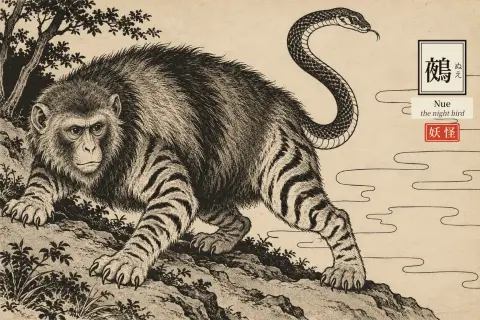
Plague deaths were already mounting when the cries began, and the fear needed somewhere to go. The court recalled an older case: the warrior-poet Minamoto no Yorimasa had once shot down a shrieking, four-part chimera called the nue from above this same palace, roughly 180 years earlier. If an archer solved it then, an archer could solve it now.
The task went to Oki Jirō Saemon Hiroari, also recorded under the name Mayumi Hiroari. He used a kaburaya, an arrow fitted with a hollow head that whistled in flight, built to announce itself as much as to wound. It worked. The bird dropped, the cries over the Shishinden stopped, and the chronicle moves on to other matters within a sentence or two, the way court records tend to once an omen has been dealt with.
A name invented 445 years later
Here is the odd part: the Taiheiki never names the bird. Throughout the episode it is simply kaichō, "a mysterious bird." Whatever Hiroari shot down that autumn, it was not called Itsumade for another four and a half centuries.
The name shows up in 1779, in Toriyama Sekien's Konjaku Gazu Zoku Hyakki, a picture book of yokai by the Edo-period artist whose catalogs gave many creatures their first fixed faces. Sekien's own note on the page points straight back to the Taiheiki story and says plainly that Hiroari shot down a bird that had been crying "itsumade, itsumade." According to the folklorist Murakami Kenji, Sekien coined the name himself, lifting it directly from the cry rather than from any earlier record. Later Edo-period warrior prints also retell the Hiroari story, some showing a transformed bird, others suggesting it with nothing more than a knot of black cloud over the palace roof. None of the surviving examples has been confirmed to use Sekien's name for it, even generations after he coined it.
The four kanji written for it, 以津真天, are ateji: characters chosen for how they sound, not what they mean. Read for sense, they suggest something like "by way of a true harbor of heaven," an image with nothing to do with a bird. Sekien just needed four characters that would read aloud as itsumade, and picked them the way ateji always get picked, for the noise, not the meaning.
Why it cried: two answers that disagree
Later writers did not settle on what the bird wanted. Mizuki Shigeru's 1994 encyclopedia of yokai gives the plainer version: leave a body from war or famine unburied, and this bird lands nearby and asks, in its own way, how long you plan to leave it there. The folklorist Tada Katsumi offers a different reading in a 1990 survey of fantastical beings: the bird is not asking about the unburied dead. It is made of them, the gathered vengeful spirits of people who never got a proper funeral. Both versions agree on the demand behind the cry. They disagree on whether the bird is mourning the dead or is the dead.
Itsumade today
Itsumade never became as well known as the nue it borrowed its hunting story from. It shows up reliably in yokai reference books, sometimes under a second, Shōwa-era reading of the name, Itsumaden, printed alongside the older one. Outside those dictionaries, it stays close to the picture Sekien drew for it in 1779: a creature over a palace roof, asking a question that ran out of time before Hiroari's arrow found it.