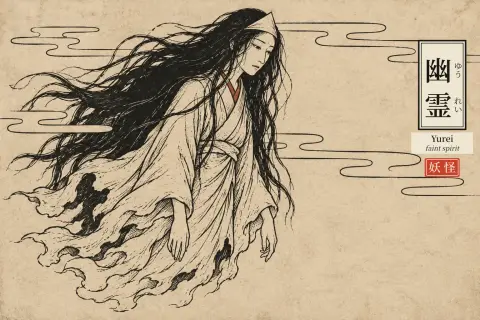
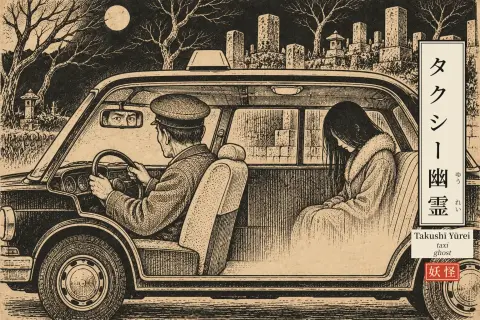
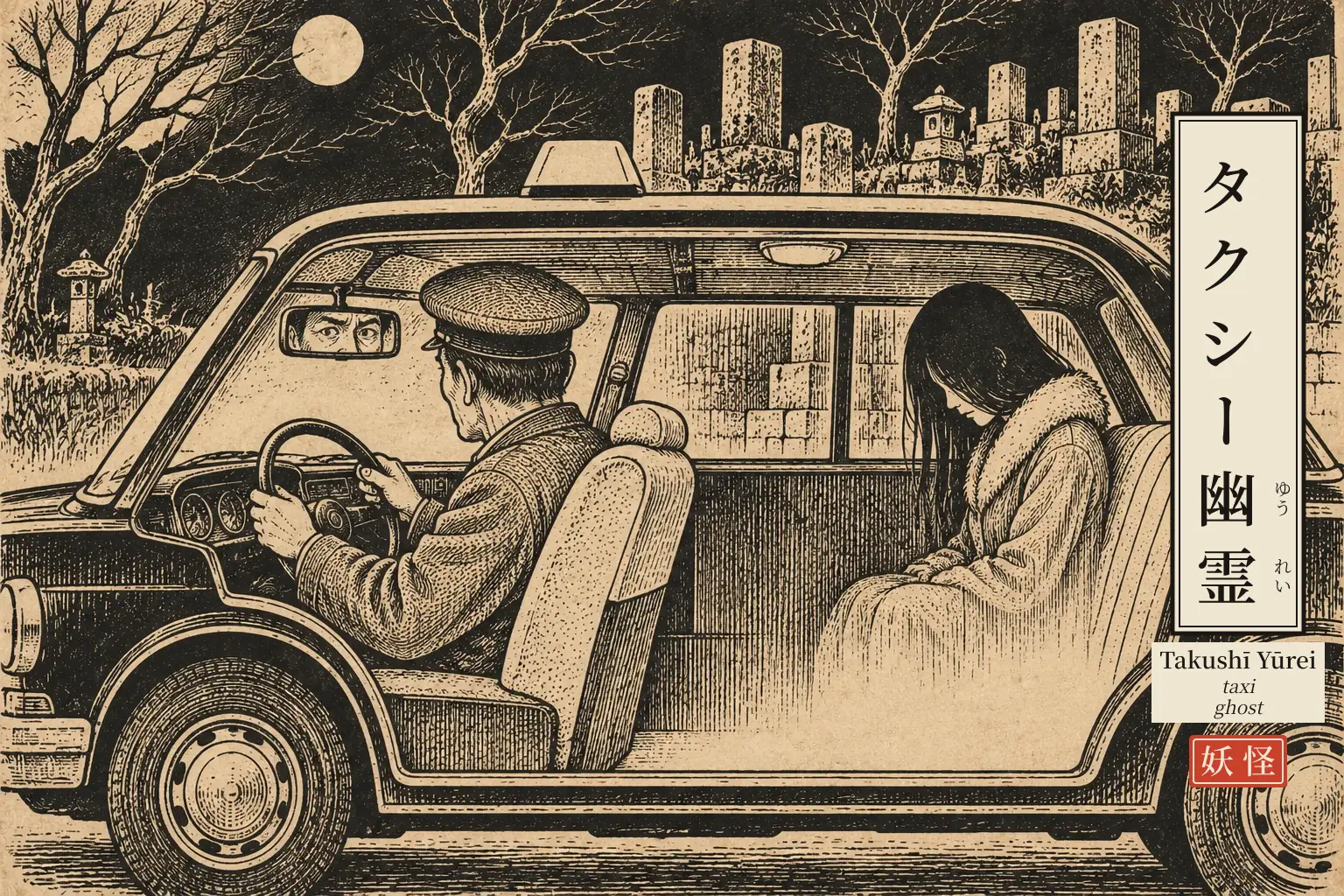
A taxi is hailed late at night. The passenger gives an address. When the driver checks the rearview mirror, or reaches the address, the back seat is empty. This is the takushī yūrei, the ghost taxi passenger. No Edo-period artist drew it, because taxis did not exist yet. Instead it has been collected fresh, from the mouths of real drivers, as recently as 2016.
A fare like any other, until it isn't
Most tellings follow the same shape. A taxi is hailed in the evening or late at night. The passenger is almost always a woman. She names a destination and the ride goes on like any other fare.
The scare sits at the end, not the start. The driver checks the mirror, or pulls up at the address, and the seat is empty. In Tokyo, the classic setting is Aoyama Cemetery. The ghost is often picked up or vanishes from the car near the cemetery. A traditional rakugo comedy-storytelling piece performs the tale under the title "To Aoyama Cemetery."
The ride itself gives the driver no warning. Most tellings agree on that much. The passenger is only recognized as a ghost once she is already gone.
After the 2011 tsunami, in Ishinomaki
In 2016, the same shape of story turned up again. This time it came from a research project. Kudo Yuka, a student at Tohoku Gakuin University, spent time in Ishinomaki, a city in Miyagi Prefecture. Ishinomaki was hit hard by the March 2011 tsunami. For her graduation thesis, Kudo asked local taxi drivers whether anything unusual had happened on their shifts. Her supervisor was sociology professor Kanebishi Kiyoshi.
Several drivers described the same kind of encounter. In one widely retold account, a passenger got in near Ishinomaki Station. She wore a heavy coat, out of place for the warm month. She asked to be taken to the Minamihama district. Minamihama was an area the tsunami had largely emptied. The driver asked if it was really all right to go there. The passenger answered, in a shaking voice, "Have I died?" The driver glanced back and found the seat empty. The taxi had not yet reached Minamihama.
Kudo wrote, in the book that grew out of her thesis, one reading of why. People who die suddenly and young may carry a stronger regret over things left undone in this world. A taxi ride, in this reading, gives that regret somewhere to go. Not everyone close to the research frames it that way. Kanebishi, the professor who supervised the thesis, spoke instead of grief carried by the living. He applied psychologist Pauline Boss's term "ambiguous loss" to cases like these. It means a death with no body and no funeral to close it. Both readings came out of the same project. What the record shows is simpler: the drivers Kudo interviewed did not describe fear. They spoke of the rides with something closer to reverence, as experiences worth keeping.
The Asahi Shimbun's digital edition ran the story in January 2016. Within three days it was shared 18,747 times on Facebook. It later reached readers in the UK and in Russian-language media.
Older than the automobile
The vanishing passenger is far older than the taxi. Before cars were common, Japanese sources describe the same story being told about palanquins. These were enclosed seats once carried by hand in Japan. A kaidan (ghost story) collection called Shokoku Hyakumonogatari, published in 1677, already has a tale like this one. In it, a palanquin passenger turns out to be a ghost.
Japan's version is not alone in the world. American folklorist Jan Harold Brunvand collected and named widely told modern legends like this one. In his 1981 book The Vanishing Hitchhiker, he documented an English-language cousin of the Japanese tale. In the American form, the vanished rider is usually hitchhiking, not paying a fare. In Japan, the same kind of tale is told as a taxi story instead. Japanese sources also point to similar stories in Canada, parts of Europe, and South Korea.
A doll on the dashboard
Folk explanations for the story grew up alongside it. One holds that the small mascot dolls many Japanese taxi drivers keep on the dashboard work as a charm. The charm is meant to keep a ghost fare from getting in at all.
A more clinical explanation comes from psychologist Nakamura Mareaki. He studied the car-based versions of the tale. He proposed that some sightings come from "highway hypnosis." Long, unchanging stretches of road can dull a driver's alertness and memory. This is one reading among several, not a settled finding. The Aoyama and Ishinomaki stories are both short city rides, not long highway stretches. The palanquin version is older still, well before any highway existed.
A story that keeps finding a new vehicle
The same basic shape keeps recurring in Japan: a passenger gone before anyone sees her leave. It arrives under whatever vehicle is current: palanquin, taxi. Folklore scholars generally treat tales like this as a recurring story type. It reappears independently in many times and places, rather than passing down whole as one tale.
A 2016 symposium followed Kudo's thesis, held at Tohoku Gakuin University that February. Its title translates roughly as "reading spirituality: the response and challenges of the taxi ghost phenomenon." Its own announcement framed the accounts as something to face thoughtfully. It was not something to simply prove or dismiss.
The taxi itself is almost beside the point. Palanquin or car, it is the same old story in a new vehicle.