The phone rings, or you fall asleep and dream. A voice asks you a question. Answer it wrong, and it takes a piece of your body. This is Kashima-san, one of Japan's stranger modern ghost stories. No Edo-period print shows her, and no shrine keeps a statue of her. She is pure toshi densetsu — Japanese for "urban legend" — a story that spreads by word of mouth, then by phone, then online.
Also known as
Kashima-san goes by several names. Some tellers call her Kashima Daimyōjin, the name of a real shrine god. Others say Kashima-sama, a more formal version of the same name. Her fuller name is Kashima Reiko. One writer, Watanabe Setsuko, recorded a kanji spelling for it: 仮死魔霊子, meaning roughly "false death, demon, spirit, child." The spelling turns her own name into a small horror story.
What does she look like?
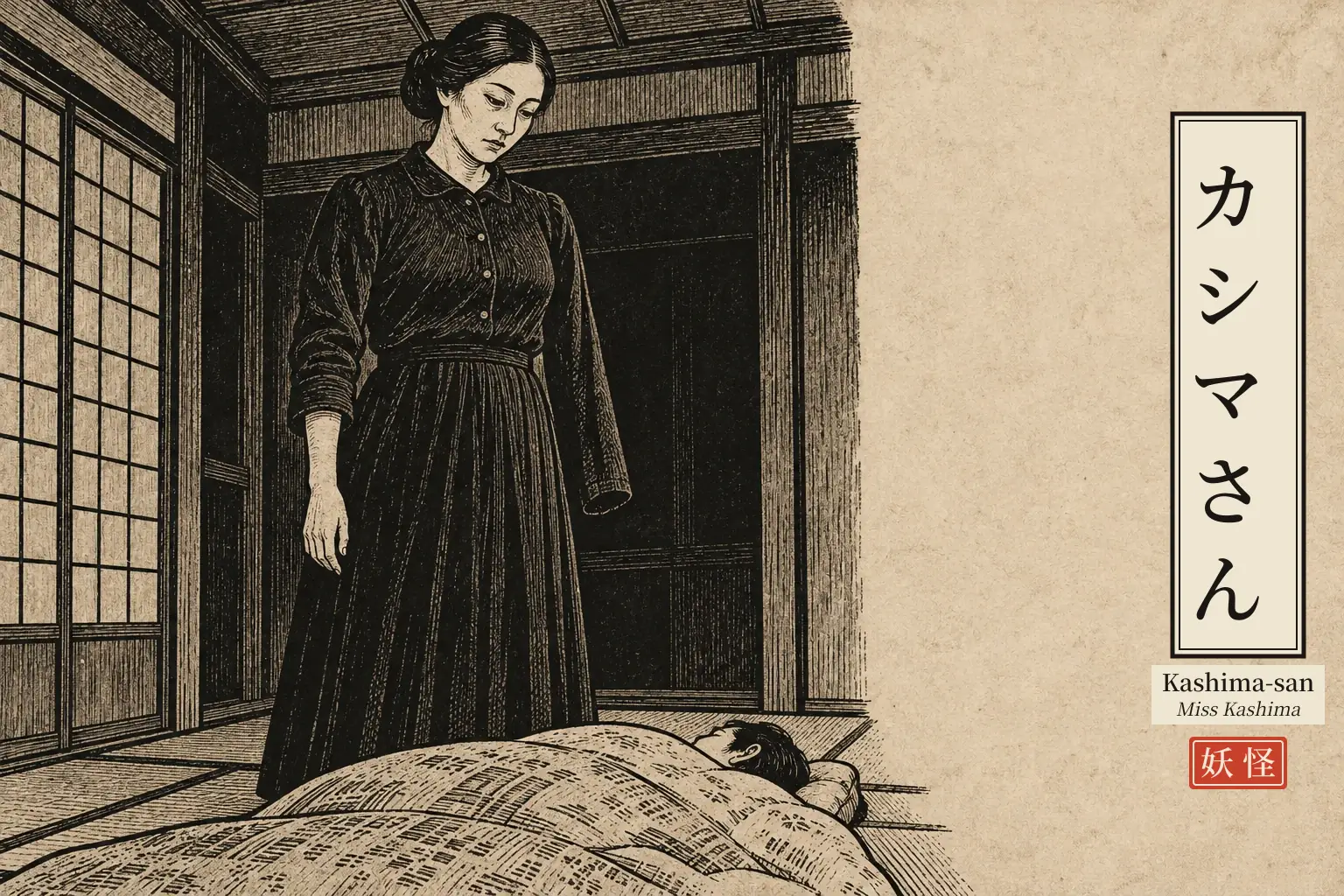
Her appearance is not fixed. Most tellings describe a woman missing an arm or a leg. Some say her skin shows keloid-like scarring, a kind of raised scar tissue. A few early versions, from when the rumor first spread, describe a wounded soldier instead — not a woman at all. Across tellings, at least one of three things recurs. She appears to whoever has heard her story. She can take a life. Or her body is missing something.
The question, and answers said to work
Most tellings start with a question, asked by phone or inside a dream. "Do you need your legs?" is one common version. "Who did you hear this story from?" is another. Folklore supplies answers that are said to work. Asked for your hands, say "I'm using them right now." Asked for your legs, say "I need them right now." Asked who told you the story, say "Kashima-san" — or recite her name letter by letter, each one standing for a word: mask, death, demon, spirit, accident. Get it wrong, and she takes a part of your body.
Accounts differ on how she died
| Version | What it says |
|---|---|
| Earliest tellings | A wounded soldier of the former Imperial Japanese Army. No clear backstory is attached. |
| Common backstory | Just after the war ended, American soldiers raped a woman, and she threw herself in front of a train. |
| Modern internet version | The same assault, but she is shot in all four limbs first. A doctor saves her life, though she loses the limbs. Still proud of her old looks, the shock of losing them drives her to throw herself in front of a train. |
None of these is official. No named writer claims to have invented any of them.
Where the panic went
Some tellings add a toilet. Instead of a phone call or a dream, Kashima-san is said to appear to people inside a bathroom. Other tellings turn the legend into a kind of puzzle: mark every place where an incident was blamed on the curse, and connect the marks with lines. The shape that appears, in this version, is a body missing its head, arms, and legs — exactly what the curse takes. A regional telling, set in Kakogawa and Takasago, two cities in Hyōgo, claims newspapers once reported deaths from the curse there, causing a panic. No such newspaper report has ever been confirmed; it is part of the story, not a verified event.
Where it comes from
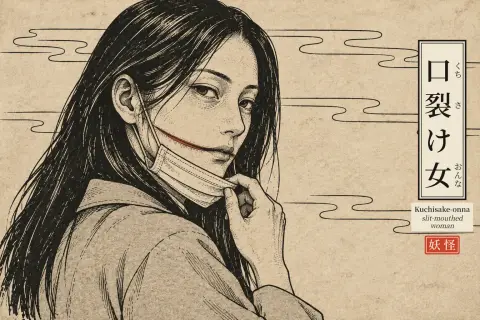
Nobody claims to have started the Kashima-san rumor. The earliest book we found that cites it is a 1995 collection edited by Watanabe Setsuko, Majo no Dengonban. The story itself is probably older. Writer Hatsumi Ken'ichi, who studies 1970s Japanese pop culture, raises a possible connection. In 1978, the rumor of a masked woman who asks "Am I pretty?" spread through Japan's schools — the story now known as kuchisake-onna. Hatsumi says Kashima-san followed soon after, as what he calls a "rehash." He recalls, from his own experience, hearing that the masked woman's "real name was Kashima Reiko." The two legends, he suggests, grew up tangled together.
The name itself may come from somewhere safer. Kashima Shrine is a real shrine. In one branch of the legend, "Kashima Daimyōjin" names that shrine's own guardian god, not an attacker. Say "Kashima-san, please help me," and in this version the threat goes away. The name that takes a limb everywhere else is, here, the one you call on to keep your limbs.
Go deeper
Books worth owning if this world pulls you in.
- The Book of Yokai →Michael Dylan FosterThe most readable scholarly introduction to yokai — where they come from, what they mean, and the major creatures.
- Japandemonium Illustrated: The Yokai Encyclopedias of Toriyama Sekien →trans. Hiroko Yoda & Matt AltThe complete Edo-period bestiaries that so many of these entries trace back to, in full English translation.
Some links are affiliate links; if you buy through them we may earn a small commission at no extra cost to you.
Kashima-san today
Kashima-san never had one author, so she never stopped changing. Through the early 2000s, whole books chased her story, including two by Matsuyama Hiroshi alone, published in June and November 2004. Online, she has merged with other legends. Some tellers now say she is the true identity behind teke-teke, the ghost that drags itself along the ground on its arms, making a "teke teke" sound. These versions reuse the same postwar-assault backstory to tie the two stories together.