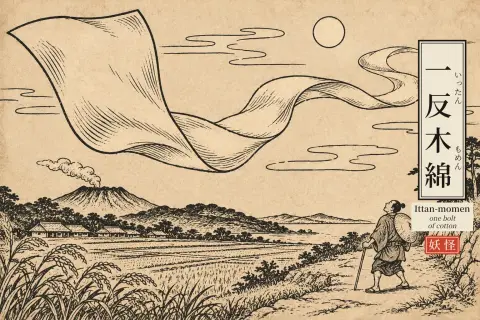
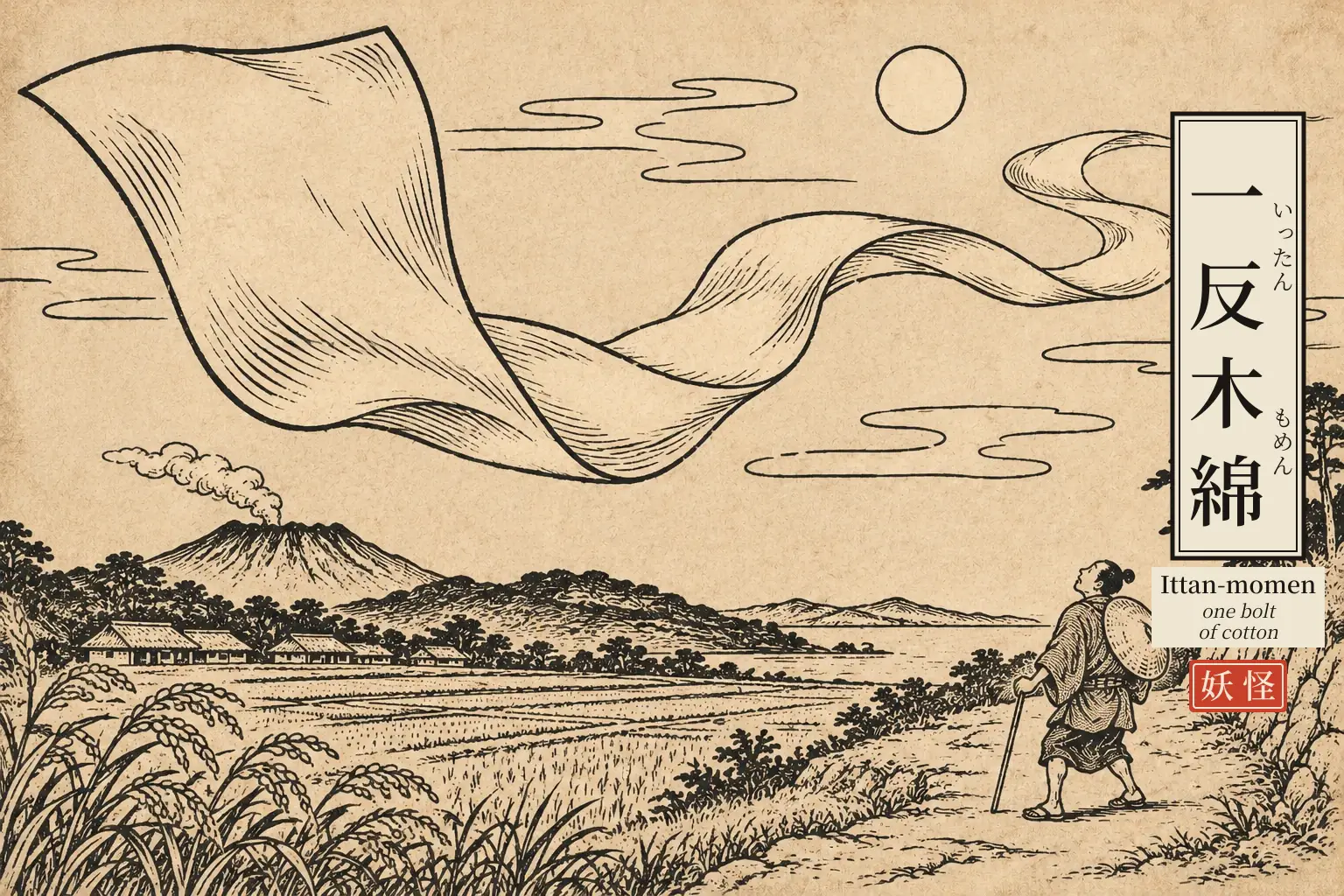
Cotton cloth about ten and a half metres long rises into the dusk sky, and it is not laundry blown off a line. In the folklore of Kōyama, a village in the far south of Kyushu, that length of cloth is alive, and it hunts whoever is still out on the road. Its name spells out exactly what it is: 一反 (ittan), one tan, an old unit for a bolt of cloth, plus 木綿 (momen), cotton.
No confirmed old picture of it has ever been found. The two-eyed, waving-armed cloth everyone pictures today came from somewhere else entirely, and much later.
A bolt of cloth with no eyes and no arms
The earliest written account is a 1942 dialect collection, the Ōsumi Kimotsuki-gun Hōgenshū, written by the local educator Nomura Denshi and edited by the folklorist Yanagita Kunio. It describes a cotton-like cloth about one tan in size, roughly ten and a half metres long and thirty centimetres wide, fluttering through the air at dusk. Yanagita repeated the same claim in his own 1956 book, Yōkai Dangi: it attacks people at night.
One folklorist, Komatsu Kazuhiko, has pointed to a different kind of clue: a limbed, cloth-shaped figure in an old picture scroll, the Hyakki Yagyo Emaki attributed to Tosa Mitsunobu. He suggests it may be a distant root of ittan-momen, though this is not confirmed.
Later accounts add detail. A 1994 picture encyclopedia by the cartoonist Mizuki Shigeru says it wraps around a person's neck or covers their face, and can suffocate them. A 2007 study of Japanese yokai pictures it flying in fast while spinning like a rolled bolt of cloth, winding around a person's whole body, and carrying them off into the sky.
In the tradition area, people also called it Ittanmonme or Ittanmonmen, local versions of the same name. Neither adds a new feature. They are just how the word was said there.
A short sword is one way out
One story follows a man hurrying home at night. A white cloth flew at him and wrapped around his neck. He drew his wakizashi, a short sword, and cut at it. The cloth vanished. When he looked down, there was blood on his hand and no cloth in sight.
Villages near Kōyama used the creature to keep children close to home. Anyone who played too late was warned, "Ittan-momen will come out." Near Shijūkusho Shrine in what is now Kimotsuki town, children believed the thing circling overhead would attack whoever passed the shrine last. So they raced each other past it, each one trying not to be the final child in line.
Why it waits for dusk
A 2007 newspaper feature on the legend offers two explanations, and does not pick between them. Neither the 1942 dialect collection nor Yanagita's 1956 book that first recorded the story gives a reason at all. Both ideas below are later readings, not part of the original telling.
The first points to the hour itself. In the old farming villages around Kōyama, parents worked the fields from morning until dusk and could not watch their children during that time. The feature suggests a story about a monster that comes out right then kept children close to home when no one else could.
The second points to a funeral custom. Burials in the area were once marked with a cotton flag planted at the grave. Wind could lift one of those flags into the air, and the same feature guesses that sight, plain cloth flying loose in the wind, fed into the story of a living bolt of cotton.
A 2010 television experiment offers a third kind of explanation, for the sightings rather than the legend's start. The Nippon TV program Tokoro-san no Me ga Ten! moved a cloth about fifty centimetres long through darkness and asked witnesses to guess its size. They averaged 2.19 metres, and one guessed six. The program blamed a positive afterimage, the trailing glow a bright object leaves on the eye when it moves in the dark, and suggested a Japanese giant flying squirrel gliding through a night forest could look the same way under that illusion: longer than it really is.
The sightings did not stop
The yokai researcher Yamaguchi Toshitaro has collected recent reports of cloth-like flying objects that match the old descriptions. In Kagoshima itself, people have seen a low white cloth near the ground. In Fukuoka, passengers on a bullet train watched one keep pace with the carriage at full speed. Farther from Kyushu, sightings turn up in Tokyo, at Higashi-Koenji and Ogikubo. In Higashi-Koenji, a woman walking her dog saw one overhead and briefly chased it.
Other reports add detail the old stories never gave. A schoolchild in Shizuoka described something transparent and sheet-like, swaying as it moved, roughly rectangular but tapering to a point at one end. In 2004, an amateur UFO-video club filmed a cloth-like shape over Mount Rokko in Hyogo and put its size at thirty metres. The actor Sano Shiro has said he saw one too: a long white shape crossing the sky above the set where he was filming a drama based on Kyogoku Natsuhiko's ghost stories.
Ittan-momen today
For a long time this was a small, local legend. That changed once Mizuki Shigeru, the cartoonist whose work shaped how Japan pictures its yokai, put ittan-momen into GeGeGe no Kitaro. His version speaks in a Kyushu accent, has an easy-going personality, and flies in a way nothing in the old accounts describes. In a 2007 popularity poll run by the tourist board of Sakaiminato, Mizuki's hometown, ittan-momen placed first. Kitaro himself came fourth.
The tokusatsu series Kamen Rider Hibiki also used the creature, giving it its own look and personality as an enemy for the show's heroes, loosely built on the old legend rather than copied from it.
Back in Kagoshima, a local historian named Takenoi began in 2007 to keep the original story alive. He makes kamishibai, illustrated paper-theatre shows, of the ittan-momen legend for children in the area where it was first told: a story that was fading even there.