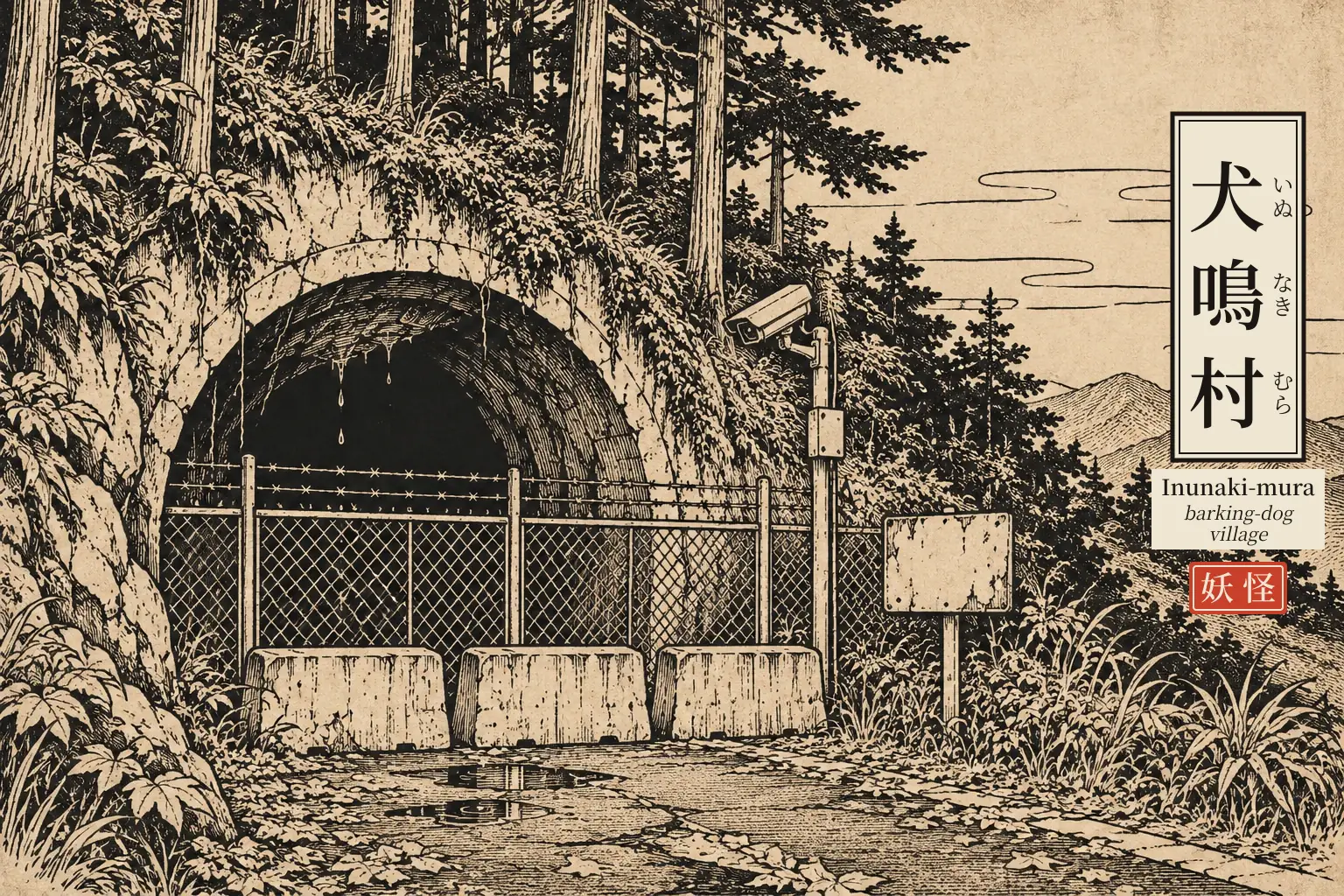
Search "Inunaki Village" and it sounds like a real place you should never visit. People say it sits deep in the Fukuoka mountains, cut off from the rest of Japan. Visitors who go looking for it, the story warns, do not come back the same. Almost none of that is true. The only real thing in the legend is the mountain it is pinned to, and even that mountain holds no hidden village.
A sign that says the law stops here
The core rumor is simple. Inside Mt. Inunaki there is a village that has cut off all contact with outsiders. Anyone who visits out of curiosity gets attacked.
Around that core, tellers added detail after detail. A closed clan, called the Inunaki-zoku, made up only of close relatives. An old woman living there alone. A sign at the border reading "Beyond this point, the Japanese Constitution does not apply." A man with a sickle or an axe who chases visitors away. A village missing from maps. Food dropped by military helicopter. A village once used to quarantine the sick. A young, armed man who massacred the villagers, leaving the place abandoned.
Japan's Wikipedia entry on the legend is blunt about all of it. Every detail except the place name is invented. None of it is true.
The pass that gave the story its address
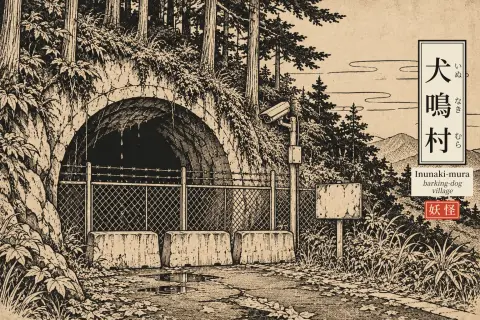
Inunaki Pass is real. It sits on the border of Miyawaka City and Hisayama Town, in Fukuoka, named for the 583.6-meter Mt. Inunaki beside it. A prefectural road once crossed the pass through a narrow, unlined tunnel.
That old tunnel still exists, but you cannot drive it. A new tunnel opened in 1975, and traffic on the old road dropped away. Illegal dumping and gangs of young bikers moved in. Local authorities later closed the road for good. Today the Hisayama-side entrance sits behind a fence and a security camera, with signs warning that trespassers will be reported to police. On the Miyawaka side, only a hiking trail past the old tunnel stays open.
Ghost stories about that tunnel predate the village rumor. People said the spirits of workers who died building it still haunted the road. In the late 1980s, a killing also took place near the old tunnel, which hardened the area's reputation as somewhere to fear. By the time the village legend arrived, the pass already had a name for being haunted.
Where the village story actually came from
The oldest version anyone can point to online is a message-board post. On 30 October 1999, someone started a thread titled "Inunaki Pass" on 2channel, an anonymous Japanese forum. Researcher Yoshida Yuki traced the story back to that thread for a 2020 article. Older ghost rumors about the tunnel existed before it, but none of them are dated.
Several writers have noticed the Inunaki legend's resemblance to an earlier one: the Sugisawa Village legend, an earlier invented-village story tied to the real 1938 Tsuyama massacre. Folklorist Hirosaka Tomonobu has written that the Inunaki story reads as an echo of the Sugisawa tale, created by association rather than by any real event.
Scholar Torikai Kaoru has studied why this particular pass attracted the story. Her research points to several local threads: a history of coal miners fleeing the nearby Chikuho coalfield, a contrast locals drew between Mt. Inunaki and a nearby sacred peak, an old iron-smelting industry once based in the area, and the general image of the Chikuho region. None of this proves why the legend grew where it did. It shows the area already carried the kind of reputation a scary story could attach to.
Researcher Yoshida Yuki suggests the legend's real model is a settlement that once stood upstream on the Inunaki River. It was never hidden, and nothing like the rumored massacre happened there. Construction of the Inunaki Dam ran from 1970 to 1994, and its reservoir now covers that settlement's old site. Residents moved in 1985, to new housing lots built for them.
Should you go looking for it?
No. There is no hidden village to find, and the real site people treat as its location is closed for ordinary reasons: dumping and trouble on the old road, and an unlined tunnel with water dripping from the ceiling and a risk of collapse. Trespassing is reported to police. Whatever the legend promises, the only thing waiting there is an old, abandoned road.
Inunaki Village on screen
The story has outlived its own forum post. In 2019, the studio Chilla's Art released a horror video game called Inunaki Tunnel on Steam. Its own store page borrows the legend's signature claim directly: it says Japanese law does not apply beyond the tunnel's entrance, and it uses "Inunaki village" as another name for the tunnel itself.
In 2020, director Shimizu Takashi made a horror film titled Inunaki Village, which spawned its own tie-in mobile and console game the same year and the next. The film skips the rumor's specific details. No axe-wielding man, no clan of relatives, no Constitution sign. Instead it tells its own invented story about a village's buried past, a family bloodline, and a dam that floods the area. That last detail echoes something real: an actual settlement nearby really was cleared for a dam, decades before the film was made.
The three kanji in 犬鳴村 read literally as dog, cry, and village, close to the older name for the pass itself. One local account says the mountain earned that name because a wolf once howled there, unable to climb up a waterfall. No source ties that story to the village legend. The two names simply share the same stretch of mountain, roughly three centuries apart.