Every story about meeting a hakutaku happens in China. None happens in Japan. In Japan, hakutaku's job was different: not to be met, but to be carried. People drew its picture, folded it into a travel bag, or set it by a sickbed, as a charm. The creature itself, Chinese sources say, speaks human language and knows everything about everything. In China it is called Báizé. Its Japanese name, written 白沢 or, in the old orthography, 白澤, breaks down simply: 白 (haku, "white") and 沢 (taku, "marsh" or "mountain stream"). White marsh.
What does it look like?
The three traditions don't agree with each other.
| Source | Shape |
|---|---|
| Sancai Tuhui (Ming China) / Wakan Sansai Zue (Edo Japan) | A white lion |
| Toriyama Sekien, Konjaku Hyakki Shūi (1781) | Two ox-like horns, a goat's beard, and nine eyes: one extra eye on the forehead, plus three down each side of the body |
| Kaiki Chōjū Zukan hand scroll | Two eyes, and a body like a sturdier kirin |
The record is not thin. It is just split three ways, across two countries and several centuries. The oldest Chinese encyclopedia draws a lion, and Japan's own encyclopedia, the Wakan Sansai Zue, copies it. Sekien's Edo-period print draws something else: two horns, a goat's beard, and nine eyes. A third, undated scroll draws something closer to a kirin, with just two eyes.
The emperor who asked it everything
The story behind all these pictures starts with the Yellow Emperor, Huangdi, the earliest king in Chinese legend. While touring the eastern coast, he climbed Mount Huan and met hakutaku by the sea. The beast spoke to him directly. It described 11,520 kinds of spirits and demons troubling the world, and told him how to guard against each one.
The Sancai Tuhui, a Ming-dynasty encyclopedia, adds a condition: hakutaku shows itself only when the ruler of the time is virtuous. The Yellow Emperor had his officials write everything down. The resulting book, the Hakutaku-zu ("Hakutaku's Illustrations"), was not just a picture book. It listed threats and gave countermeasures for each, closer to a disaster-response manual than a bestiary.
Two things only the book knew
The Hakutaku-zu itself is lost, but later Chinese writers quoted from it. The Jin-dynasty text Soushen Ji preserves two of its entries as true stories.
In the first, Zhuge Ke, a governor of Danyang, was hunting in the mountains when a child-shaped creature grabbed at him. He pulled it loose and it died on the spot. His puzzled officers asked how he knew what to do. He told them the Hakutaku-zu names this mountain spirit Keinō, and says it dies the moment it is pulled away from its ground.
In the second, Lu Jingshu, a governor serving under Sun Quan of Wu, ordered a great camphor tree cut down. It bled when the axe struck it. When it finally fell, a creature climbed out with a human face and a dog's body. Lu identified it as Hōkō, boiled it, and ate it. It tasted like dog. The Hakutaku-zu, he said, describes Hōkō as a tailless black dog that lives inside trees and can be eaten.
Lost, then half-found
By the Northern Song dynasty, the Hakutaku-zu itself had disappeared. Only quotations survived, scattered through other books. Then, in the early 20th century, researchers found related drawings among the Dunhuang manuscripts, in the Buddhist cave library of Mogao, in western China. Working from the quotations and these fragments, the scholar Sasaki Satoshi published an attempted reconstruction of the lost book in 2017.
A charm, not a story, in Japan
Japan never developed its own hakutaku legend. It inherited the picture instead. From the Tang dynasty onward, Chinese folk belief held that hakutaku's image alone worked as a charm against evil, with or without the book behind it. Edo-period Japanese travelers copied that belief directly. Guidebooks such as Yasumi Roan's Ryokō Yōjinshū included a hakutaku print to carry on the road. People also kept the image by a pillow, against illness.
The symbol reached the top of Japanese society, too. A painting of hakutaku decorates a sugi-wood door at Nikkō Tōshō-gū, in the room where the shogun once sat. In China, emperors are said to have flown a "hakutaku banner" at the head of their guard.
Where it comes from
Hakutaku was invented to answer one question: what do you do about 11,520 kinds of demons? The Yellow Emperor got his answer and had it written down. For centuries, Chinese scholars kept quoting pieces of that answer, case by case, the way Zhuge Ke and Lu Jingshu did.
The book itself did not survive that process. It was gone by the Song dynasty, leaving only fragments behind.
What outlived it was simpler: the face. By the time hakutaku's picture reached Edo Japan, nobody needed to read the Hakutaku-zu to use it. The protection had detached from the knowledge entirely. The book that named every demon was lost. Only its protector's face survived.
See the original print
Toriyama Sekien drew Hakutaku in Konjaku Hyakki Shūi (1781). This book has that picture, with its caption in English.
- Japandemonium Illustrated: The Yokai Encyclopedias of Toriyama Sekien →trans. Hiroko Yoda & Matt AltThe complete Edo-period bestiaries that so many of these entries trace back to, in full English translation.
- The Book of Yokai →Michael Dylan FosterThe most readable scholarly introduction to yokai — where they come from, what they mean, and the major creatures.
Some links are affiliate links; if you buy through them we may earn a small commission at no extra cost to you.
Hakutaku in Japan today
Hakutaku has one clear foothold in modern pop culture. Eguchi Natsumi's manga Hōzuki no Reitetsu (鬼灯の冷徹) gives it a youthful, human form. Hakutaku and the main character Hōzuki carry on a long-running feud through the series.
The manga had a real, documented side effect. In 2017, interest from its fans drove unusually strong sales of Sasaki's scholarly reconstruction of the Hakutaku-zu — an academic book about a creature most of its new readers had only just met in a comic.
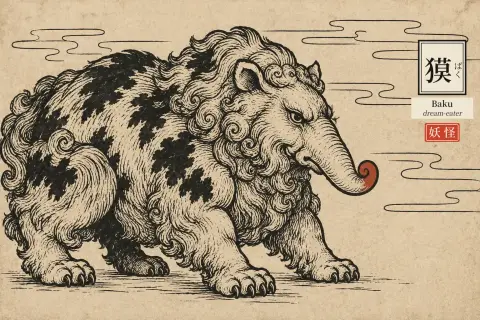
Two other beasts in this almanac share hakutaku's old job of warning rather than haunting: kudan, a calf born to speak one true prophecy and die, and baku, the dream-eater kept near pillows for a different kind of protection.