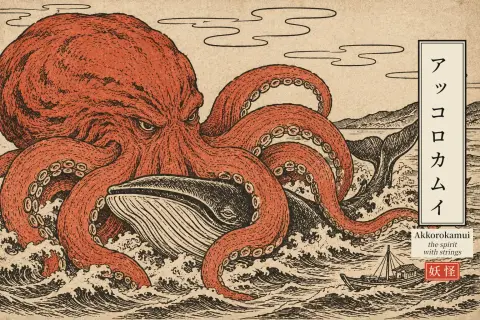
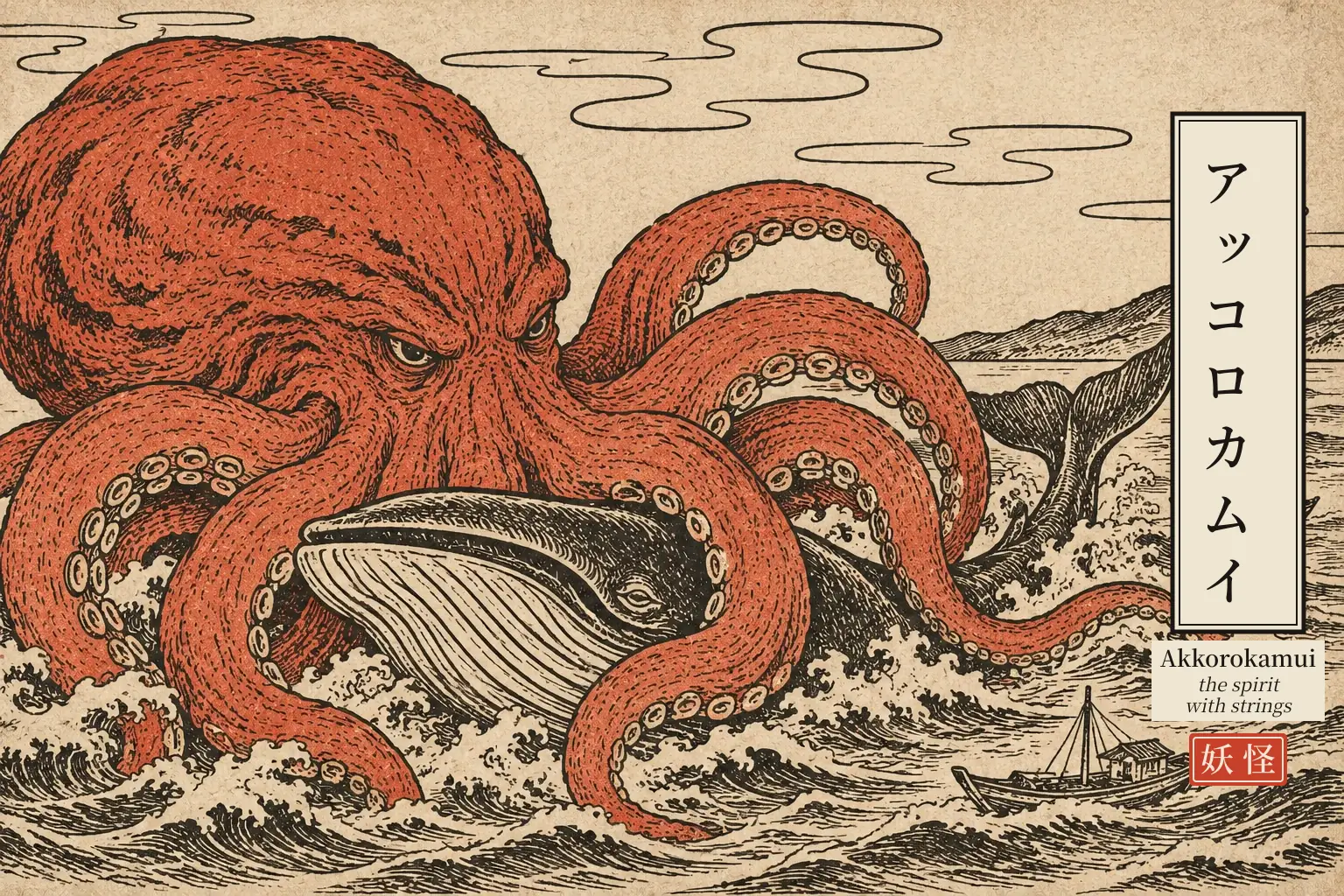
Funka Bay, on Hokkaido's southwest coast, is a near-perfect circle of water ringed by volcanoes. Its official name is Uchiura Bay, in the Iburi region. For the Ainu, the Indigenous people of Hokkaido, one creature was blamed: Akkorokamui, a giant red octopus. Its body glowed red, bright enough to spot from far off. It was said to swallow boats, and even whales, whole.
A red glow across the water
Written accounts describe Akkorokamui as enormous. Exaggerated accounts put its size at about one chō of farmland. A 1970 retelling converts that to roughly a hectare. Its whole body was red, and the glow reached the sky. That is how sailors were said to spot it before it ever came close.
The name explains the shape. In Ainu, at means cord or string, kor means to have, and kamuy means spirit, or god. Akkorokamui is "the kamuy that has cords": its tentacles. Some later books write the name with the kanji 大章魚, literally "great octopus."
Not every source agrees it was an octopus at all. An old folklore glossary, the Nihon Yōkai Henka Goi, describes the creature without ever using the word for octopus. Partly because of that gap, one 1997 reference book, Kusano Takumi's Gensō Dōbutsu Jiten, calls it a giant fish instead. Many tellings still call it a giant octopus, red from the glow it was said to give off.
Also called Atsuina, or Adoi-inau
Akkorokamui was not its only name. Yoshida Iwao, the folklorist who first wrote the tale down in 1914 in the journal Jinruigaku Zasshi, also recorded it as Atsuina. In a follow-up piece the next year, he noted that this name plainly means "octopus" in Ainu. When Sarashina Genzō retold the story in 1971, he used a third name, Adoi-inau, which he read as "the sea's sacred wood wand." Three names, one giant octopus.
Boats, whales, and a sickle kept at hand
Fishers who worked Funka Bay took real precautions. Akkorokamui was blamed for swallowing bezaisen, the cargo ships that sailed Japan's coast, whole. Even without a shipwreck, fishing where yellowtail schooled often ended in a capsized boat. Old-time Ainu carried a large sickle with them on the water, just in case.
One account names a witness. At Cape Ekori, near Rebunge in what is now Toyoura, a man called Itakunep said he watched the creature swallow a whale in one gulp. He described something roughly forty meters square, with the sea around it churned into foam. It is a legend tied to a named man, not a dated sighting. Nobody wrote it down until Yoshida collected it decades later.
A monster the sea had to swallow
Two separate stories explain where Akkorokamui came from, and they do not agree with each other.
In the first, a giant spider monster called Yaushikepu terrorized Rebunge, wrecking homes and tearing up the land. Several kamuy tried to shrink it and failed. Finally, the sea god Repun-kamuy offered to take the monster into the water instead, to protect the people on shore. Once Yaushikepu was pulled into Funka Bay, its shape changed. It became an octopus, and it kept going by the name Akkorokamui.
In the second story, the hero-god Kotankarkamuy was hurt by a bear. His wife, Turesi, rushed to care for him. She had to throw away the earthly clothes she could not carry into the heavens. One item, a cord belt woven from eight strands, landed in the sea. It became Akkorukamuy, "the kamuy that owns a cord": the octopus.
The spider story was recorded in a 1970 collection of Hokkaido folktales. The belt story comes from Chiri Mashiho, the Ainu linguist who wrote it down in 1953. Neither story explains the other. A monster that once menaced dry land, and a god's discarded belt, both arrive at the same red shape in the water.
Not the only giant in the bay
Funka Bay holds more than one monster in Ainu tradition, though the names overlap. Atsuikakura is a giant sea cucumber, said to float with its mouth fixed to driftwood and flip over any boat that drifted close. Near Muroran, people also told of Atsuikoroekashi, a giant red creature that swallows ships, and of Rebun-ekashi, said to have swallowed eight whales. Some sources treat Atsuikoroekashi and Rebun-ekashi as two names for the same monster, so the bay's full roster of giants may be two names or three.
In one Rebun-ekashi story, it swallowed two fishermen too. They escaped by lighting a fire inside it and being spat back out, though the tale guesses its venom cost them every hair on their heads.
None of these are Akkorokamui. Even by the most careful count, this one stretch of coast kept more than one giant's name alive.
Akkorokamui today
Nothing in the record gives Akkorokamui a mascot or an anime lead role. Its clearest afterlife is scholarly. In 2006, the folklorist Murakami Kenji edited a reissue that reprints a glossary entry on the creature, from Hino Iwao and Hino Yasuhiko's Dōbutsu Yōkai-tan.
Japanese Wikipedia lists one other sea monster in its "see also" links: the Kraken. The two are comparable in scale, but the Wikipedia article itself draws no comparison between them. The Kraken is Scandinavian, and modern writers often read it as sailors' memory of real giant squid. Akkorokamui has no such tidy explanation. Most tellings of it are transformation myths. One account, Itakunep's, is instead framed as a named witness's legend. What keeps its name on record is not an anime or a mascot. It is the handful of ethnographic collections, from 1914 to 1971, that bothered to write a red octopus down at all.