A stone once stood as a sumo wrestler's gravestone in Tokushima City and called out to passersby. It did not moan or shriek. It asked, in one word, to be carried. That word was "Oppasho" — carry me on your back — and it is the only name the stone has ever had.
What does it look like?
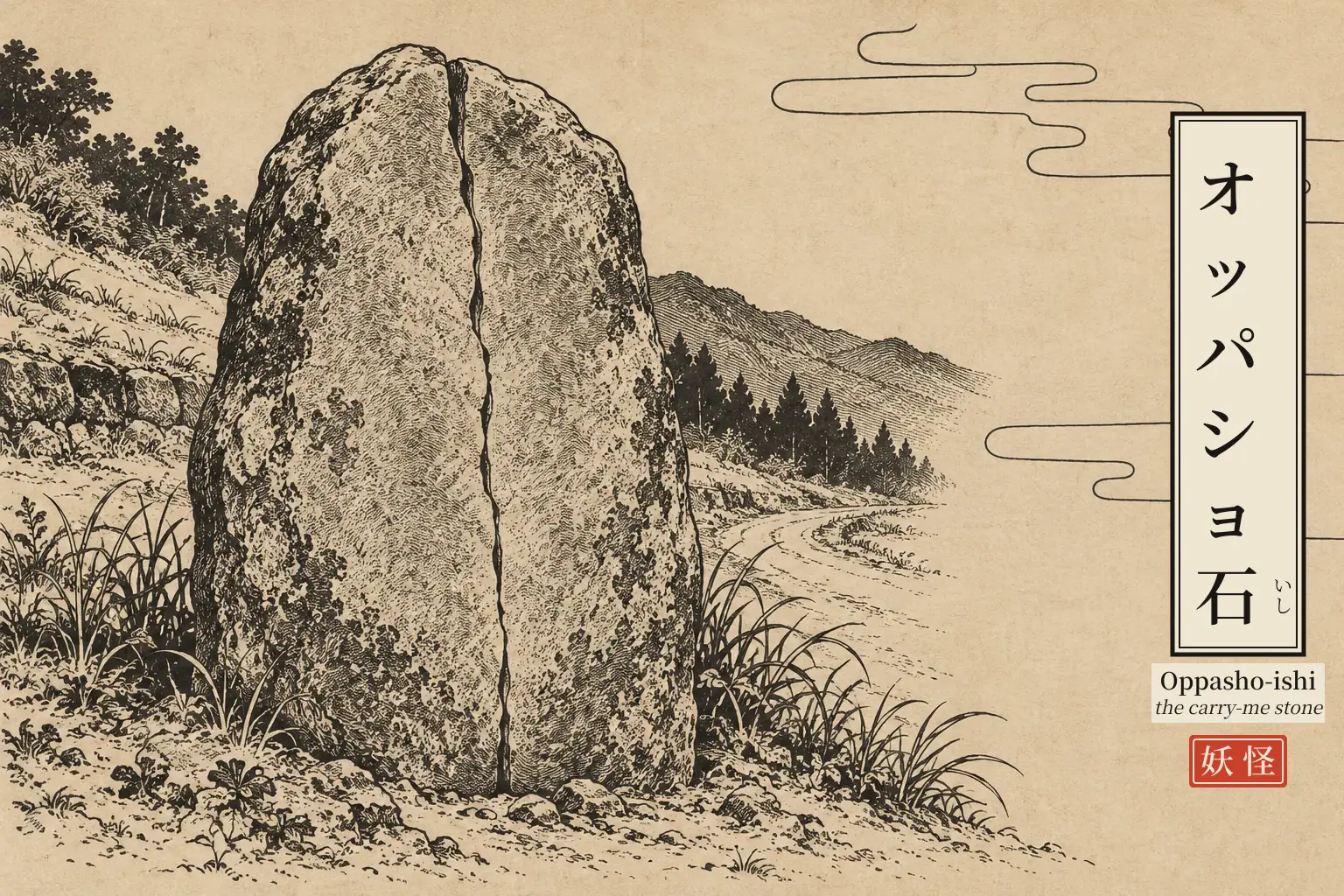
There is nothing to see at first glance. The Oppasho-ishi is just a stone, with no face and no limbs, set up as a well-known sumo wrestler's gravestone in Tokushima's old Nikenya district. It shows its story only in its shape today: split clean in two, the halves now rejoined, with the crack still running down the middle. It now stands at the former Shōkōan temple cemetery, on the border of Nishi-Nikenya-chō and Jōnan-chō, a short walk from JR Nikenya Station.
A grave that learned to speak
Two or three months after the gravestone was set, the stone began to call out. It said only "Oppasho" to anyone who passed. That word means "carry me on your back." People who obeyed found the stone light at first. It did not stay that way. With every step, it grew heavier, until the weight became unbearable.
Word of the talking stone spread through the neighborhood. Fewer people chose to walk that road at all.
The strongman who answered it
A man known for his strength heard the rumor and went looking for the stone on purpose. The story does not treat this as an accident. Sure enough, the stone called "Oppasho" to him as well, and he hoisted it onto his back.
It began to grow heavy, just as the rumors said. He decided something had gotten into the stone, though no one ever said what. Rather than carry it further, he threw the stone to the ground as hard as he could. It split cleanly in two.
After that, it never spoke again.
Where it comes from
No source names what was inside the stone, and the legend never answers the question. It simply stops, mid-silence, once the stone is broken.
It is tempting to read the test itself as the point. A gravestone made for a famous sumo wrestler starts demanding to be carried, and the only way through the story is to carry it — the same way a wrestler is carried, hoisted, thrown. The strongman who finally breaks it is answering strength with strength. That reading stays a guess; the sources describe the trick, not its meaning.
Japan keeps a whole family of named stones with their own reputations folded into their names: the yonaki-ishi, the "night-crying stone," the sessho-seki, the "killing stone," and the sakabashira, an "inverted pillar" set upside down by mistake and never at peace in a building afterward. The Oppasho-ishi belongs to that same habit of giving a stone a verb instead of a face.
Oppasho-ishi today
Most yokai survive only on paper, in old picture scrolls or someone's retelling. The Oppasho-ishi is still physically where the story says it ended up, broken and mended, in a cemetery a few minutes from a train station in Tokushima. The seam from that final throw is still there to look at, for anyone who makes the walk.