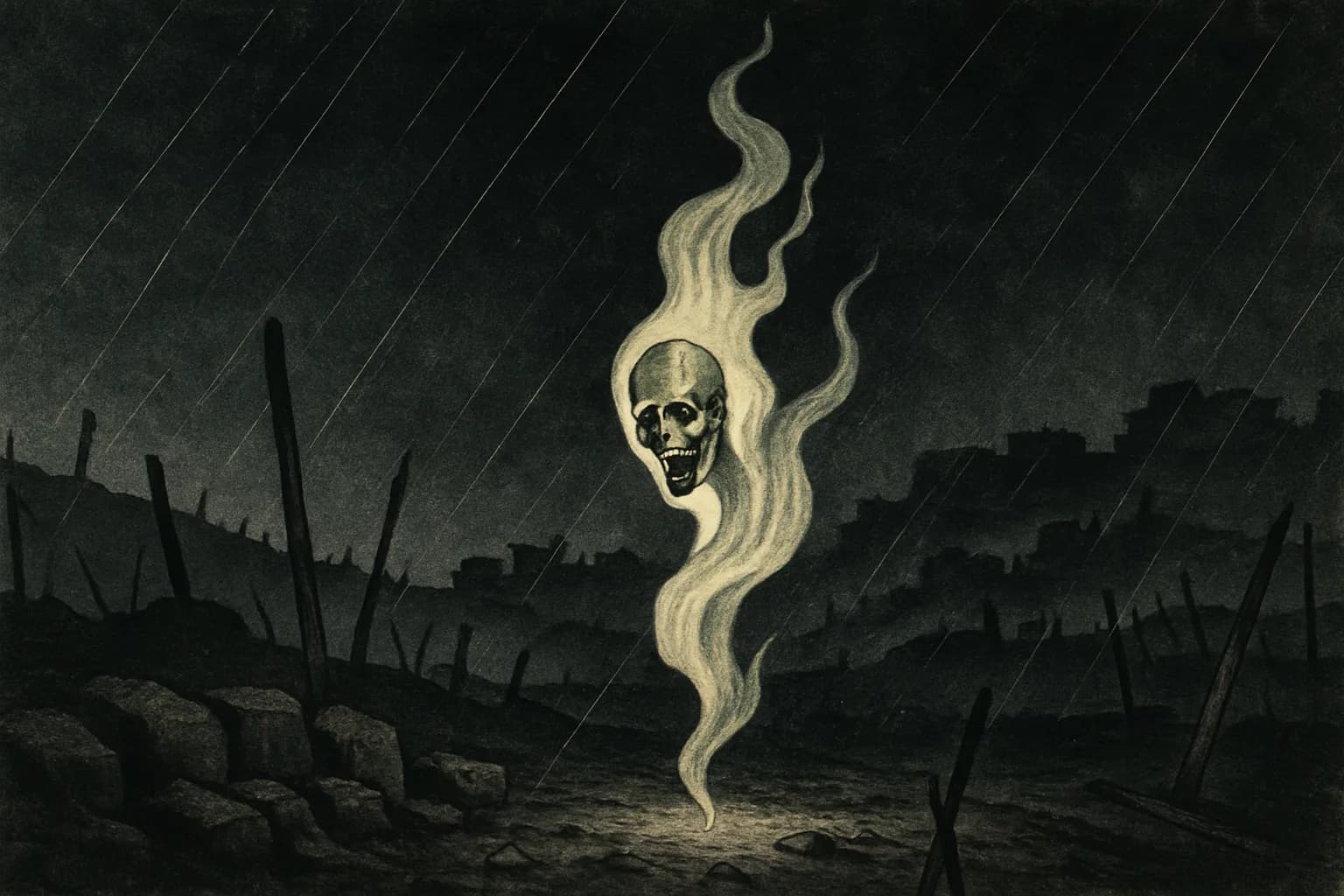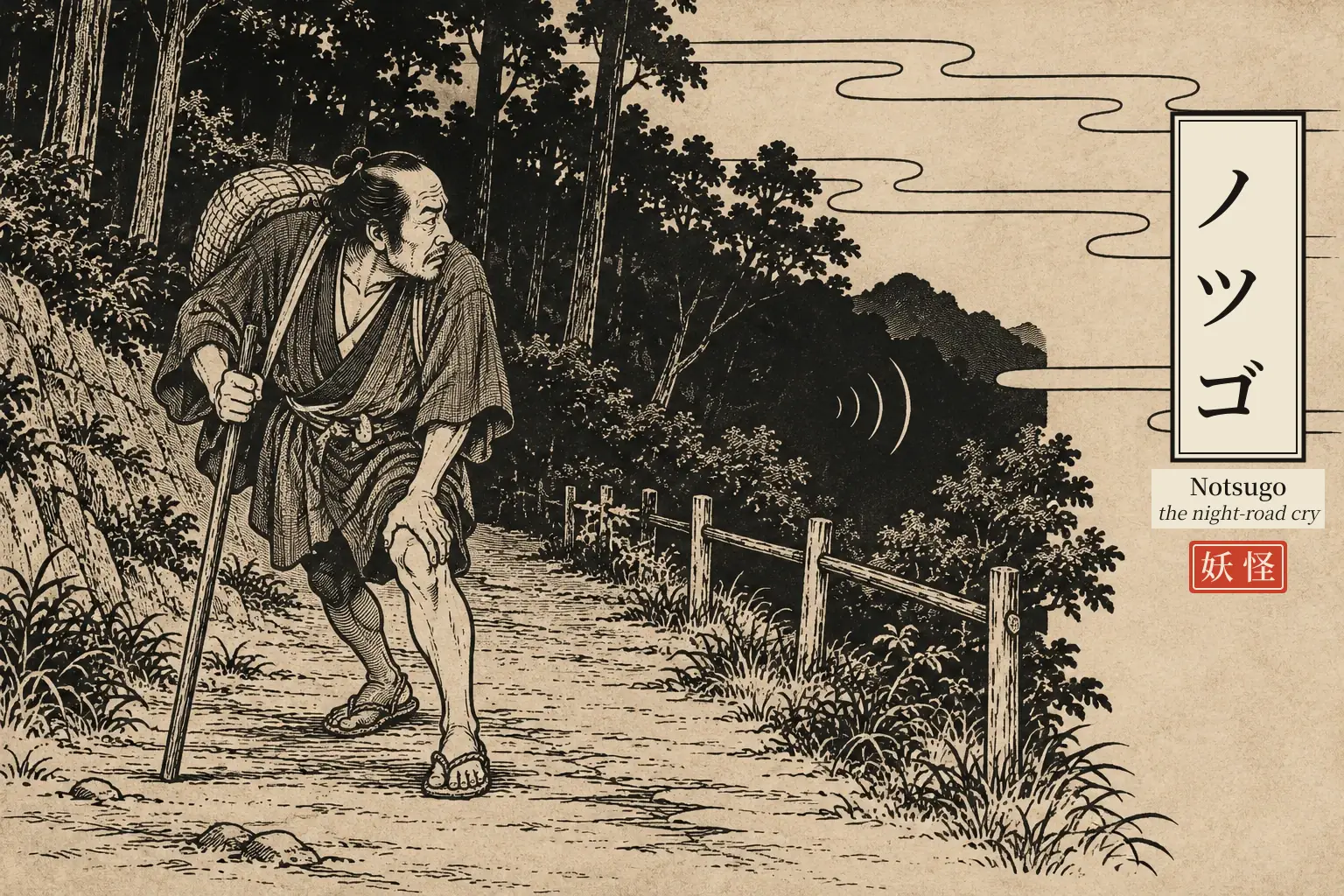
Walk a back road in southern Ehime after dark and your legs may turn to lead. Somewhere nearby, something cries like a newborn baby. Villagers call it Notsugo. One valley over, they may call it Nozuko instead. Nobody has ever settled on a kanji for the name. Every record of it is written in plain katakana, ノツゴ — a sound passed down, not a word anyone claims to have coined.
What does it look like?
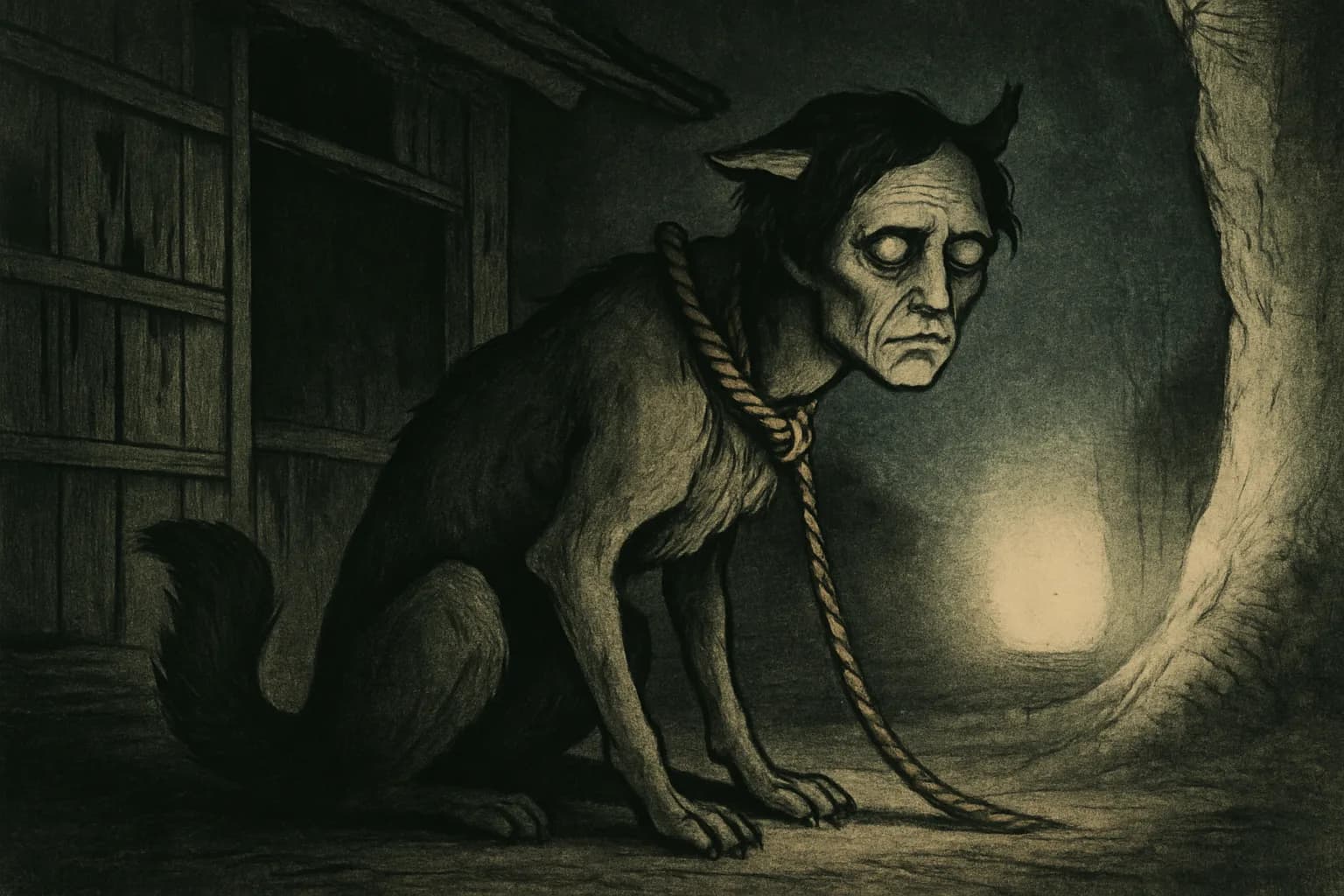
Almost no one describes a body. In Jōhen, now part of the town of Ainan, villagers called it a kind of bird. Elsewhere in the same stretch of Ehime, meeting any ghost or unidentified presence is called "meeting a Bōko." Local ghost stories there are even named "Bōko-banashi." Notsugo is counted as one kind of Bōko among several. Past that, there is no agreed size, face, or clothing. It is something you hear or feel on a dark road, not something you could sketch from memory.
Heavy legs on the road home
The most common story has nothing to do with sight. In the Abura-bukuro area of old Uchiumi village, Notsugo is an evil presence that calls out, "Give me zori!" It then chases down whoever it caught. The victim's legs suddenly turn too heavy to lift. In the same village's Kashiwa area, legs that tangle for no reason on a night road are simply called "being possessed by Notsugo."
In Uchiumi, the cure is specific. Cut the chi — the small cord-loop — off a straw waraji sandal. Or cut the hanao, the thong, off a zori sandal instead. Throw the cut piece to the ground, and the legs come free again. Other villages keep a version of this same cure, but the details shift: which cord, and whether it is thrown away or simply handed over.
A cry in the dark
In other villages, Notsugo has a voice instead of a grip. In Jōhen it screams "gya" on the road at night, and throwing down a waraji's chi makes it stop. In the Koyama area of old Ippommatsu village, it stays hidden and cries "wah, wah" or "ogyaa, ogyaa" — the sound of a baby's first cry. Travelers in old Hiromi village say it bites at a waraji's chi while screaming, until someone gives the cord up. Across the water in Kōchi, in the Kusuyama area of old Hashigami village, the same crying voice follows night travelers up mountain roads, and the same zori sandal drives it off.
In Sone, part of old Mima village, the stakes are higher: Notsugo is blamed for snatching children who are playing hide-and-seek.
Parents used the name as a threat for exactly this reason. In Uchiumi, a child who tried to sneak outside after dark was warned that Notsugo would possess them. In Sone, children still playing outside at dusk were told to hurry home, or Notsugo would hide them away.
Where it comes from
The clearest explanation ties Notsugo to child death. In these districts, infanticide and abortion were historically common. Unwed mothers sometimes smothered an unwanted child and buried it quietly, without rites. The spirit of a child who died that way, never sent properly to the next world, was said to wander the roads as Notsugo. In Hiromi specifically, Notsugo is named as a child who starved because its mother's milk never came. Villagers believed such a spirit could still reach Buddhahood, if someone poured 1,004 cups of water over it as an offering.
A second explanation calls Notsugo a yukiai-gami — a spirit met on the road — and names it as the vengeful ghost of a dead ox or horse instead of a child. Under this reading, the shrines called Nozuko-san and the mounds called Nozuko-zuka, found across Shikoku, were raised to quiet the curse of dead cattle. A third account goes further back. It treats Notsugo as a nogami, a god who once guarded fields and wild land. By this telling, Shikoku once kept a custom of worshipping Notsugo as a god every May 5th.
One funeral custom may tie the child theory together. In old Mishō village, when a young child died an unnatural death, mourners buried the chi cut from a relative's own worn zori together with the body. The belief was that this let the child let go of its family and travel on to the next world. Some trace the sandal-cutting cure for Notsugo back to this same rite — the same gesture, repeated on the road, for a spirit that never got to make the crossing.
Where ubume is a mother who died in childbirth, often still holding a bundle she insists is her child, Notsugo is said to be the child itself, with no mother left to speak for it.
Notsugo today
Notsugo has no well-known anime or game appearance. It survives mainly in the folklore collections of Ehime and Kōchi, and in the Shikoku shrines still marked Nozuko-san. That narrowness is its own kind of record. This is a yokai nobody had to redesign for a screen, because almost nobody outside its own valleys ever asked what it looked like.