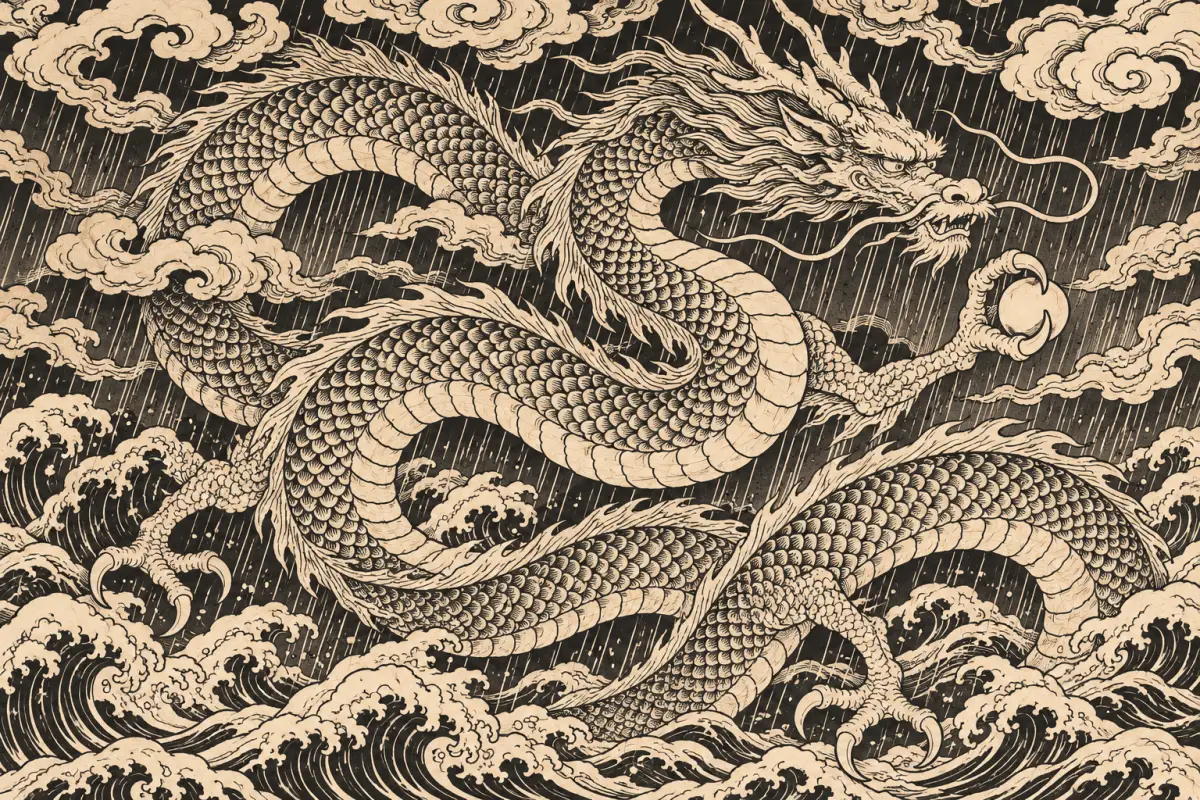
A Japanese dragon tattoo shows a water god. It does not breathe fire. It sleeps in the sea or in a pond, rises into the clouds, and brings rain.
That is the opposite of the dragon in many European stories, which burns villages and guards gold. The Japanese dragon is the one you pray to when the rice fields are dry. And in old Edo, today's Tokyo, the men who wore dragons on their backs were often men who fought fires.
What do people put into a dragon tattoo?
A Japanese dragon does not destroy. So the wishes people put into it are about rising, protection and good things to come.
| If you want it to say | Draw | The story behind it |
|---|---|---|
| "I will rise." | A carp climbing toward a dragon | A carp that climbs the Dragon Gate becomes a dragon. In Japan, it stands for rising in the world. |
| "Keep me safe in danger." | A dragon in rain clouds | In old Edo, dragon tattoos were worn as a kind of charm. A dragon brings the rain that puts fire out. |
| "Good things will grow." | A dragon over waves, bringing rain | The dragon is the god you pray to when the rice fields are dry. |
| "Some treasures take courage." | A dragon with a jewel under its chin | An old Chinese book puts a priceless pearl under a sleeping dragon's chin. You must risk your life to take it. |
| "Gentle, until you cross me." | A calm dragon, with its throat showing | One scale under its throat grows the wrong way. Touch it, and the gentle dragon kills you. |
Each wish raises a question. Why would a fish become a dragon? Why would a dragon protect a firefighter? The answers follow, one wish at a time.
Why does a carp turn into a dragon?
Because it did what no other fish could do. The dragon was its prize.
On the Yellow River in China there is a stretch of rapids called the Dragon Gate. Legend says thousands of fish try to swim up it each spring. A Chinese collection from 978 calls them yellow carp. No more than seventy-two make it in a year, and at the top, they become dragons. Our koi fish tattoo article tells the rest.
Why a dragon, of all things? The carp lives in the water, and the dragon is the god of the water. So the fish that passed the hardest test became the water's god.
That is where the Japanese word tōryūmon comes from. The kanji say it: 登 "climb" + 竜 "dragon" + 門 "gate." It means a hard test that opens the road to success. The phrase is in the Book of the Later Han, a Chinese history from about 1,500 years ago.
In Japan, the picture became koi no takinobori, "the carp climbing the waterfall." It stood for rising in the world. The carp streamers flown for boys each spring, koinobori, come from this. Samurai families began flying banners in the Edo period (1603–1868). Later, merchants made them carp-shaped.
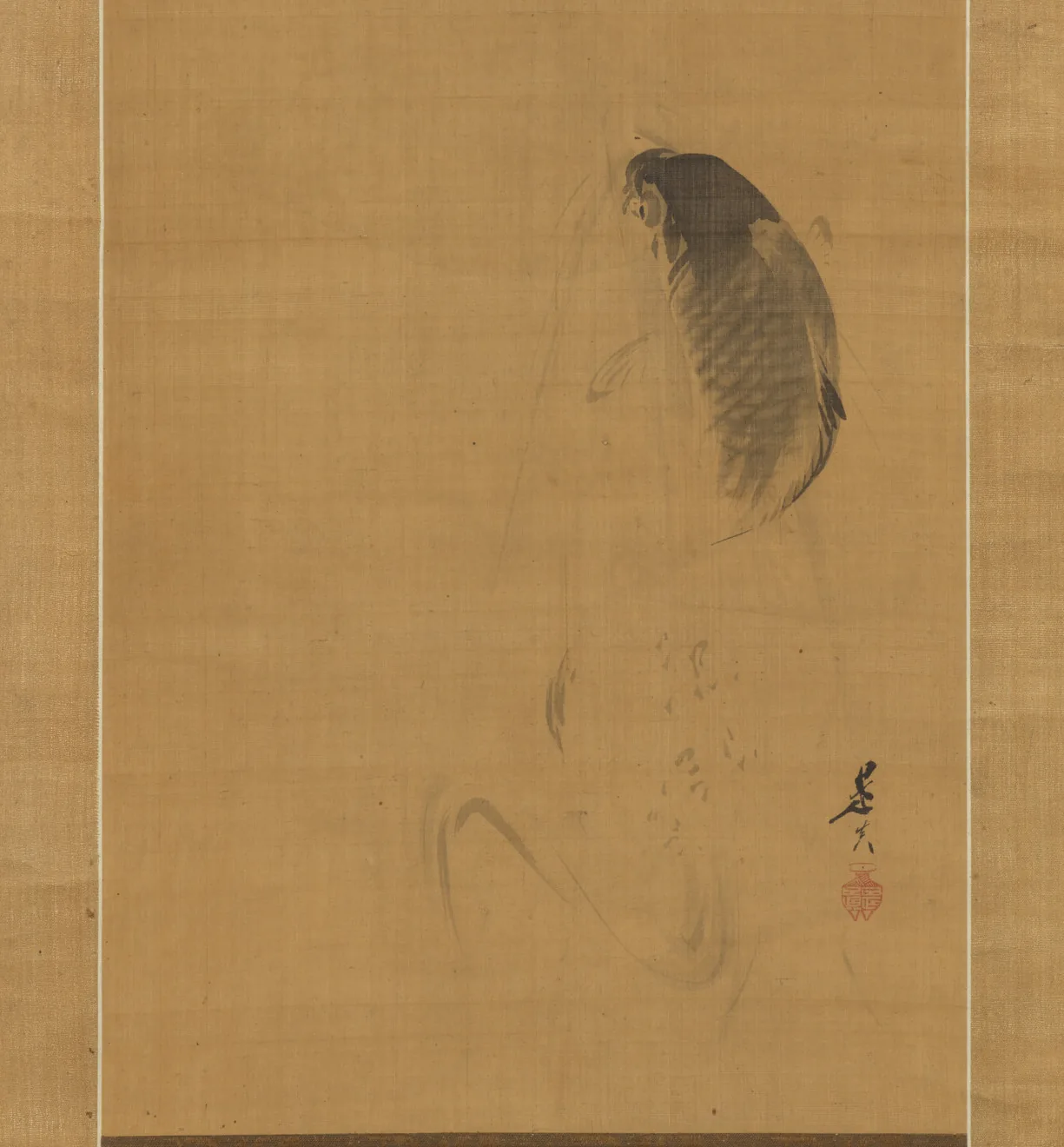
Carp Ascending Waterfall, attributed to Shibata Zeshin, 19th century. The Metropolitan Museum of Art, public domain (CC0).
So a carp and a dragon on one body are not two animals. They are the start and the end of the same climb.
Why would a dragon protect a firefighter?
Because a dragon brings rain, and rain puts fire out.
Start with the city. Edo was a city of wood. In a city of wood, a fire spreads from house to house.
Next, the men. The tobi were the brave workers of Edo who climbed high on buildings. They also fought fires. They pulled houses down to stop a fire from spreading.
Why did they get tattoos at all? To move freely, they tied back or took off their outer clothes, sometimes down to a loincloth. Tattoos covered and decorated that bare skin, writes the cultural anthropologist Yamamoto Yoshimi. Tobi were seen as the model of iki, Edo's word for cool, sharp style. A well-tattooed tobi was the pride of the neighborhood.
Now the dragon. Yamamoto writes that dragon tattoos were liked as a kind of charm. The reason, she says, was possibly that dragons were believed to bring rain. She does not say the firemen chose dragons for that reason. But put the two facts side by side.
A man who ran into burning streets wore the god who brings the rain.
Why is a dragon a god of rain and harvest?
Because it lives in water and flies in the sky. That is the same road rain takes.
A standard Japanese dictionary sums the dragon up in one line. It mostly lives in water. It is said to rise to the sky, stir up clouds and make rain.
Think about where rain comes from. Water goes up into the sky as clouds. Then it comes back down as rain. An animal that lives in the water and flies in the sky is the one that carries it.
Now think about what Japan grew. Japan grew rice, and rice needs water. No rain meant no rice, and no rice meant hunger. So in a dry year, people prayed to the dragon. A Japanese encyclopedia says rain festivals used water from ponds where a dragon was said to live.
The most famous story is set in Kyoto, Japan's old capital. In 824, the monk Kūkai held a rain-prayer contest at a palace garden pond called Shinsen-en. Kūkai was one of the most famous Buddhist monks in Japanese history. The story says he called down a dragon king, Zennyo Ryūō, from a holy lake in India. Rain fell, and he won. The dragon is said to live in that pond still.
The same idea is on temple ceilings. Many Zen temples paint a dragon in a circle on the ceiling of their lecture hall. Zen is a school of Buddhism known for meditation. The monks teach under the dragon. One explanation is that it rains the Buddha's teaching down on the people below, like rain on a field.
So a dragon over waves, bringing rain, is not a picture of a storm. It is a picture of the rice harvest to come.
Why does a dragon hold a jewel?
Because in the oldest story, the jewel is guarded. You only get it if you dare to reach under a dragon's chin.
The story comes from an old Chinese book of ideas, the Zhuangzi. It says a pearl worth a thousand pieces of gold lies deep in a pool. It sits under the chin of a black dragon. Japanese still has the phrase 驪竜頷下の珠 (riryū ganka no tama), "the pearl under the black dragon's chin." It means a treasure you can only win at great risk.
The jewel picked up more meanings in Japan. In Buddhism, the nyoi hōju is a jewel that grants any wish. Japanese Wikipedia repeats the old saying: the dragon keeps a jewel below its jaw.
Japan's own sea god owned jewels too. Japan's two oldest books of myth, the Kojiki (712) and the Nihon Shoki (720), tell of him. He lives in a palace at the bottom of the sea. He owns two jewels. One makes the tide rise, and the other makes it fall.
Those old books never say he looks like a dragon. The first clear record of calling him Ryūō, "dragon king," is a picture scroll from the 1100s. Once the sea god became the dragon king, his tide jewels became a dragon's jewels as well.
So the jewel means power, wishes and treasure. But the oldest layer is the clearest. The jewel was never a free gift. You have to reach for it.
Why is the dragon gentle until you cross it?
Because of one scale. Under the dragon's throat, one scale grows the wrong way.
It is called gekirin, the "reverse scale." The kanji are 逆 "reverse" + 鱗 "scale." Han Feizi, a Chinese thinker, wrote about it over 2,000 years ago. A dragon is gentle enough to ride, he said. But touch that one scale, and it will kill you.
He was not really talking about dragons. He wrote advice on how to speak to kings. He meant that a king can be friendly. But say the one wrong thing, and you die.
The phrase is still alive. In Japanese today, "to touch the reverse scale" means to make your boss very angry.
So a calm dragon with its throat showing is not weak. It is easy to live with, and it has one line you do not cross.
The meaning at a glance
| What you see | What it means |
|---|---|
| A long body like a snake | A god of water. In Japan, dragons and snakes overlap. |
| Clouds around it | It has risen from the water into the sky. It is about to make rain. |
| Waves below it | Its home in the sea, where the dragon king rules a palace. |
| A round jewel | A treasure. In Buddhism, a jewel like this grants wishes. |
| Three claws on each foot | A common Japanese way to draw it (but see below). |
| A carp nearby | The fish that climbs a waterfall and turns into a dragon. |
Why are there so many dragon tattoos in Japan?
Partly because of one famous set of prints. Between 1827 and 1830, the print artist Utagawa Kuniyoshi drew heroes from Water Margin, a Chinese novel about 108 outlaws. The prints were a huge hit. Yamamoto credits prints like these, and kabuki plays, for the bigger tattoos of the 1800s.
One of those heroes is Shi Jin. His nickname is Kyūmonryū, "Nine Dragons." He got it from the nine dragons tattooed on his upper body.
The other part is the tobi, the firefighting workers above. Their tattoos were the pride of the neighborhood.
How it looks on skin
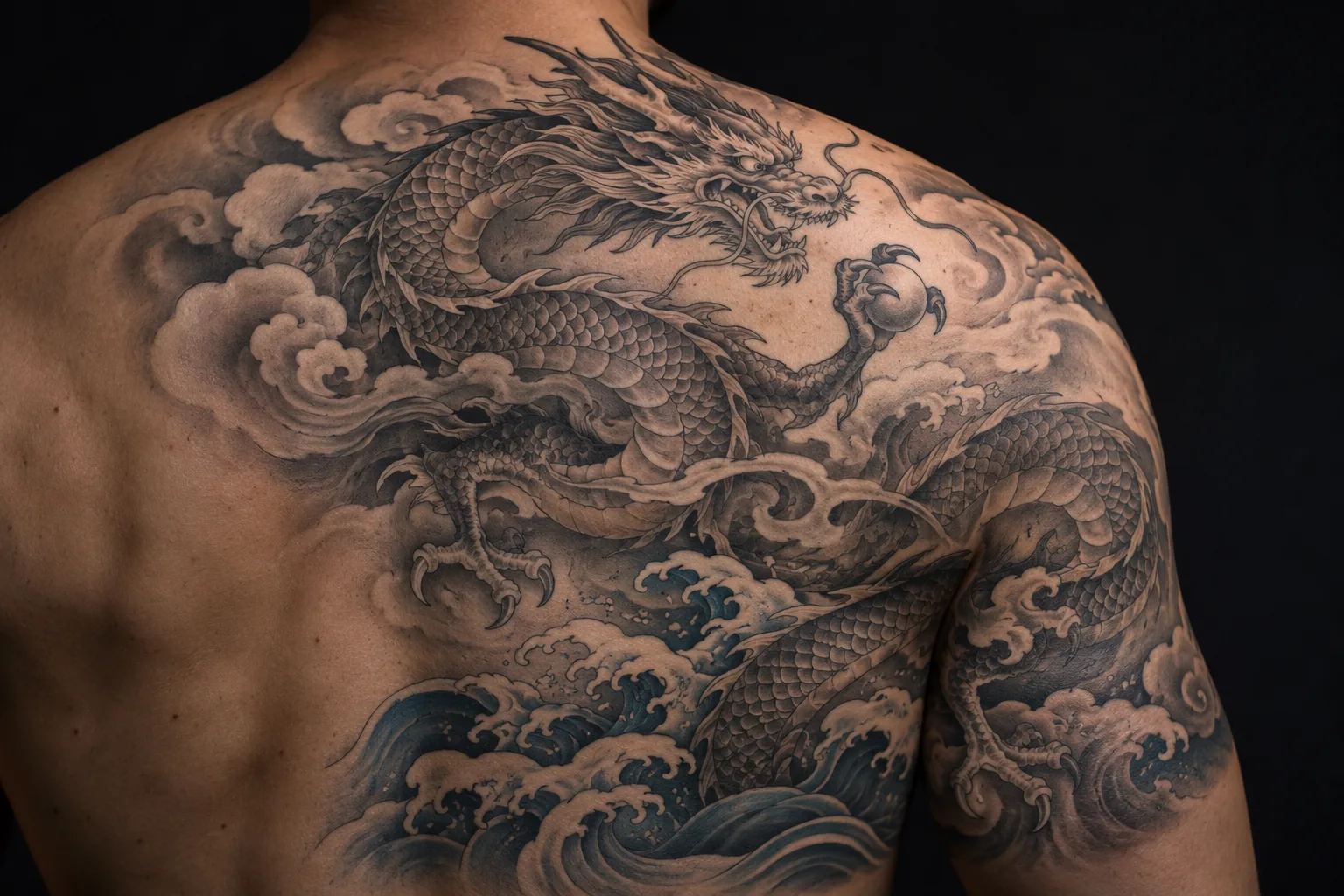
A dragon rising from the waves into the clouds, holding a jewel. This image was made with AI to show how the tattoo can look. It is not a photo of a real person.
What does 龍 mean? The dragon in two kanji
The word is ryū, and the dragon can also be read tatsu. Japan writes it two ways.
| Kanji | What it is |
|---|---|
| 龍 | The full, older-looking form. Still common, and used in names. |
| 竜 | The short form used in daily writing. |
Here is the surprise. 竜 looks like a modern shortcut, and in Japan it is used as one. But a Japanese character dictionary lists it as an ancient form of the same character too. The "simple" version is not new at all.
One more word to know is 龍神 (ryūjin): 龍 "dragon" + 神 "god." The dragon god of the sea.
Where the dragon king came from
The dragon king idea came from China and from Buddhism. It came from even further away, too. In India, Buddhists told of the nāga, snake gods, especially cobras. In China, the holy animal of the water was the dragon. So Chinese Buddhist texts wrote nāga with the character 龍, "dragon."
In Japan, the dragon king and the old sea god became one: Ryūjin. He is worshipped as a god of Shinto, Japan's own religion.
The full story of the sea palace is on our Ryūjin page. Strange lights that rise from the sea were called "dragon lanterns," lit by the same god. See Ryūtō.
Three claws or five?
Many tattoo pages say Chinese dragons have five claws and Japanese dragons have three. Part of that is true, and part is a story.
What is true. In China, the five-clawed dragon belonged to the emperor. A museum in Los Angeles explains it this way: five claws for the emperor, four for nobles, three for ordinary people. It worked like the stripes on a uniform. More claws, higher rank.
What is a story. In 1886, the writer Charles Gould, in his book Mythical Monsters, wrote that Japanese dragons always had three claws. A Japanese folk belief explains why. The dragon was born in Japan and gained claws as it traveled. It had four in Korea and five in China.
What history says. The order really went the other way. Three-clawed dragons were the main kind on robes in China's Tang dynasty (618–907). The three-clawed dragon came to Japan from China. The five-claw rule came much later. In 1299, an emperor of China's Yuan dynasty issued an edict on which ranks could use which dragons. Five claws were for the emperor alone, and the Ming and Qing kept the rule. Three claws are not a lower rank. They are the older look.
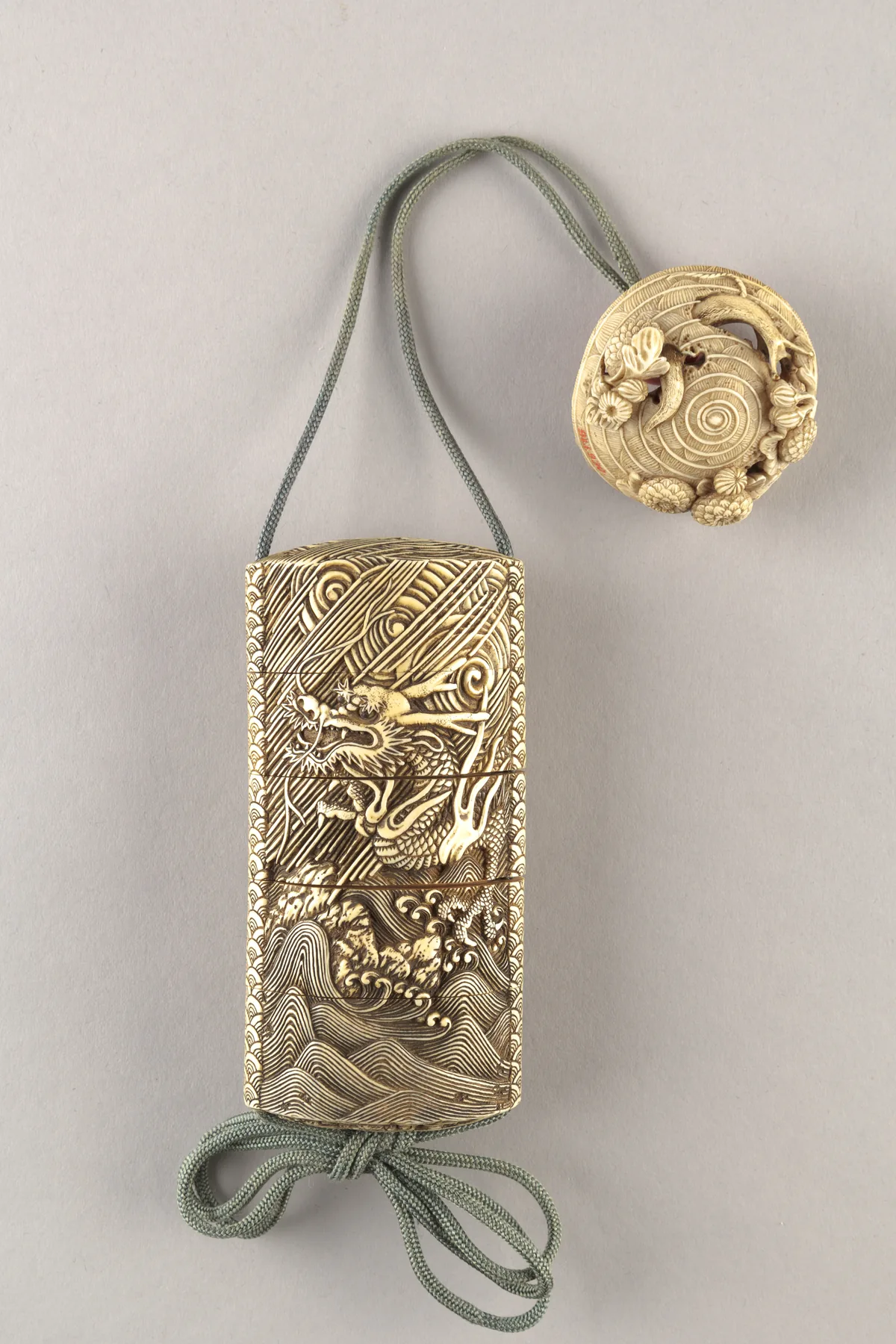
A three-clawed dragon in rain and clouds, on an inrō, a small case once hung from the belt. Japan, 19th century. The Metropolitan Museum of Art, public domain (CC0).
So on skin, the number of claws is not a rule. Three is a common Japanese choice. It does not mean the dragon is weaker.
How a dragon tattoo is seen in Japan
The dragon itself is not the problem. Japan paints it on temple ceilings. The tattoo is what matters. For a long time in Japan, a tattoo meant crime. From 1720, courts tattooed criminals as a punishment. So a tattoo looked like a criminal's mark. A ban on tattooing began in Tokyo in 1872, covered all of Japan from 1908, and ended in 1948.
Why ban it in 1872? Japan had just opened its doors, and foreign visitors arrived in large numbers. Their travel writings noticed men walking through town with full-body tattoos. The government feared tattoos would make Japan look "backward" to them, writes the cultural anthropologist Yamamoto Yoshimi. The ban was about how Japan looked to outsiders.
The link to the yakuza came later, mostly from films. In the 1970s, yakuza films, about Japan's organized crime groups, showed gangsters with large Japanese tattoos. In 2019, Temple University's Tokyo campus held a talk with Yamamoto. Its notice said this link "still lingers today." That image belongs to the tattoo, not to the dragon.
All of this is about how Japanese people see tattoos on other Japanese people. A foreign visitor is a different case. I, the editor of this site, live in Japan with tattoos myself. I think most Japanese people see a foreigner's tattoo as part of that person's culture. To reject the tattoo would be to reject the culture. So people treat it with respect. Some places still have rules, though, mostly where people bathe or swim. At some hot springs, bathhouses and pools, you may be asked to cover a tattoo. At others, you may not be let in.
Baths are where the rules still matter. People bathe together, naked, so there is nowhere to hide a tattoo.
| Kind of bath | Tattoos? |
|---|---|
| Neighborhood bathhouse (sento) | Usually fine. In 2017, the national sento association told a Japanese news site that its members do not turn people away for tattoos. |
| Hotel or inn bath | About half say no. In a 2015 government survey of 581 hotels and inns, 56% refused guests with tattoos, 31% let them in, and 13% let them in if covered. |
| Private bath (kashikiri) | Fine. You book the bath only for yourself. |
The law does not stop you. In 2017, Japan's government said the public bath law has no rule against people with tattoos. A year earlier, the national tourism agency asked baths not to refuse guests only for a tattoo. It suggested cover stickers, set bathing times and private baths.
So check the bath's rules before you go. More on tattoos and baths is on our hannya tattoo page.
Why tattoos carry this weight in Japan at all, from the punishment marks of 1720 to today's bath signs, is in our guide: Why Are Tattoos Taboo in Japan?
Frequently asked questions
Does a Japanese dragon tattoo mean good luck?
It is closer to protection and strength. In Edo, dragon tattoos were worn as a kind of charm. The dragon brings rain to dry fields, and it rises from the water to the sky.
Is a Japanese dragon different from a Chinese dragon?
They are the same kind of animal. Japan got the dragon from China, then mixed it with its own sea god. The biggest difference people point to is the number of claws, and that difference is smaller than tattoo pages say.
Is Yamata-no-Orochi a dragon?
Not in the old texts. The eight-headed monster of Japan's oldest myths is called orochi, "great serpent." English often calls it a dragon. In Japan, snakes and dragons have always overlapped. See Yamata-no-Orochi.
Is the Japanese dragon male or female?
There is no single answer. Look at the rain dragon of Shinsen-en, Zennyo Ryūō. Ryūō means "dragon king." But Zennyo is written 善女, "good woman." And in the oldest sea myth, the one who shows a dragon-like body is the sea god's daughter. And in the Dōjōji legend, a woman turns into a giant serpent. See Kiyohime.