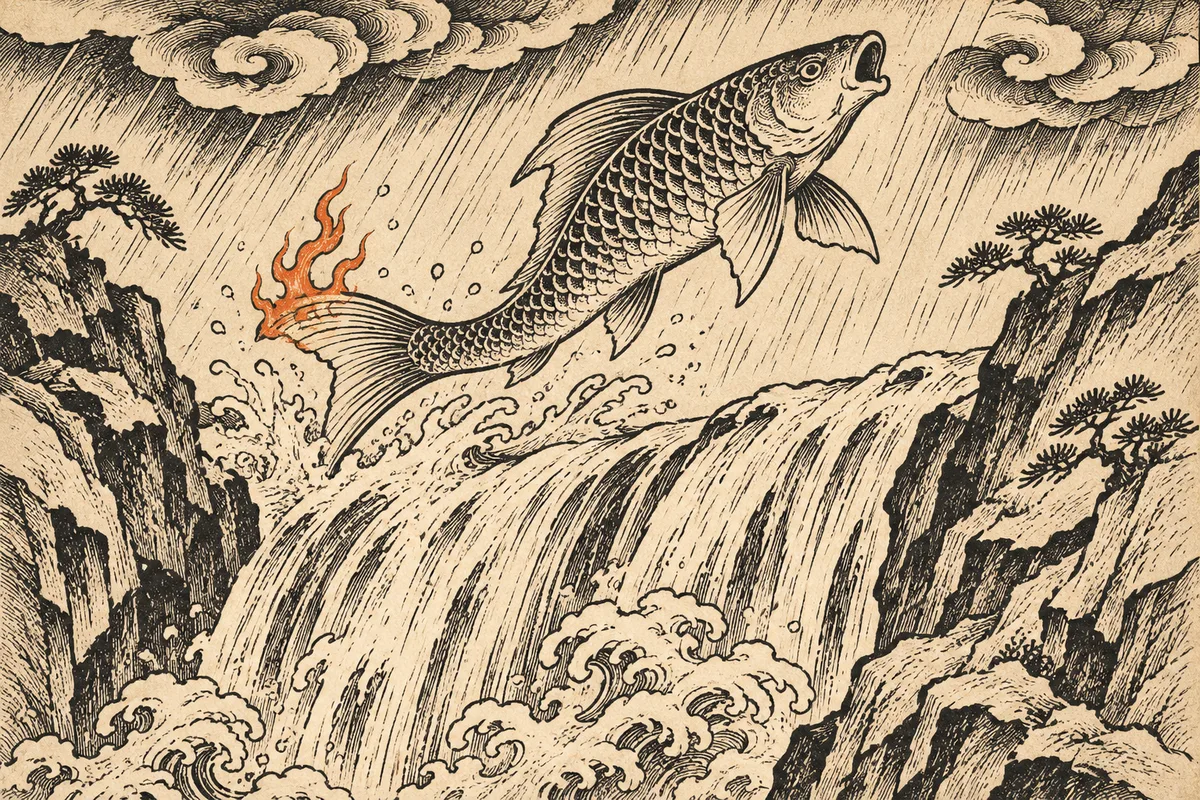
A koi is a carp. A koi tattoo shows one swimming hard upstream. In Japan it means one thing above all: climb until you become a dragon.
But the color charts online, gold for wealth and blue for peace, are not Japanese tradition. We found no old Japanese source that gives each color a fixed meaning. Only two stories give a carp's color a role. Both are below.
What people put into a koi tattoo
| If you want it to say | Draw | The story behind it |
|---|---|---|
| "I will keep climbing until I change." | A carp leaping up a waterfall | Fish that climb the Dragon Gate become dragons. |
| "I made it." | A carp beside a dragon, or turning into one | The dragon is the end of the same climb. |
| "Strength, from the very start." | Kintaro wrestling a giant carp | In Edo prints, the strong boy and the carp stood for a boy's rise in the world. |
Each wish raises a question. Why a dragon? What do the colors mean? The answers are below.
Why does a fish become a dragon?
Because it passed a test no other fish could. The story comes from China.
On the Yellow River there is a stretch of rapids called the Dragon Gate. An old Chinese book, the Sanqin ji, told what happens there. Each spring, fish swim up from the sea and the rivers to try the climb. In a year, no more than seventy-two make it. Clouds and rain follow the winners. Fire from heaven burns their tails, and they become dragons.
In one old Chinese version, the fish are yellow carp. Japan tells the story with a carp, too.
Japan made the picture its own: koi no takinobori, "the carp climbing the waterfall." Painters of the Edo period (1603–1868) loved it. It came to mean rising in the world: passing a hard test that opens the road to success.
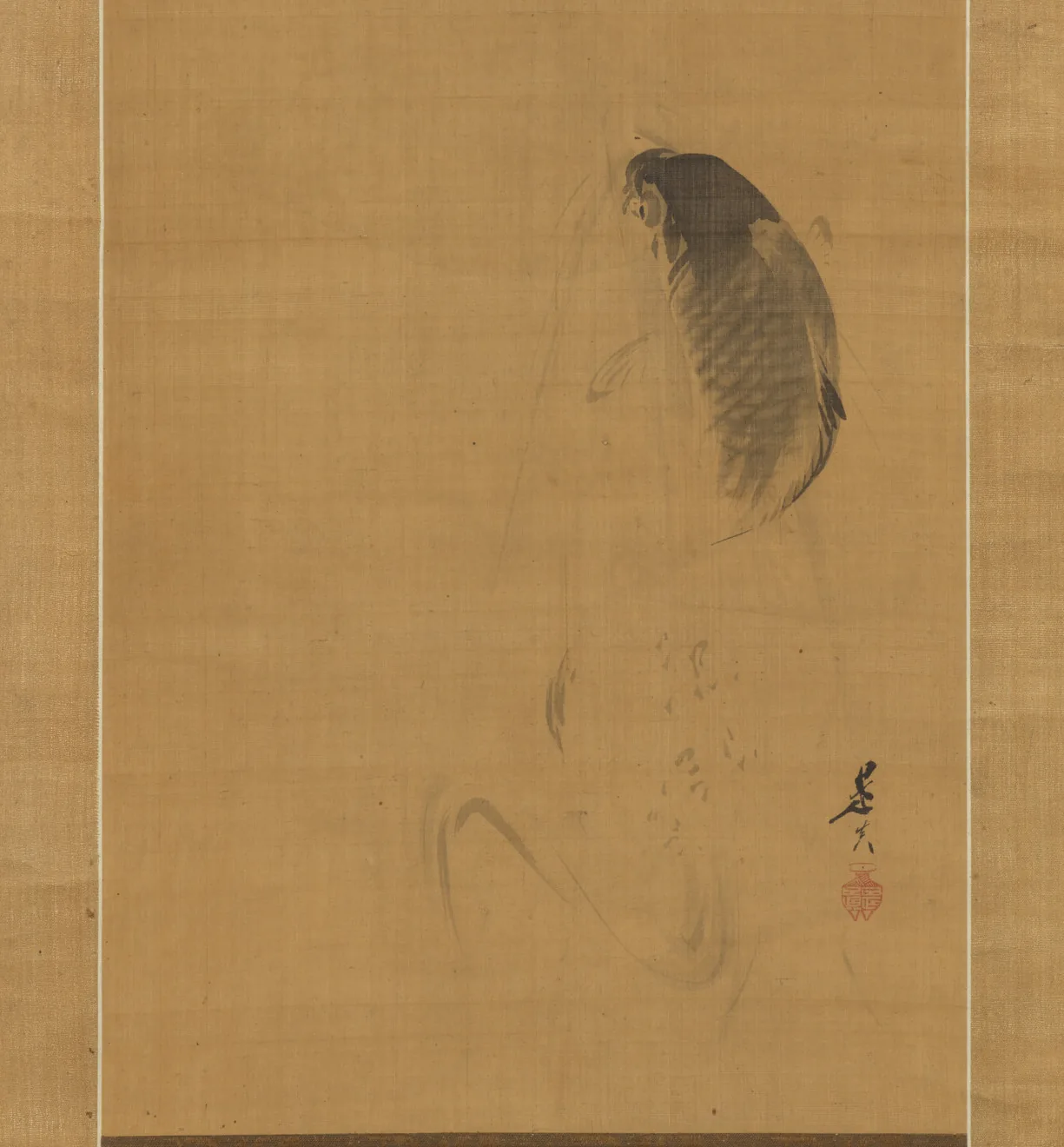
Carp Ascending Waterfall, attributed to Shibata Zeshin, 19th century. The Metropolitan Museum of Art, public domain (CC0).
So a koi and a dragon on one body are the start and the end of one climb. The full dragon story is in our Japanese dragon tattoo article.
Why Kintaro and a carp?
Because the carp was a test for a boy, too. Kintaro is a Japanese folk hero, a boy of great strength.
Edo print artists drew him wrestling a giant carp under a waterfall. The Edo-Tokyo Museum has a Kuniyoshi print with a small picture of Kintaro catching a carp. Its notes say the boy and the carp stood for a boy's rise in the world.
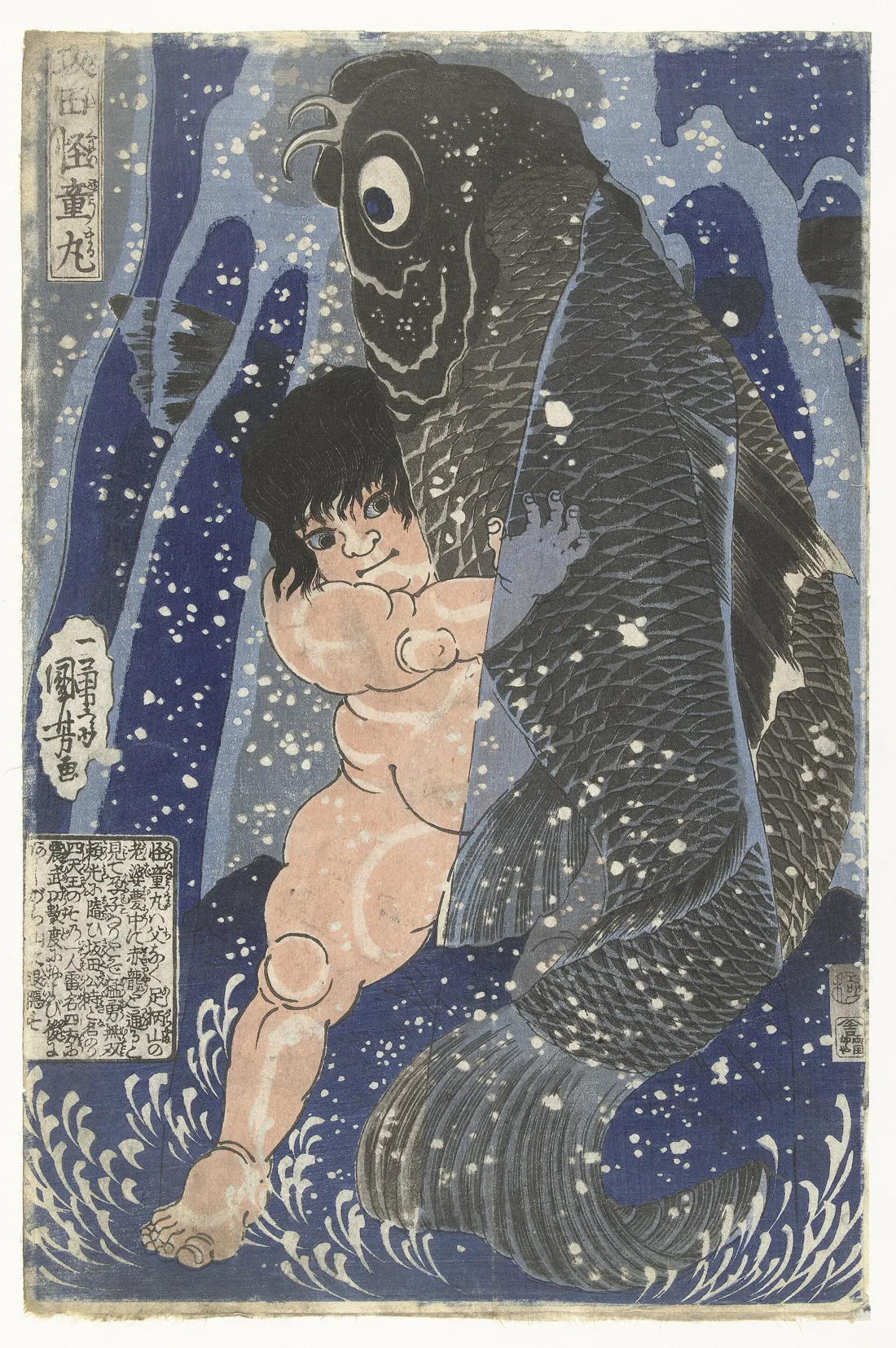
The boy Kintaro wrestling a giant carp, by Utagawa Kuniyoshi, about 1834–38. Rijksmuseum, Amsterdam, public domain (CC0).
Tattoo artists still draw it. A tattoo studio in Asakusa, Tokyo, says that in Japanese tattooing, Kintaro is usually shown grappling the carp. So Kintaro with a carp says: strong from the start, and ready to rise.
What do koi colors mean?
There is no old color chart. But two old stories use color.
Japan has known colored carp for a long time. A dictionary from 918 already lists red, blue, black, white and yellow carp. The patterned koi of today's ponds came later. Farmers in Niigata bred them from the early 1800s. Yet none of these old sources says what a color means. The color charts online came much later.
Only two stories give a carp's color a job.
1. The Dragon Gate: yellow. In the Chinese telling from 978, the fish that climb and become dragons are yellow carp. So a yellow or gold koi on a waterfall fits the Dragon Gate story. It means the climb, not wealth.
2. The carp streamers: black and red. Japanese families fly carp streamers, koinobori, for Children's Day. At first there was only one black carp. A red carp was added from around 1900 to the 1920s, and it stood for a boy. A famous 1931 song makes the black carp the father, with no mother at all. Only decades later did people start calling the red carp the mother.
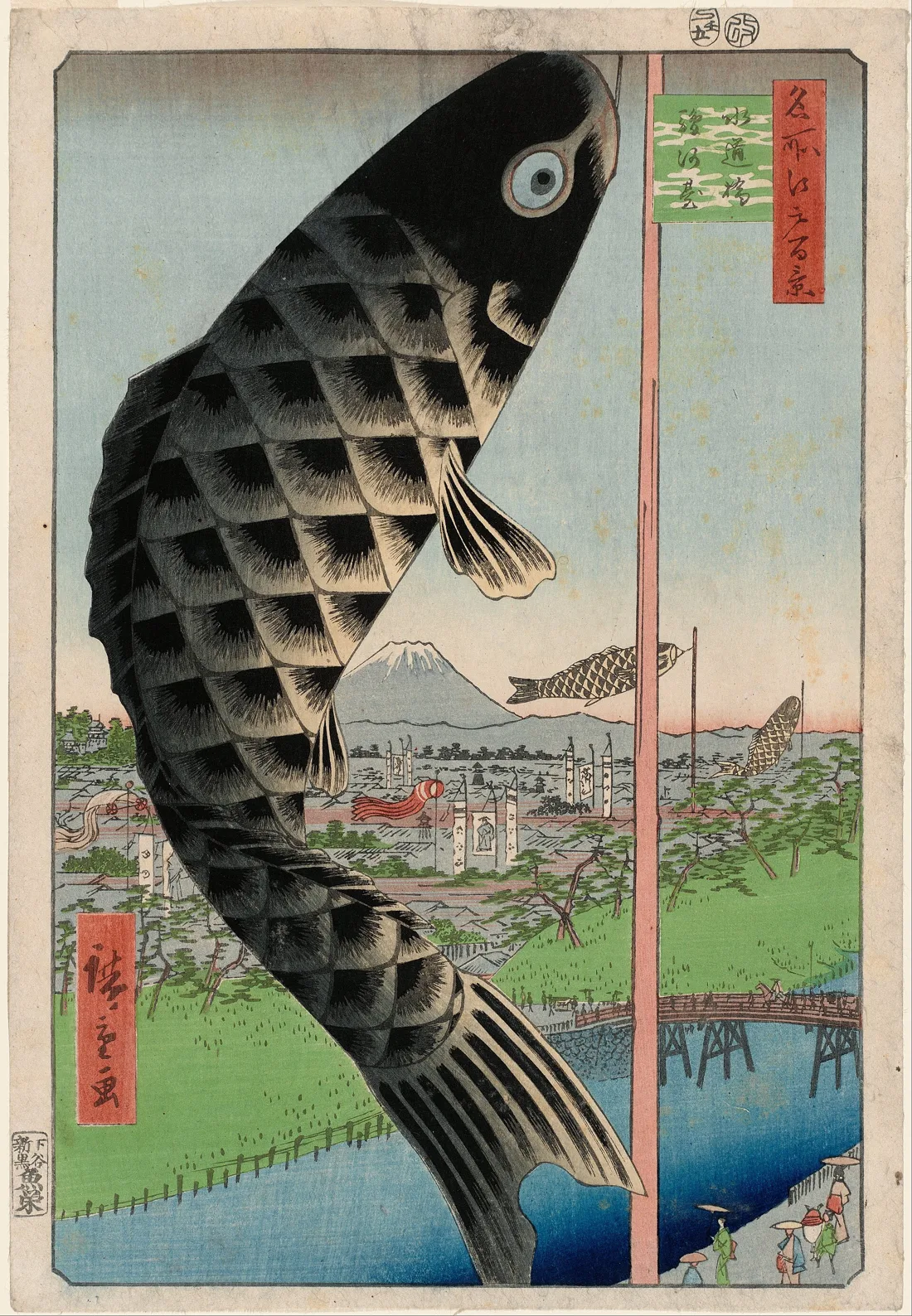
A giant black carp streamer over Edo, with Mount Fuji behind. Utagawa Hiroshige, 1857, from One Hundred Famous Views of Edo. Freer Gallery of Art, Smithsonian, public domain, via Wikimedia Commons.
So if you want a color with a story, here is what the two stories give you:
- Yellow or gold: the carp that climbs and becomes a dragon
- Black: the father, in the 1931 streamer song
- Red: first a boy, later the mother
Any other color is simply your choice. And with a waterfall, the climb says more than the color.
Two koi in a circle?
That picture comes from China, not Japan. The black-and-white circle of yin and yang, ☯, is a Chinese diagram. People in China call its two halves "yin-yang fish," because they look like two fish.
The Dragon Gate came from China too. But Japan made it its own, in paintings and streamers. We found no Japanese source that did the same with two koi in a circle. It is a fine choice. It just is not a Japanese tradition.
Swimming up or down?
Many tattoo pages say an upstream koi means struggle, and a downstream koi means success. We found no Japanese source for this. The Japanese waterfall pictures we found all show the carp climbing. If you want the old story, draw it swimming up.
How a koi tattoo is seen in Japan
Large tattoos of any design were long linked to crime in Japan, and many bathhouses still have rules. Our hannya mask tattoo article explains the history and the bath rules.
Frequently asked questions
Is a koi tattoo lucky?
Yes, in a sense. In Japan, carp streamers carry a wish: that a boy, and today any child, grows up healthy and rises in the world. The carp stands for that climb.
Is the koi Japanese or Chinese?
Both. The Dragon Gate story is Chinese. The waterfall pictures, the streamers, Kintaro and the patterned koi bred in Niigata are Japanese.