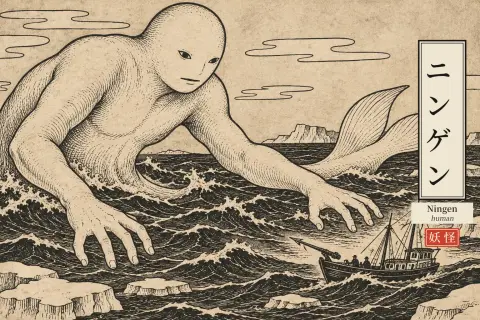
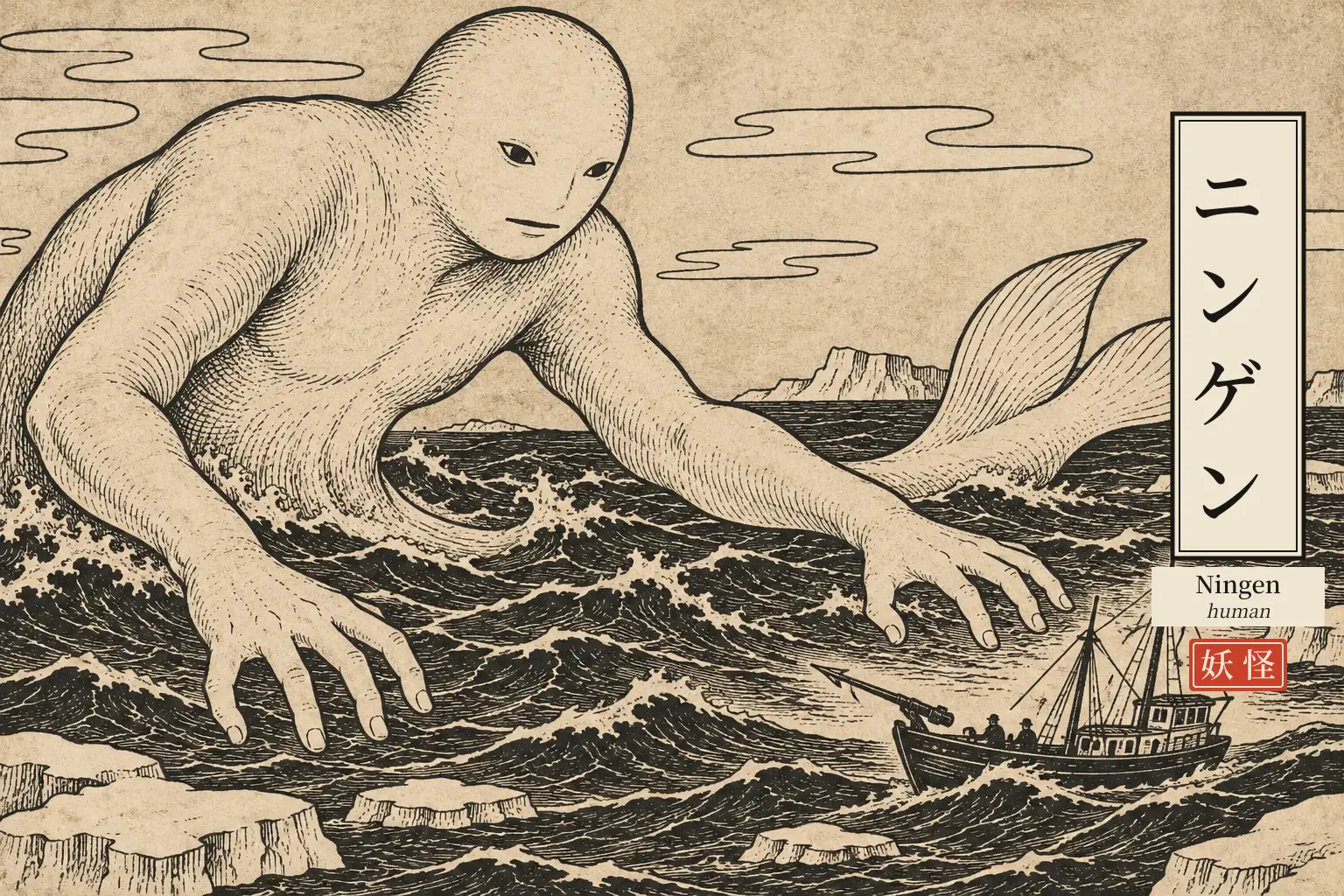
In May 2002, someone started a thread on a Japanese internet forum, about giant and unexplained fish. From it came a new creature: something huge, pure white, and shaped like a person. Years later, print coverage filled in the story. Crew members on a Japanese research whaling ship, magazine articles said, had spotted exactly this shape in the sea near Antarctica. The creature came to be called Ningen. It is written in katakana, ニンゲン. The ordinary word for "human" is 人間. It soon picked up magazine coverage and a cousin in the Arctic. Today it is still retold as one of Japan's modern legends.
Three different bodies, always pure white
Ningen has no single agreed-on shape. Accounts describe three different versions. One type has two arms and two legs, built roughly like a person's. A second has five-fingered hands, but its feet end in fins instead of toes. A third looks like several human upper bodies, joined together into one mass. What every version keeps is color and scale. Ningen is said to be pure white from end to end. It is also huge: several tens of meters long, far bigger than any whale a crew would expect to see. Its Arctic twin goes by a different name, Hitogata, meaning roughly "human-shaped." It is said to appear in Arctic waters, as Ningen's counterpart.
A sighting, a forum post, and a magazine feature
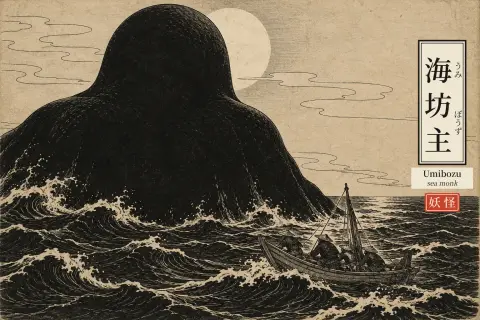
The core story stays simple across retellings. Crew members on a Japanese research whaling ship said they spotted something enormous in the water. It was far out in the Southern Ocean, and shaped like a person. They could not explain it. The legend began on 2channel, a huge Japanese anonymous forum. Japanese Wikipedia dates it to a post of 11 May 2002, in a thread about giant and unexplained fish ("巨大魚・怪魚"). The whaling-crew detail is tied to the later Mu article, not to that post. It took years to reach print. By 2007, at least two books on urban legends and unidentified creatures, or UMA (未確認生物), had picked up the story. Mu, a long-running magazine devoted to UFOs and the unexplained, covered Ningen twice. Its November 2007 issue claimed a satellite photo on Google Earth showed the creature. A longer feature followed in April 2008, written by Asuka Akio. It linked Ningen to the "Flying Humanoid" and to umibozu, a giant sea yokai of Japanese coastal lore. Both links were offered as speculation, not as proof.
The "evidence" photo that isn't even Antarctica
That Google Earth claim is worth a closer look. Japanese Wikipedia's article on Ningen (南極のニンゲン) links to the image's location: 27°36'14"S, 15°29'20"E. You can type those numbers into any map yourself. They point to the coast of Namibia, not anywhere near Antarctica. Namibia is in southern Africa, thousands of kilometers from the Southern Ocean sightings. Even Wikipedia's own footnote on that link says the object in it is unidentified. Treated carefully, this detail says more about how such claims get repeated than about Ningen itself. A single ambiguous photo, loosely tied to the right general direction, was enough for a magazine to run it as evidence.
Internet lore, not an old legend
Ningen breaks from most entries on this site in one obvious way. It has no Edo-period print, no centuries-old scroll, and no named folklorist behind it. It is netlore: a story shaped for the internet, written like a sighting report. It spreads from board to board until it reads like something older. Ningen fits the pattern of other online-born legends: copied, retold, and sometimes treated as true. One version of the story claims that sightings of Hitogata, its Arctic twin, get quietly suppressed. The reason given: protecting Japan's scientific whaling program. Japanese Wikipedia itself flags that specific claim as unsourced. So it stays a rumor here too, not a confirmed fact.
A separate, real piece of whaling history sometimes gets cited alongside that rumor. A history of Japanese coastal whaling records cases of operators hiding information about whales that looked like unrecorded species. In one case, only the leg portion of a sperm whale was kept as a specimen, because the whale itself was a protected juvenile. That history is documented. Whether it has anything to do with Ningen is not.
Ningen today
Ningen never got a hometown festival or a mascot costume. Its home has stayed the internet. Japanese Wikipedia itself files the story under categories like internet culture, 2channel, and Japanese urban legends, not folklore or yokai. No one has added it to either of those older categories, which fits a legend barely two decades old. The original 2channel post is nearly a quarter-century old now. It still gets retold online. No confirmed sighting exists. The question stays open: what, if anything, did those whaling crews see?