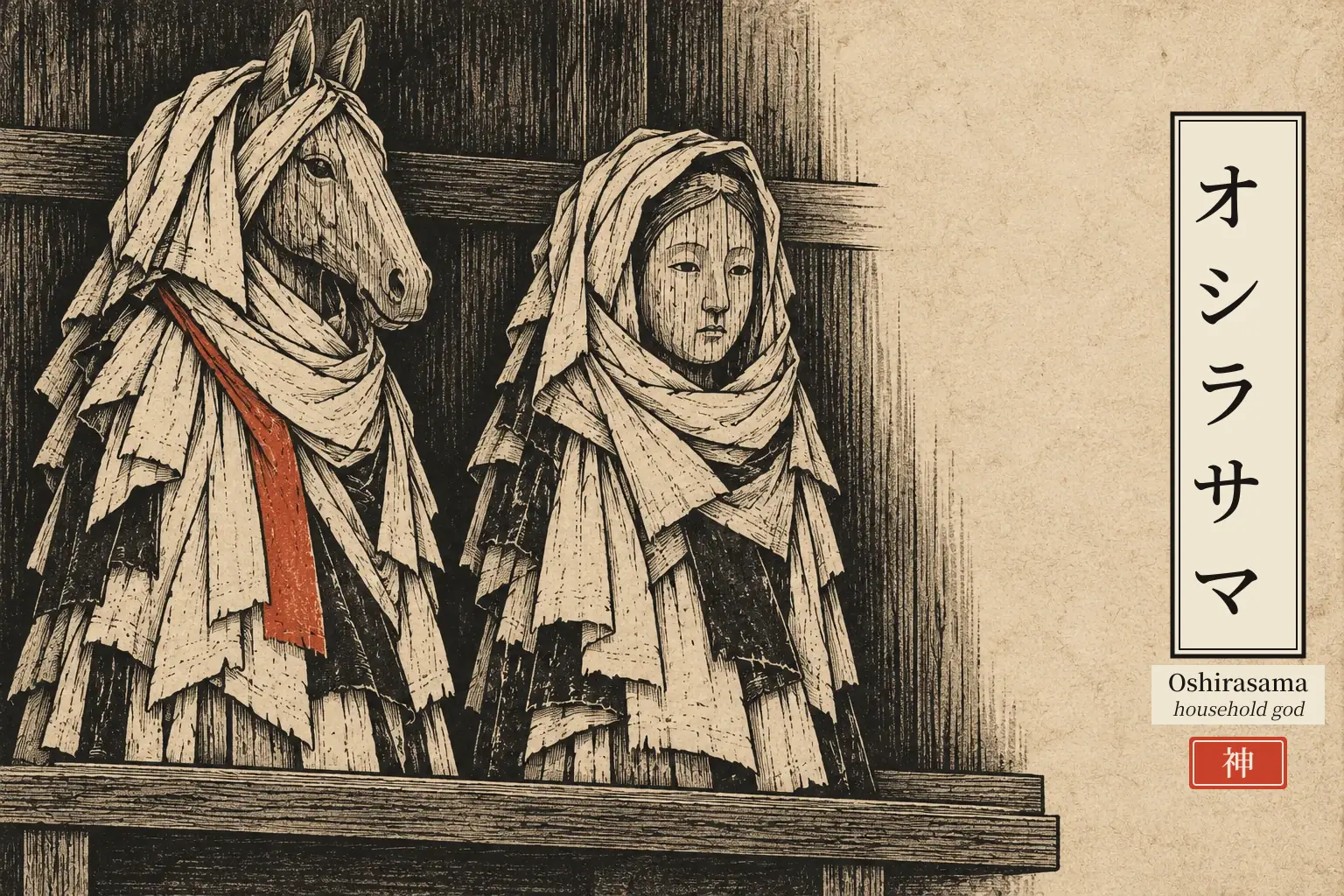
In farmhouses across Tohoku, a stick of mulberry wood sits on the household altar shelf. It has no arms or legs. Its tip wears a carved face. In many houses, three times a year, someone takes it down, feeds it, and wraps it in a fresh strip of cloth. This is Oshirasama (おしら様), a household god of Japan's northeast.
Oshirasama is not a yokai. It is also not zashiki-warashi. In Yanagita Kunio's Tōno Monogatari (1910), the zashiki-warashi leaves a house on its own, and the house falls. Oshirasama stays. A family keeps it, and in Tōno, neighbors gather at the old house to worship it. They feed it and dress it themselves, every year, without fail. Stopping is said to bring a curse.
What does Oshirasama look like?
The sacred body, called the shintai, is plain. It is a mulberry-wood stick, about one shaku long, roughly 30 centimeters. Its tip is carved or painted with a face. Some pairs show a man and a woman. Others show a horse and a person. The stick is wrapped in cloth, layer over layer, year after year. One style pulls a poncho-like wrap over the head through a hole. The other simply drapes cloth over the top.
Oshirasama usually comes as a pair. It sits on the household's kamidana shelf, or in the tokonoma alcove. The oldest dated Oshirasama comes from Taneichi, in Iwate's Kunohe District, now part of Hirono-cho. It carries the date 1525. Pairs dated 1574 come from Niisato and Kawai, two old villages now part of Miyako City.
The name changes with the region. Fukushima calls it Oshinme-sama or Oshinmei-sama. Parts of Yamagata call it Okonai-sama. In Tōno, though, Okunai-sama is a separate god kept beside it. Elsewhere it is known as Oshiragami, Oshirahotoke, or Kanoki-jinjo, meaning "mulberry-wood doll." The cult sits heaviest in Aomori and Iwate, with a dense pocket in northern Miyagi. A 1998 survey counted 1,191 households in Iwate alone still keeping the god.
The festival days
Oshirasama has festival days called meinichi. In many areas they fall on the 16th day of the first, third and ninth months of the old lunar calendar. In Tōno, Yanagita's 1910 book gives the 15th of the first month, when villagers gather to worship it. On these days, a family takes the god down. They offer it food. They dress it in a new layer of cloth, a rite called osendaku.
On these days, an old woman of the main family line might recite a ritual text, the oshira saimon. It told how silkworm farming began. Or a young girl might carry the god on her back to let it play. This suggests the cult was once kept by groups of women from related families.
Itako often took part. These were blind women who worked as mediums. An itako chanted a sutra to call the god down. Then she held the paired figures and danced, reciting the saimon. She would seem to fall into a trance and speak an oracle. Worshipping this way is called "asobaseru," or "letting it play." At Kudo-ji temple in Hirosaki, Aomori, the rite is called Oshira-ko. It still runs every May 15 and 16, when people from across the Tsugaru plain and northern Akita bring their household's own Oshirasama.
What it is feared and asked for
Oshirasama keeps a short list of rules. It dislikes meat from animals with two legs or four. It dislikes eggs too. Offer either, and the god is said to answer with illness, or with a curse that twists the face. Once a family starts worshipping it, the rites cannot stop. Letting them lapse is said to bring misfortune on the house.
In return, Oshirasama is asked for a great deal. Families pray to it for a woman's illness, and for trouble with the eyes. It is called a god who loves children. Several regions tell of adults who scolded a child for playing with it and were cursed in turn. Farmers ask its help at planting, weeding, and harvest. Hunters once held the figure in both hands and spun it, then walked in whatever direction the horse face landed. One record, Tōno Monogatari Shūi (1935), suggests the name itself may mean Oshirase-sama, "the one who tells." It is also credited with warning of earthquakes and fires.
Where it comes from
Yanagita Kunio's Tōno Monogatari (1910), tale 69, records how Oshirasama began. A farmer had a daughter. She loved her father's horse, and in time the two became husband and wife. Her father found out. He hung the horse from a mulberry tree and killed it. The daughter found it and clung to the dead horse's neck, weeping. Her father, angrier still, cut off its head. She stayed riding the head and rose into the sky. Oshirasama was made from that mulberry tree.
A later collection, Sasaki Kizen's Kikimimi Zōshi (1931), adds an ending. The daughter appeared in her parents' dream from heaven. She taught them to raise silkworms on mulberry leaves inside a mortar, and showed them how the worms spun silk thread. This, the story says, is how sericulture began. From these tales, some scholars read the horse and the daughter as two silk gods, one horse-headed and one woman-headed.
Where did the silkworms come from?
Read the two books side by side, and something odd shows up. Yanagita's 1910 version has no silkworms in it at all. A horse dies, a girl rides its head into the sky, and gods are carved from the tree. That is the whole tale. The silkworms arrive 21 years later, in Sasaki's 1931 book.
Yet one detail was there from the start: the tree. The horse was hung from a mulberry, and the gods were carved from it. Mulberry leaves are the only food a silkworm eats. The 1910 tale does not say so. But anyone in a silk-farming village would have known.
And China told the same story much earlier. The Soushen Ji, from the 4th century, has a girl, a horse and a killing. Her father shoots the horse and dries its skin in the yard. The skin rises, wraps the girl and carries her off. Days later, both are found in a big tree. They have turned into silkworms. The tree is then named 桑, "mulberry." The book explains why: the word sounds like 喪, "mourning." That is over 1,500 years before Yanagita.
So which came first in Tōno: the horse tale, or the silk? No source settles it. Perhaps the silk ending was always there, and Yanagita's teller left it out. Perhaps it came back later, from books. Either way, the mulberry was waiting in the story for it.
A different tale, in Uchida Kunihiko's collection of Tsugaru legends, gives the god another birth. A blind man once stayed the night in an empty house at a mountain pass. To ease his loneliness, he sang. A woman's voice asked for more songs, and he obliged. Near dawn, she named herself Tako. She warned him never to tell anyone about her, or he would die. Back in his village, he let the story slip, and died on the spot. Tako then warned the villagers themselves: tell anyone about her, and the whole village would sink into a swamp. They fenced the mountain pass with iron. Tako could not return to it, and died. Her true shape was a snake. The villagers enshrined Tako and the blind man together. This, the tale says, is also how Oshirasama came to be.
No single theory settles which account is older, or truer. One line of thought points to China. The Soushen Ji, from the 4th century, and a Tang-dynasty text both tell a "silkworm girl" story close to the horse-and-daughter tale. Another theory reads Oshirasama as a blend of mountain-god worship, silkworm farming, and a farmer's dependence on the horse, folded into one household god. A third theory traces it to the Tenpaku-shin of the Ise region, or to a Chinese myth figure known as the silk-horse. The god's own keepers rarely settle the question either. In many villages, telling an outsider the details of the rites is still treated as a quiet offense. That silence is part of why so much about Oshirasama stays unclear.
Oshirasama today
Most Oshirasama still live inside private houses, seen only by the family that keeps them. The best-known public display stands in Tono City, Iwate. At a facility called Densho-en, a hall named Oshira-do displays about a thousand Oshirasama figures. In Miyagi, the Tohoku Gakuin University museum holds a set once kept at Daijo-ji temple, worshipped by an itako known locally as an ogamisama.
The Oshira-ko rite at Kudo-ji, in Hirosaki, still runs every May. A 1991 Heibonsha video recorded it, along with a related rite in Miyako City.