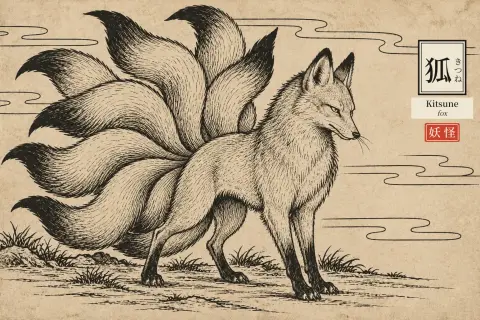
If you want to meet the foxes of Japan, go to Fushimi Inari, five minutes from Kyoto Station. Most visitors walk through the red gates, take a photo, and leave. They miss the foxes.
The foxes have their own places here. Up the mountain, you can draw a fox's face on a wish plaque, lift a stone that answers your wish, and clap at a pond that echoes back. This page takes you to each place in the order you walk. For each one, it tells you what to do there and the fox story behind it.
Why the fox is here
The shrine's own story starts with a rice cake. An old record of the Kyoto area, the Yamashiro Fudoki, tells it. A rich man named Hata no Irogu shot an arrow at a rice cake, used as a target. The cake turned into a white bird. It flew to the top of this mountain. Where it landed, rice grew. So the shrine was named Inari, from words for "rice grows."
The shrine dates its founding to 711, on the first Horse Day of the second month. That year comes from shrine tradition. The shrine points out that the old record itself gives no year.
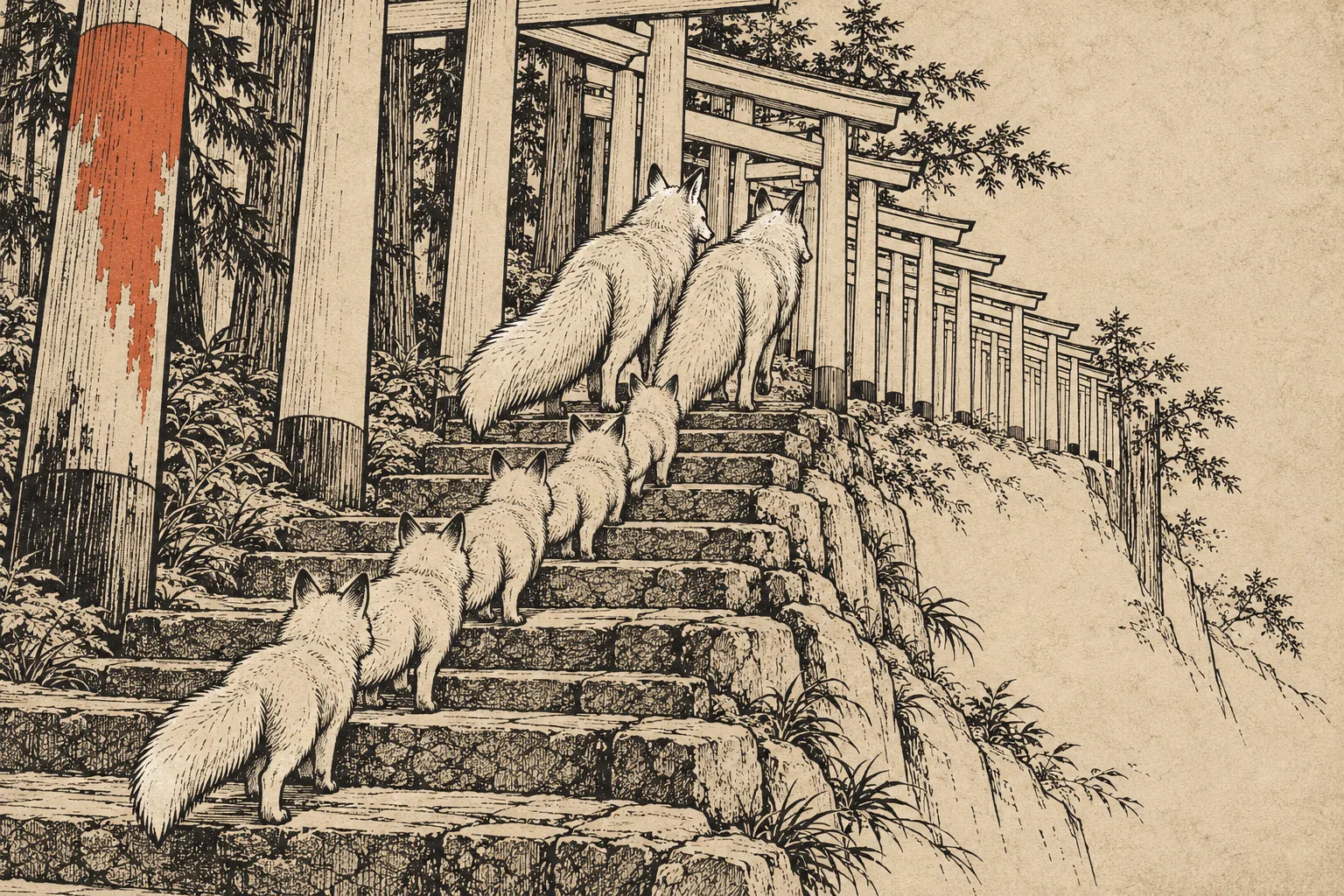
The founding story has no fox in it. The fox is the god's messenger, not the god. The shrine's English FAQ is very clear about this: "this does not mean that Inari Okami is a fox!" It says the fox messengers are white, and invisible to us. So they are not the foxes of the fields.
Why a fox at all? Nobody knows for sure. There are several ideas. The shrine names the two most common ones. One is wordplay. Inari is a food god, a miketsu-kami. Over time, miketsu turned into miketsune, "three foxes." The other comes from Buddhism. The goddess Dakiniten rides a fox, and she was linked with Inari. If you want the bigger picture, read why the fox is everywhere in Japan.
At the bottom: the gate and the foxes
1. The Rōmon gate
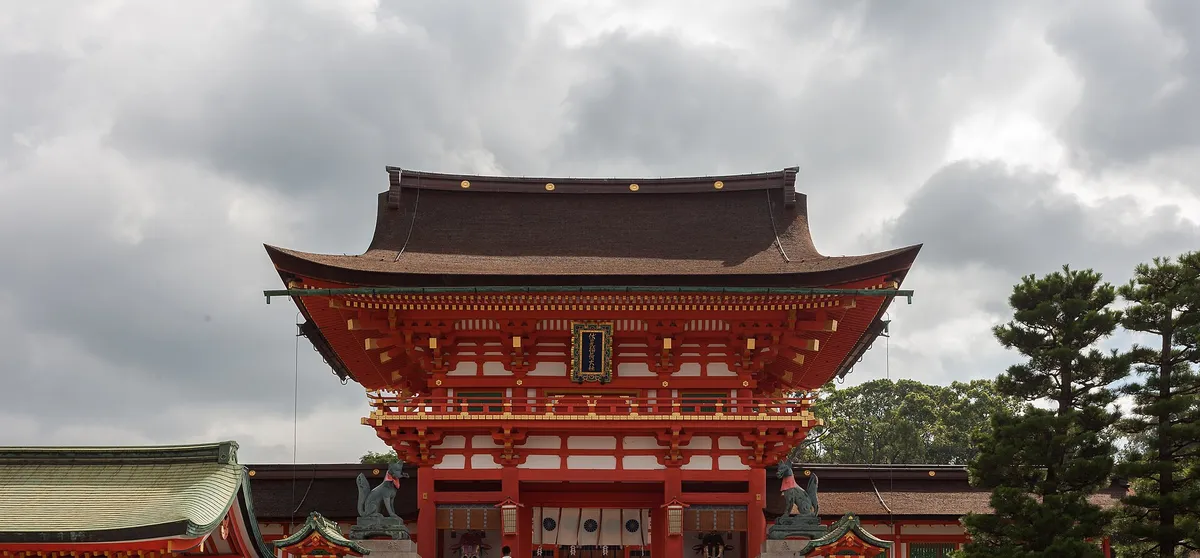 Photo: Marco Almbauer, CC0
You enter through a huge two-storey gate, painted vermilion. The main hall stands just behind it. From the station, it is a short walk up the approach.
2. Foxes with something in their mouths
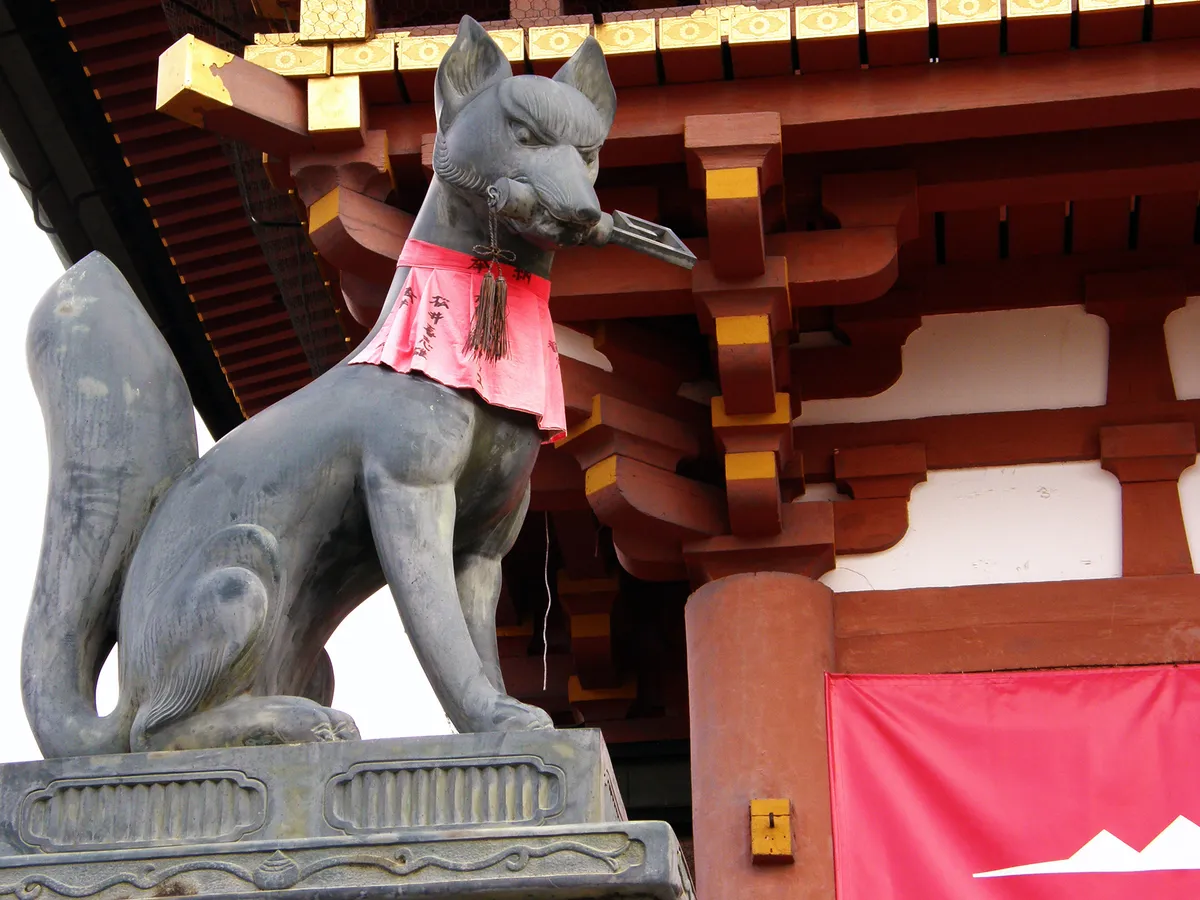 Photo: Tomi Mäkitalo, CC BY-SA 3.0
Stone foxes stand in pairs all over the grounds. Many hold something in their mouths: a key, a round jewel, a sheaf of rice, or a scroll. Guides often say the rice means a good harvest and the key opens the rice store. The shrine itself does not explain them, so take these as common readings. Many foxes also wear red bibs.
The fox is also the face of a famous mask. Read what a kitsune mask means.
The gates: Senbon Torii
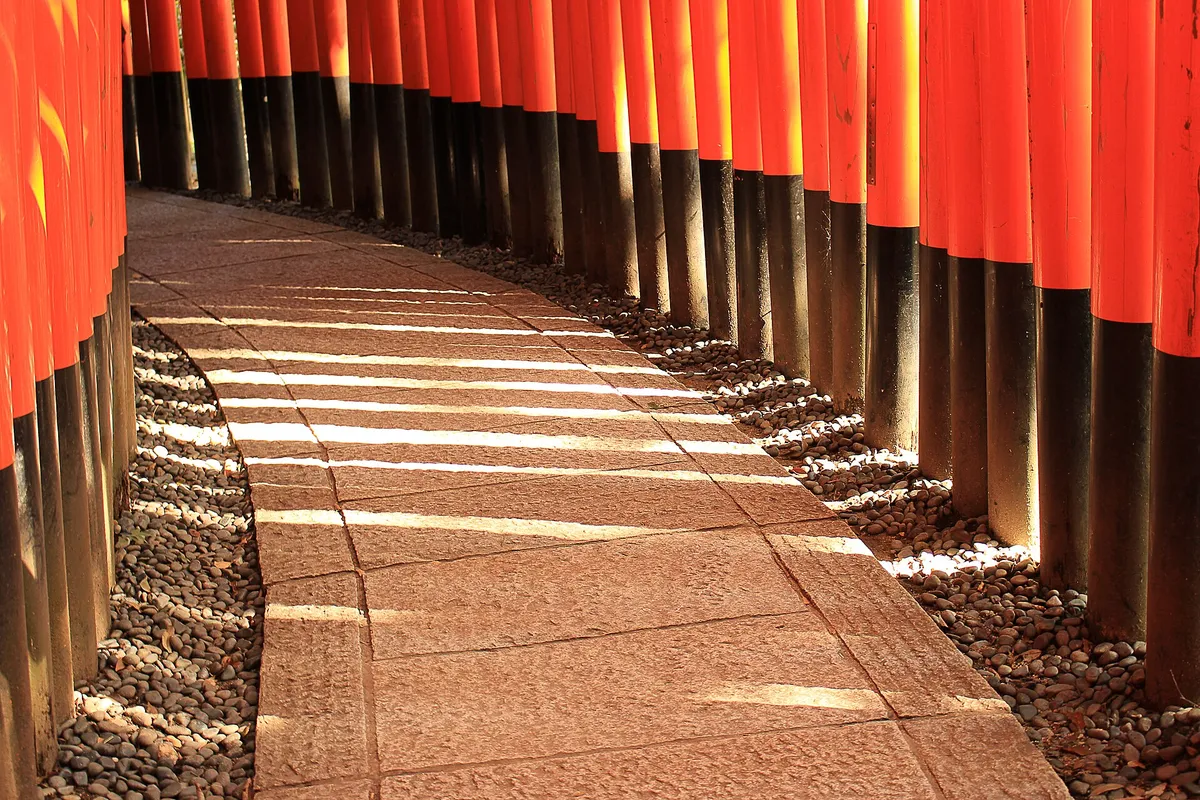 Photo:
Behind the main hall, the path enters the famous tunnels of gates. This stretch is called Senbon Torii, "a thousand gates." In fact there are far more. The shrine says about 10,000 gates line the paths over the whole mountain.
Each gate is a thank-you. People and companies give one when a wish "goes through," the way you go through a gate. The custom spread from the Edo period, from the 1600s on.
Why vermilion? The shrine says the color keeps evil away. The old paint was made with mercury, which also protects the wood.
The inner shrine: foxes, stones and wishes
3. Okusha Hōhaisho and the heavy-light stone
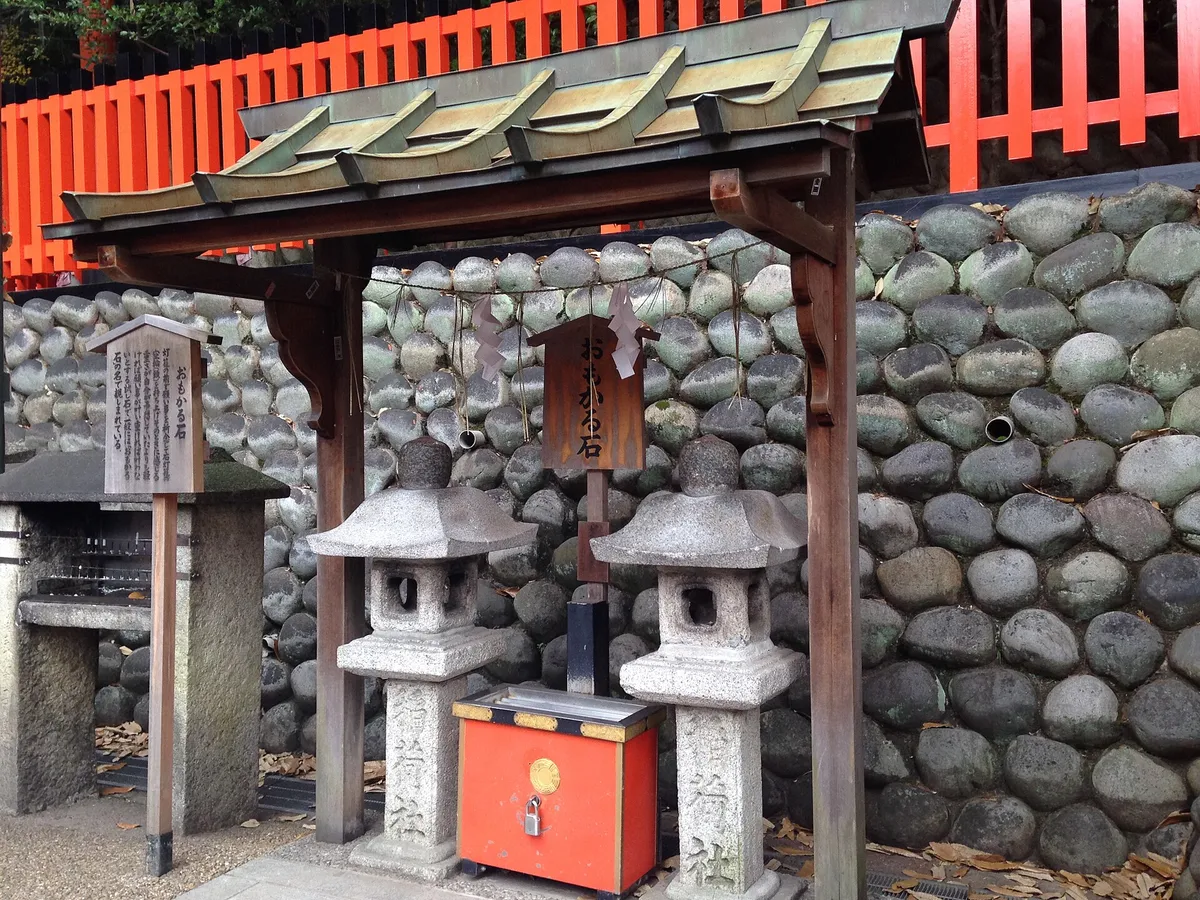 Photo: そらみみ, CC BY-SA 3.0
The gates lead to the inner shrine, Okusha Hōhaisho. Its little valley has an old nickname, Myōbu-dani, "the valley of the fox messengers." A record from 1499 already speaks of a figure of Myōbu, the fox messenger, here.
Behind it, on the right, is the Omokaru-ishi, the heavy-light stone. Stand before the pair of stone lanterns. Make a wish, then lift the round stone on top. If it feels lighter than you expected, your wish will come true. If it feels heavier, it will be hard.
4. Fox faces you draw yourself
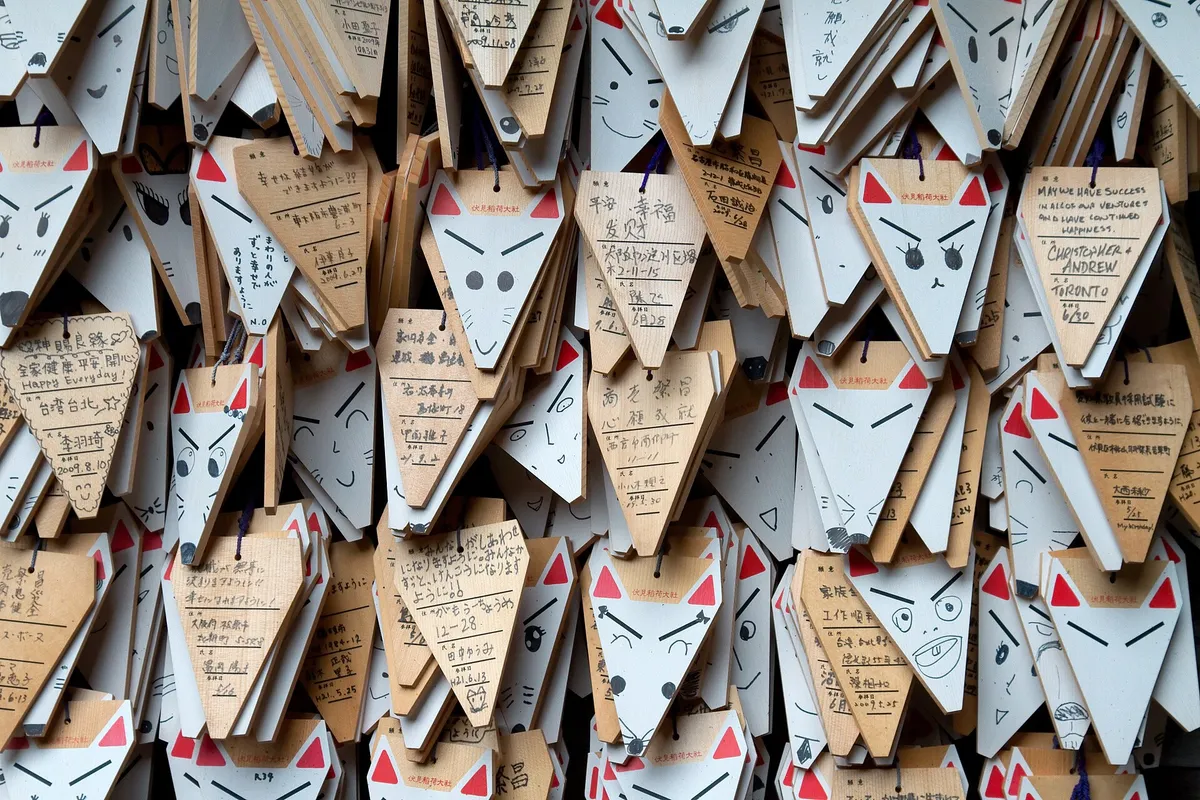 Photo: KimonBerlin, CC BY-SA 2.0
Most shrines sell flat wooden wish plaques, called ema. Here, at the inner shrine, they come in the shape of a fox head, as in the photo. You write a wish on it and draw the fox's face yourself. Many hang together here, and no two faces match.
The legend of the white fox couple
The shrine's history page tells this fox legend. It comes from Inari Ryūki, an old record said to be by the monk Shinga.
In the early 800s, an old white fox couple lived at the foot of Funaoka Hill, in Kyoto. Their fur stood up like silver needles. One day they climbed Inari Mountain with their five cubs. They asked the god to let them serve as messengers.
The god agreed. From now on, it said, they must help and care for the people who come to pray. The male was named Osusuki. The female was named Akomachi.
The shrine also has a small shrine to the fox messengers themselves, Byakko-sha, the White Fox Shrine. It is the only one here for the god's foxes, not the god.
Up the mountain
The full walk over Inari Mountain is called oyama-meguri, "going round the mountain." Travel guides put it at about 4 km and 2 to 3 hours. The shrine gives no official time. The path is all steps, so wear good shoes.
5. Kumataka-sha and the echo pond
Halfway up is a quiet pond, Shin-ike, also called the echo pond. The worship place of Kumataka-sha sits on a stone platform that reaches out into the pond. There is an old custom here. If someone is missing, clap your hands toward the pond. The echo comes back from the direction where you will find a clue.
6. Yotsutsuji, the crossroads
At Yotsutsuji, four paths meet and the view opens over southern Kyoto. It is a good place to rest before the loop to the summit.
7. Mitsurugi-sha and the little fox sword
Higher up is Mitsurugi-sha. It has a sword stone and an old well. The shrine links this place to a Noh play. In it, the swordsmith Sanjō Munechika forges a great sword with help from the god of Inari. The sword is called Kogitsunemaru, "little fox."
8. The summit
The top of the mountain, Ichinomine, is 233 meters high. An old shrine site marks it. From here, the loop leads back to Yotsutsuji. Then you walk down the way you came.
How to get there
Take the JR Nara Line from Kyoto Station to Inari Station. Take a local train, as the rapid trains do not stop there. It is two stops, about five minutes. The shrine is right in front of the station. You can also take the Keihan Line to Fushimi-Inari Station, then walk about five minutes east.
Japanese reference works say the grounds are open day and night, with no entry fee. The amulet counters, where you get omamori charms, close in the evening.
Two rules to know. You may eat and drink only in the free rest areas. Eating while walking is not allowed. Drones are not allowed either.
When to go
- Early morning and evening: the gates are quieter. Midday is crowded.
- November 8: the Hitaki-sai fire festival. Priests burn over a hundred thousand prayer sticks.
- The first Horse Day of February: the Hatsuuma festival, for the day the god first came to the mountain.
- July: on the eve of the Motomiya-sai festival, thousands of lanterns are lit. About 400 painted lanterns are shown for two days.
- New Year: the busiest time of all. Avoid it unless you love crowds.
The photos on this page come from Wikimedia Commons. Each credit links to the photo's own page.