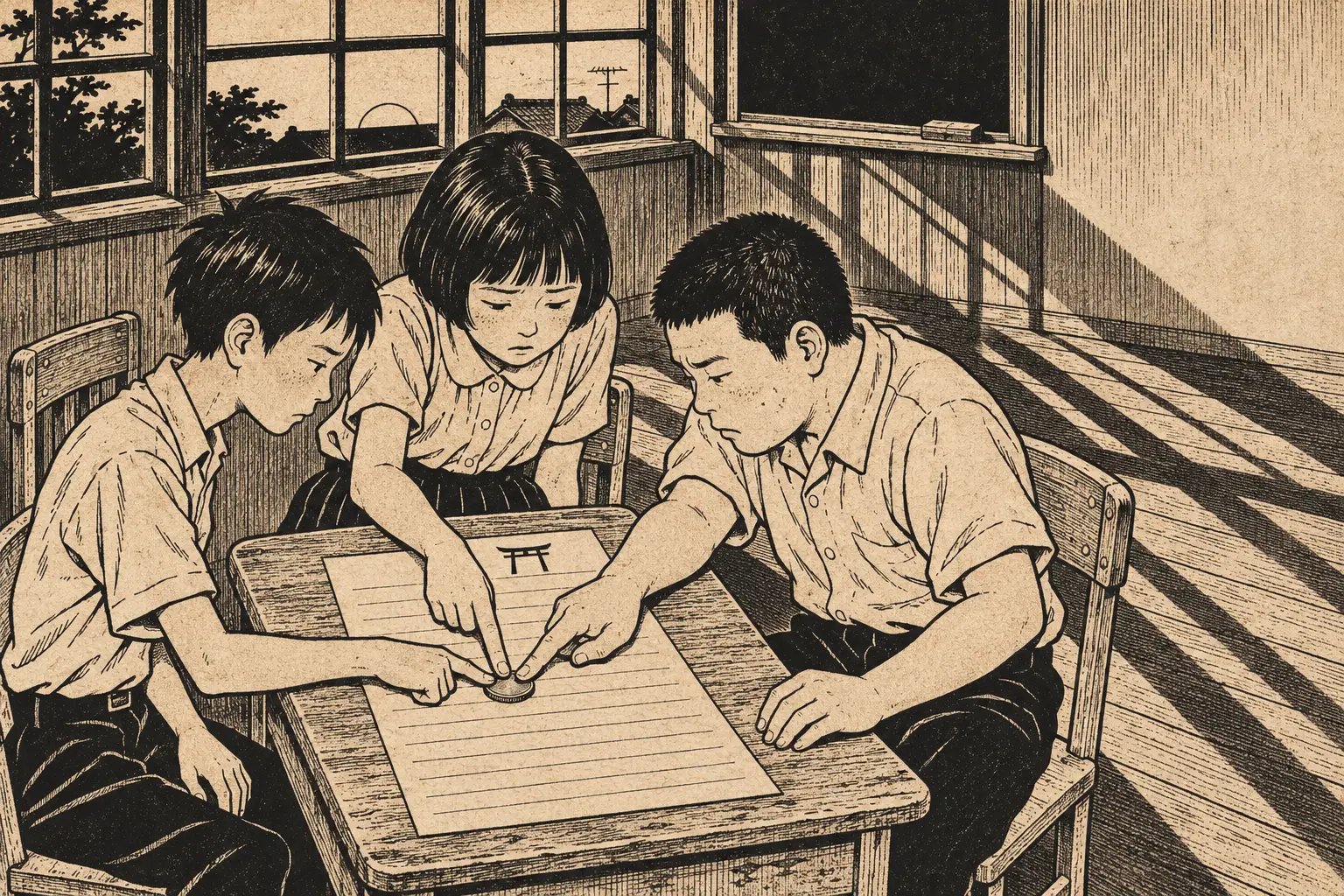
Kokkuri-san is Japan's version of the Ouija board. You need a sheet of paper, one coin and at least two players. Everyone rests a finger on the coin, calls kokkuri-san, and asks questions. The coin slides to the answers.
The game is older than it looks. In 1887, a Tokyo magazine joked about a man who heard "please come in" and "please go home" from next door every day, and thought his neighbours had opened a shop.
What you need
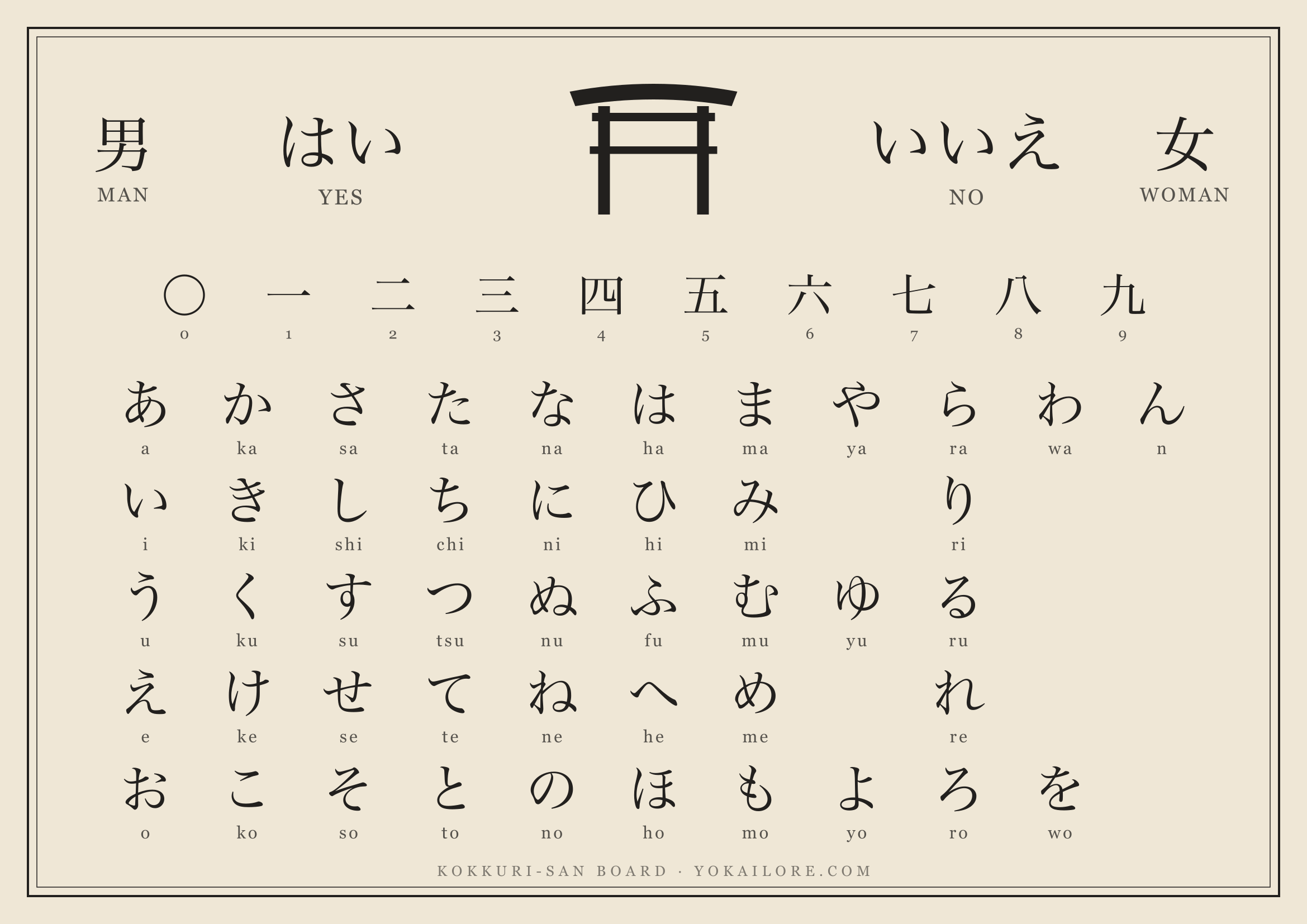
- A large sheet of paper. Or print our board (A4, free).
- One coin. A 10-yen coin is the usual choice. A 5-yen coin works too.
- Two or more players. Everyone needs to reach the paper.
- A pen, if you draw the board yourself.
Draw the board, or print it
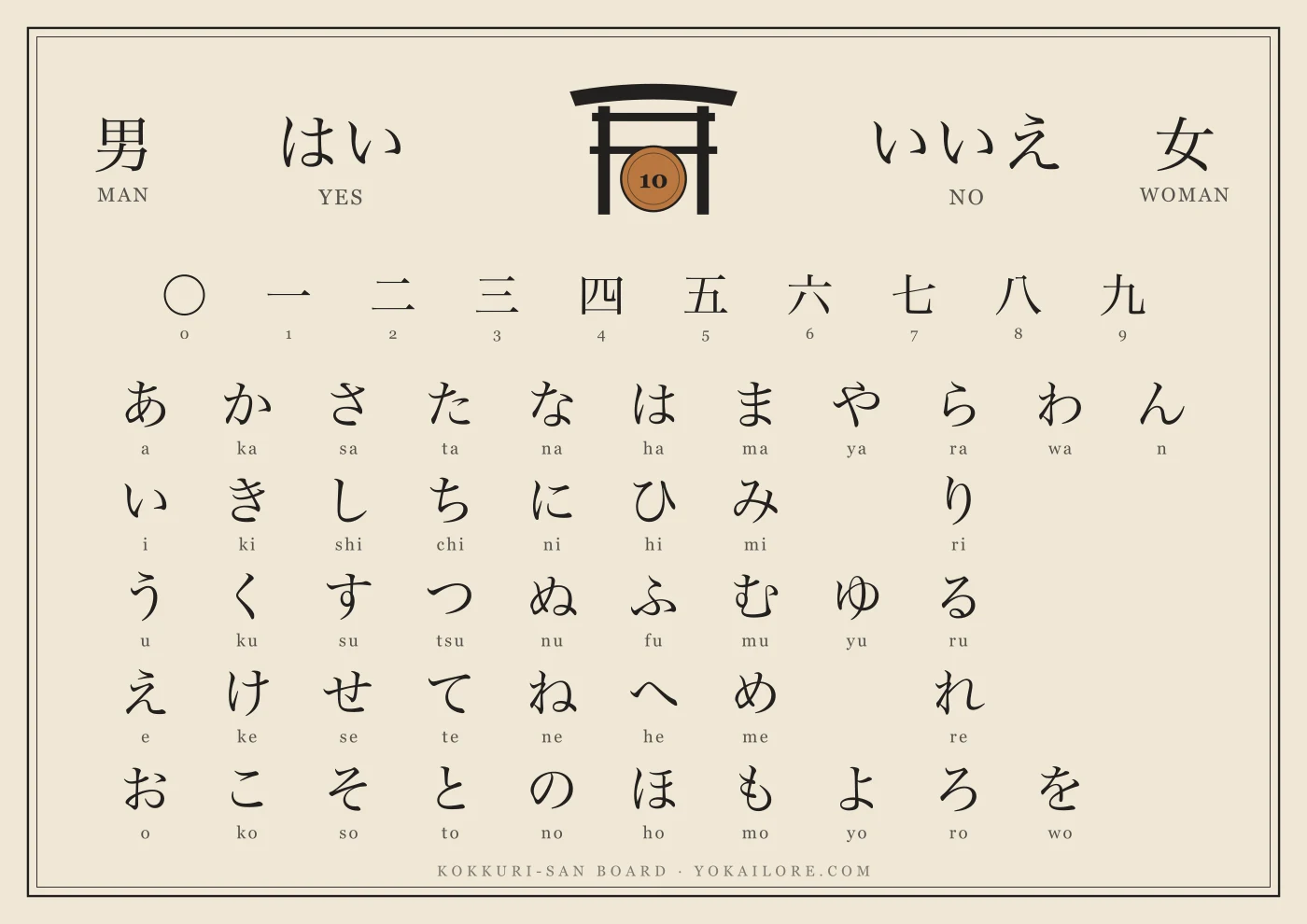
The sheet Japanese children draw has five parts:
- A torii gate at the top. This is where the coin starts and ends.
- Yes and no. はい (hai) means yes. いいえ (iie) means no.
- Man and woman. 男 (otoko) and 女 (onna).
- The numbers 0 to 9. Many players write them as kanji: 〇 一 二 三 四 五 六 七 八 九.
- The kana, the 46 letters of Japanese. The coin spells longer answers with them.
Our board puts the romaji under every kana. So you can read an answer even if you do not read Japanese.
How to play, step by step
- Put the coin on the torii.
- Everyone rests one index finger on the coin. Touch it lightly. Do not press.
- Call it together: "Kokkuri-san, kokkuri-san, oide kudasai." That means "please come."
- Wait. If the coin moves, players say kokkuri-san has arrived.
- Ask one question at a time. The coin slides to yes or no, a number, or kana that spell a word.
- Send it home. When you finish, say "Kokkuri-san, please go home." Wait for the coin to go back to the torii.
- Say thank you, then lift your fingers.
The rules players pass on
These change from school to school. Here are the ones you hear most:
- Never lift your finger in the middle. Wait until kokkuri-san has gone home.
- If it will not leave, keep asking politely until the coin goes back to the torii.
- Get rid of the paper the same day. Some say tear it into 48 pieces. Others say burn it.
- Spend the coin soon. Some say within three days. Others say the next day.
The "please go home" rule is the oldest of them. In June 1886, an Osaka newspaper told a story about a geisha. She laughed at a friend who loved the game. Then she suddenly cried that kokkuri had entered her body. Everyone bowed and begged it to go home quickly. When that failed, they offered it red rice and rice cakes.
It came off an American ship in 1884
The philosopher Inoue Enryō recorded the story. Around 1884, an American ship was wrecked near Shimoda, on the Izu peninsula. Its sailors showed local people table-turning, a game from home. Hands rest on a table, and the table tilts to answer.
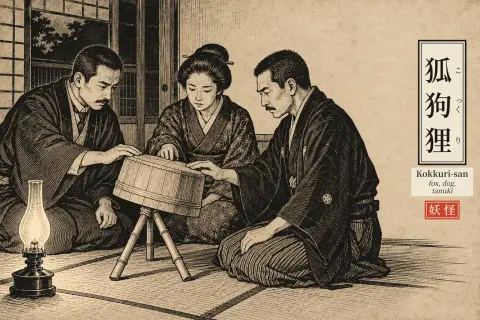
Most Japanese homes had no Western tables then. So people used a round wooden rice tub, or its lid, set on three bamboo sticks. It tipped back and forth. Kokkuri, kokkuri: that nod became the name. Later the name was written 狐狗狸, "fox, dog, tanuki."
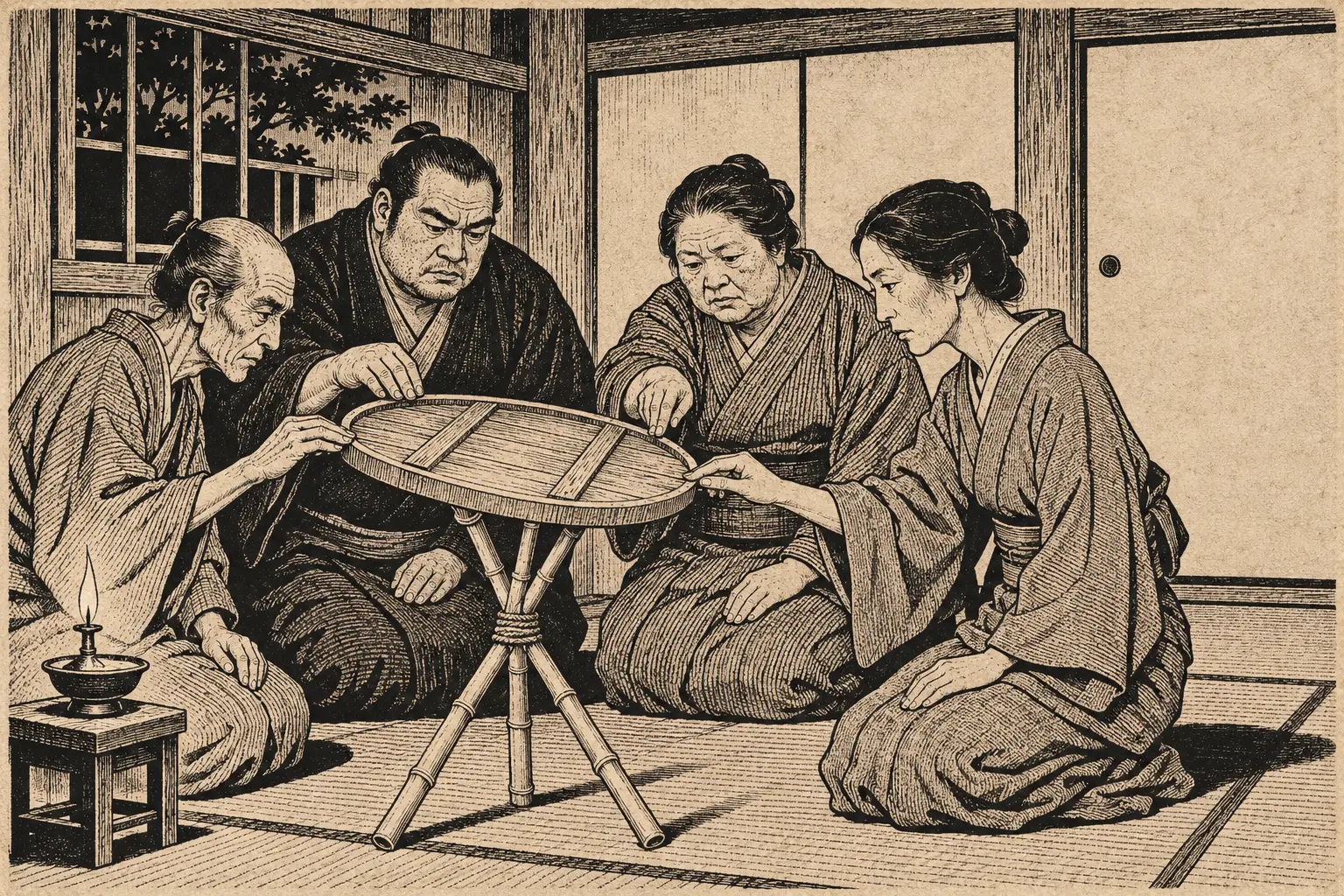 Our picture of the game in the 1880s: a rice-tub lid on three bamboo sticks, and adults, not children, around it.
At first, it was not a children's game. Adults loved it. A Tokyo newspaper wrote in 1887 that people asked it about marriages and illness. Some families played every night past midnight. Police sometimes came to lecture them.
The children came later. In the 1970s, the manga Ushiro no Hyakutarō by Tsunoda Jirō showed the game. It spread through schools. Some teachers warned children and their parents to stop.
Kokkuri-san is a cousin of the Ouija board
Kokkuri-san and the Ouija board are cousins. Both grew out of the same craze for table-turning in the 1800s. The Ouija board was first sold in America around 1890. Japan's kokkuri boom had started a few years earlier, in the mid-1880s.
The difference is the tool. A Ouija board comes with a pointer, called a planchette. Kokkuri-san uses whatever is in your pocket: a single coin.
Some Japanese schools played a version called Angel-san. Players drew a small cupid in place of the torii gate, and called an angel instead of a fox.
Is kokkuri-san real? Try Inoue's test
Inoue Enryō did not just write about the game. He played it himself, and in 1887 he wrote up what he found.
Ask the coin "Rain or sun tomorrow?" and it can answer. Ask it "At what minute will the rain start?" and it cannot. He said the players' own hands move the coin, without meaning to.
You can try his test tonight. First ask something everyone at the table can guess. Then ask something nobody at the table knows, like a number in a book that none of you has opened.
One way to read this: the coin knows exactly what the people touching it know. Nothing more.
Read more about kokkuri-san itself, and about Japan's urban legends.