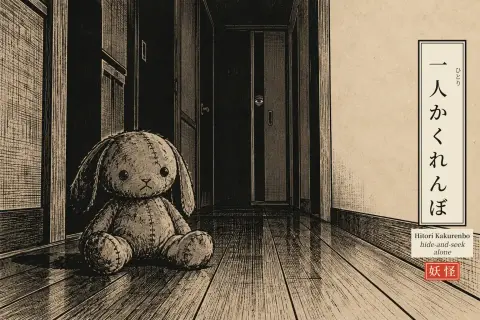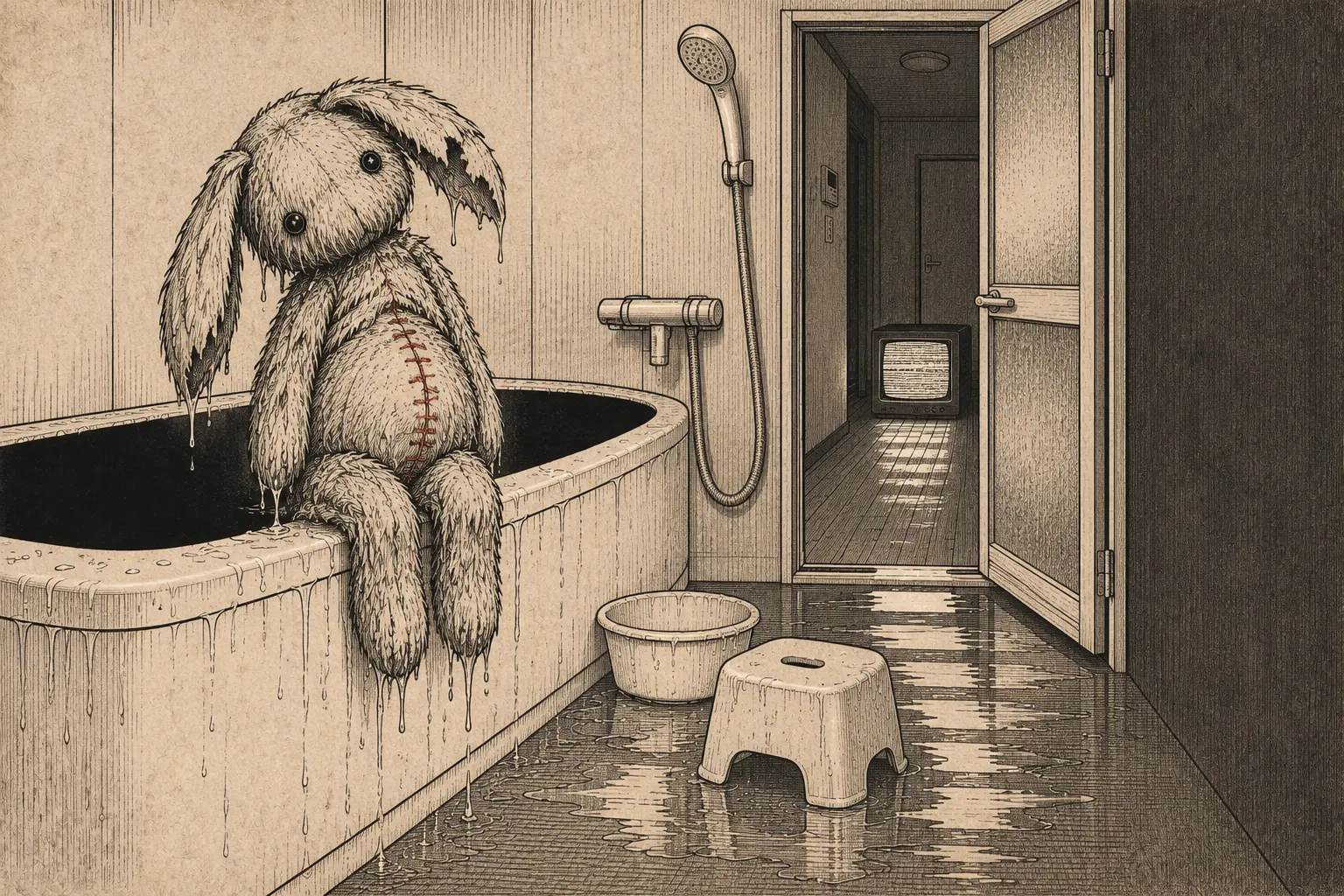
Hitori kakurenbo is hide-and-seek played alone, against a stuffed doll. Japanese sources count it as a kind of spirit rite. You make the doll "it," hide in a dark house, and wait for something to come looking for you. It starts at three in the morning.
It is also very young for a Japanese legend. The full method was posted on an online forum in April 2007. Two months later, a post signed as the original poster claimed he had written many of the early "I tried it" reports himself.
What you need
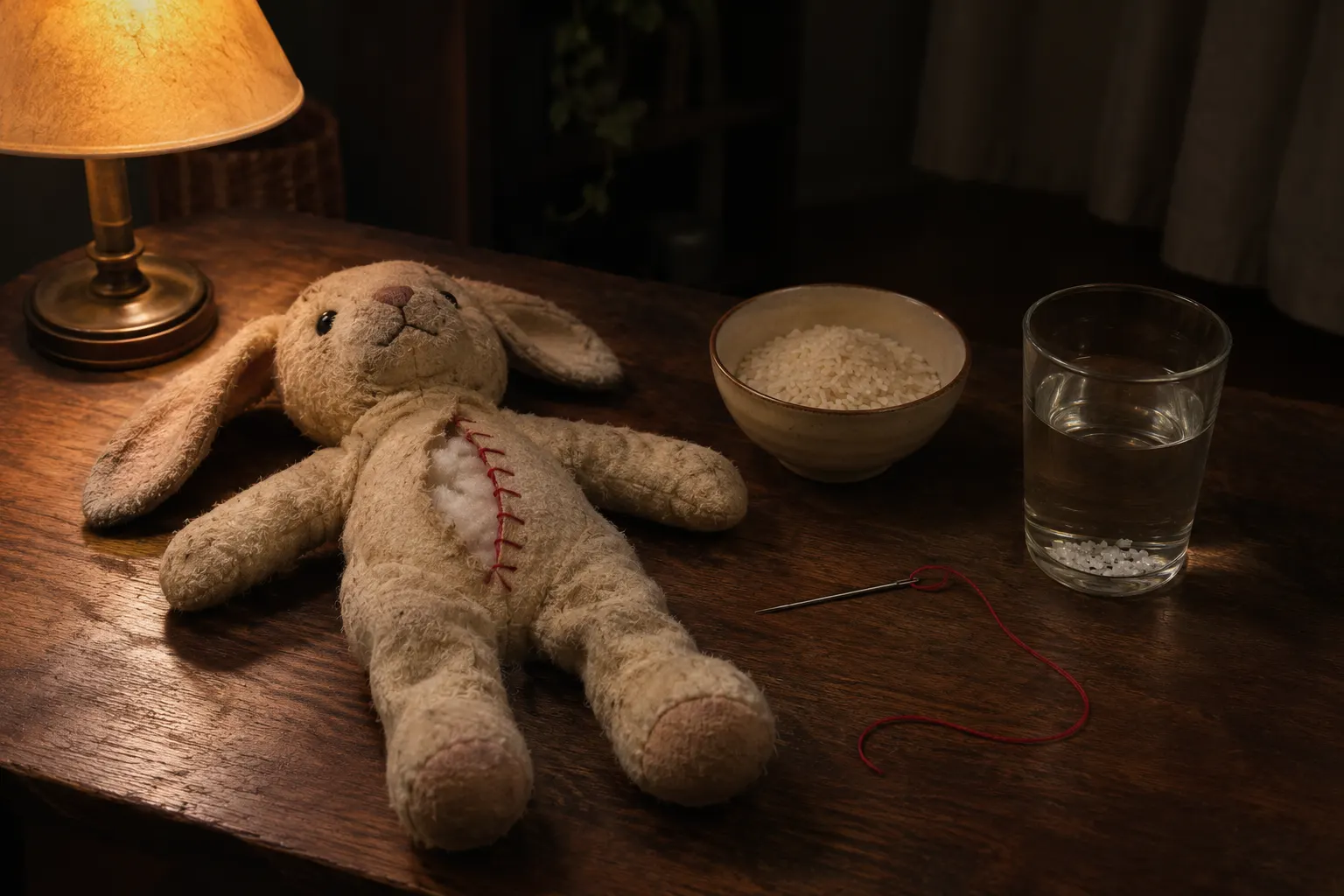 Our illustration, not a photo: the doll, the red thread, the rice and the salt water.
These are the items in the common version:
- A stuffed toy with arms and legs. Players give it a name.
- Uncooked rice, enough to fill the doll.
- Your own nail clippings. Some versions say hair or skin makes it stronger.
- A needle and red thread.
- A cup of salt water. Natural salt is said to be best.
- Something sharp, such as a kitchen knife or scissors. It is used on the doll, not on anything else.
Get the doll ready
- Take the stuffing out of the doll.
- Fill it with the rice and the nail clippings.
- Sew it shut with the red thread. Wind the spare thread around the doll and tie it off.
- Put the cup of salt water in your hiding place.
How it is played, step by step
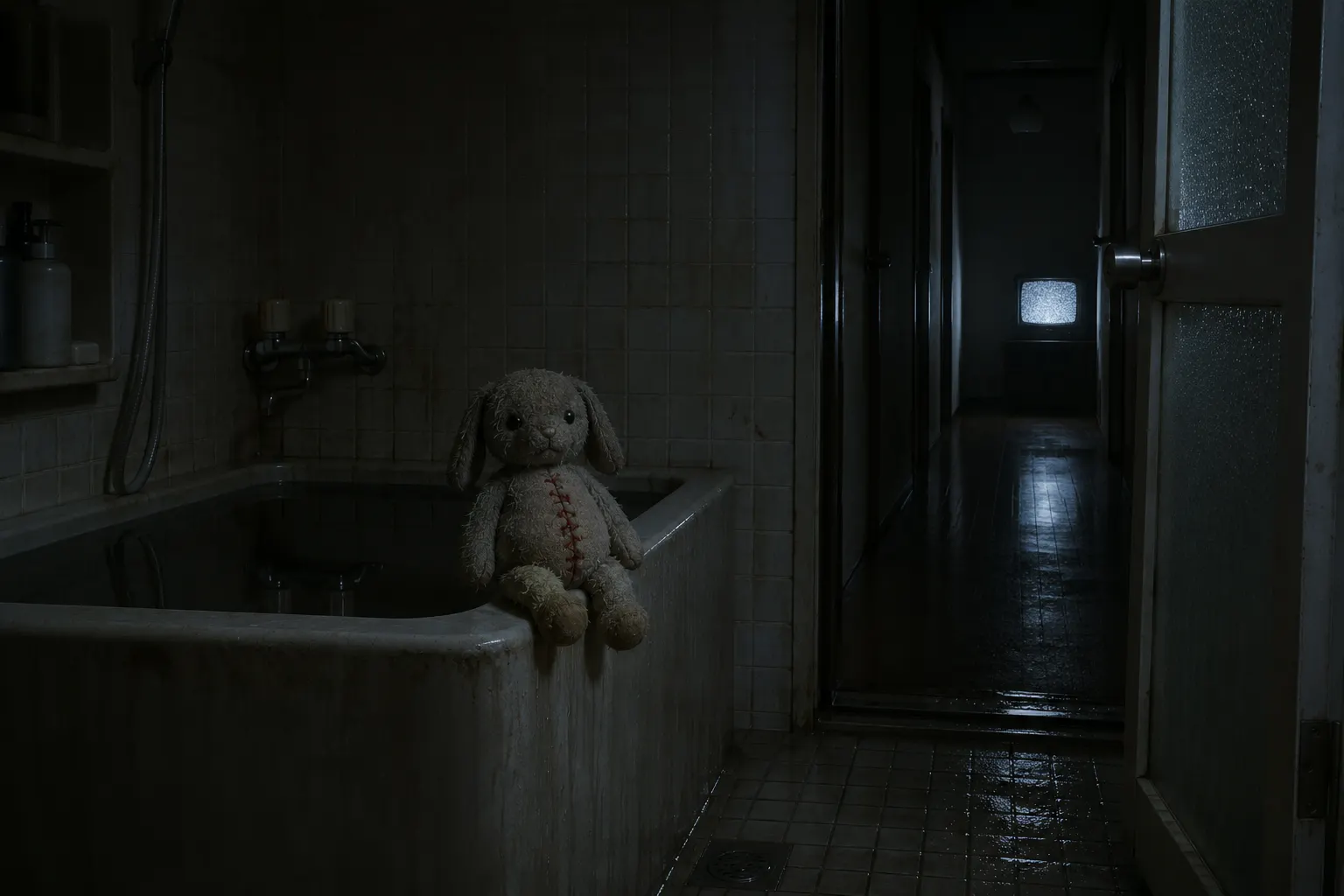 Our illustration, not a photo: 3 a.m., with every light off except the static.
- At 3 a.m., say to the doll three times: "The first 'it' is me." Use your own name. Then put the doll in a bathtub full of water.
- Turn off every light in the house. Turn on a TV with no channel, so the screen shows only static.
- Close your eyes and count to ten.
- Go back to the bathroom with the sharp object. Say "Found you," using the doll's name, and stab the doll.
- Say three times: "Now you are it." Then go to your hiding place and hide.
- To end it, take a little salt water into your mouth. Come out, find the doll, and pour the rest of the cup over it. Spit out the salt water from your mouth onto it too.
- Say three times: "I win."
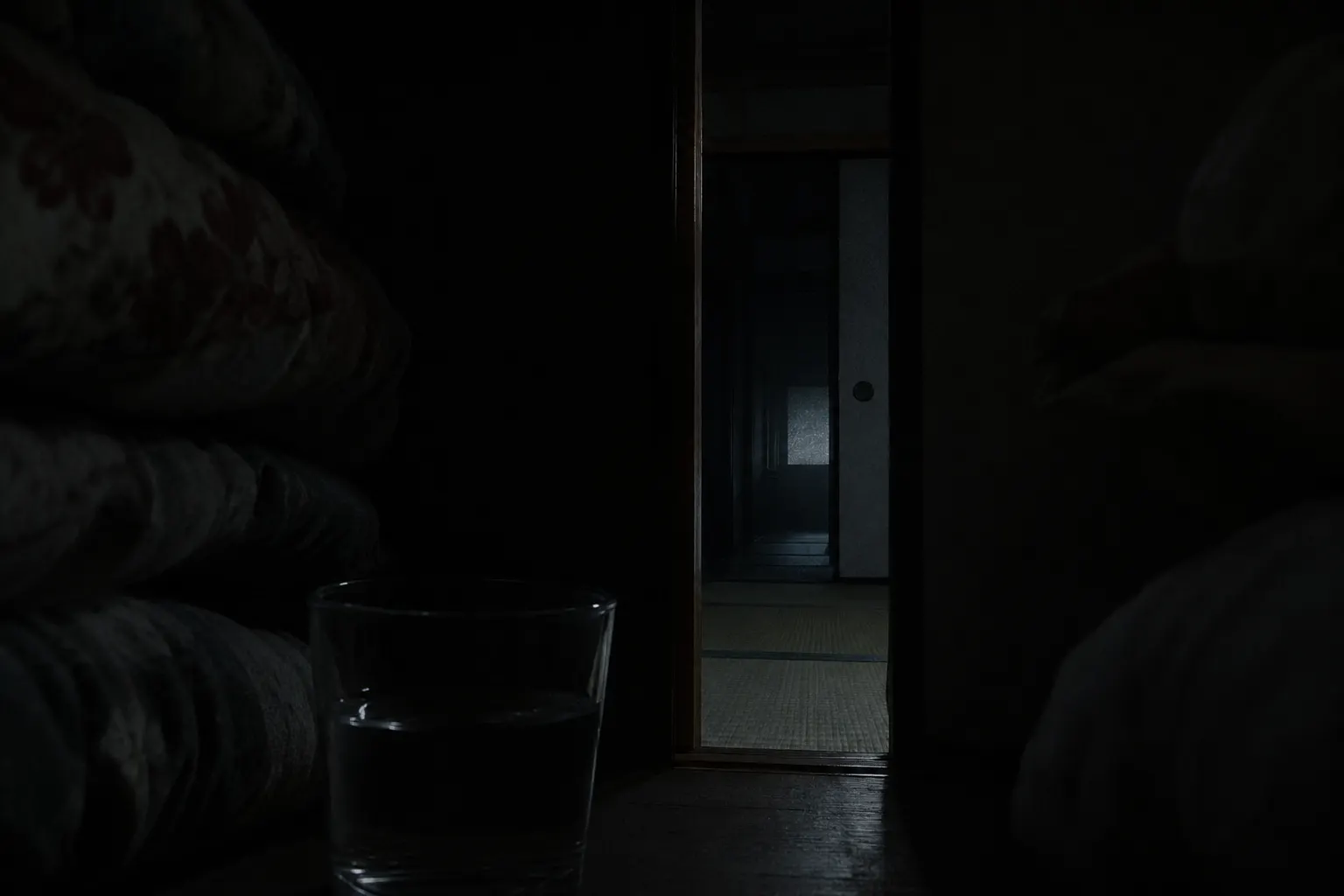 Our illustration, not a photo: waiting in the hiding place, with the salt water close by.
Versions differ. Some use a sink instead of a bath. Some say to run straight from the bathroom to the hiding place. Some add candles, and one even uses a chicken's heart.
The rules people repeat
These rules come from later retellings, not from one source. They change from site to site.
- Finish within one or two hours. Some say after two hours the salt no longer works.
- Play alone. Others in the house are said to stop it from working.
- Do not leave your hiding place in the middle, whatever you hear.
- Burn the doll afterwards. This is often repeated, but Japanese Wikipedia gives no source for it.
- Turning the lights back on does not end it. If you get scared and switch them on, the retellings say that only calms you down. The game is still running.
The retellings also warn against playing in risky places, such as a car or an abandoned building. That warning has nothing to do with ghosts. A dark, empty place at 3 a.m. is dangerous on its own.
What is supposed to happen
Here is the idea behind the fear. You are not really playing with the doll. One way to put it: you are lending something a body.
When you say "Now you are it," the doll is meant to stop being a toy. Something is supposed to be inside it now, and it is the seeker. You are the one being hunted, alone, in your own dark house.
Then comes the worst part. The game does not end by itself. To finish it, you have to leave your hiding place, walk through the dark house, and find the doll yourself. The retellings say strange things may happen while you search. Whatever happens, you must not spit out the salt water in your mouth. It is your protection, and the only way to end the game.
The warnings go further. Many retellings call it more dangerous than kokkuri-san. Some say that by playing, you put a curse on yourself. Others say trouble can follow in the days after, even if you finish every step: an accident, an injury, an illness, or being possessed.
People who played it wrote about what they said happened. Those reports are the whole of the evidence. And as the next section shows, some of them may not be what they seem.
It came from one forum post in 2007
On 18 April 2007, a thread on the occult board of 2channel, a huge Japanese forum, named the game. On 21 April, one poster set out the items and the steps in detail.
Then the reports came in. People wrote that they had tried it, and posted what they said happened. That is how the name spread beyond the first thread.
In June 2007, a new post appeared, signed as the original poster. It claimed that many of the early "players" had been him. If that is true, much of the early evidence came from the man who wrote the rules.
The same month, a late-night TV Tokyo show covered the game. A video film called Hitori Kakurenbo came out in 2008, and a cinema version opened in May 2009.
Was it an older game?
Two stories compete, and they do not agree.
One says the game was already known in Kansai and Shikoku, played alongside kokkuri-san. In that telling, the 2007 post wrote down something older.
The other says a university club spread it on purpose, to study how rumors travel. That claim comes from a 2010 audiobook. It names only "a certain university."
Both can be partly true. An old game can be rewritten, and a new post can pretend to be old. Either way, April 2007 is when the steps became easy to copy.
Is it real?
Nobody has shown that anything happens. What the game does reliably is put you alone in a dark house at 3 a.m., listening hard. Every creak sounds like footsteps.
One way to read it: the doll is "it," but the person doing the seeking is you, in your own head.
Read more about hitori kakurenbo itself, and about Japan's urban legends.