Most Japanese gods hate death. To them it is pollution, and shrines work hard to keep it out. Kanayago-kami, the goddess of iron smelting, asked for it. She told her smiths to hang corpses from the pillars of the furnace.
Why would a goddess want that? One old answer hides inside the name of her sacred tree. We will get to it below.
Kanayago-kami is not the miners' god. As trades split in the early modern period, miners took Yama-no-kami as their patron. She became the god of tatara sand-iron smelting. Smiths built her a shrine. They kept her taboos, down to which trees she liked and which animals she could not stand. Her name is written 金屋子神: 金 (kana, "metal") + 屋 (ya, "house") + 子 (go, "child") + 神 (kami, "god"). She is also known by the variant reading Kanayako-kami.
Most accounts call her a goddess. A few call her male. Some writers link her to the mining pair Kanayama-hiko and Kanayama-hime. Others link her to the smithing god Amenomehitotsu-no-kami. Some treat her as a separate god entirely. At her head shrine, one old hanging scroll gives her a second face. Buddhism and Shinto blended there, and the scroll draws her as the three-faced fire god Sanbō Kōjin — the same figure worshipped in ordinary kitchens as Kōjin.
The flight to Izumo
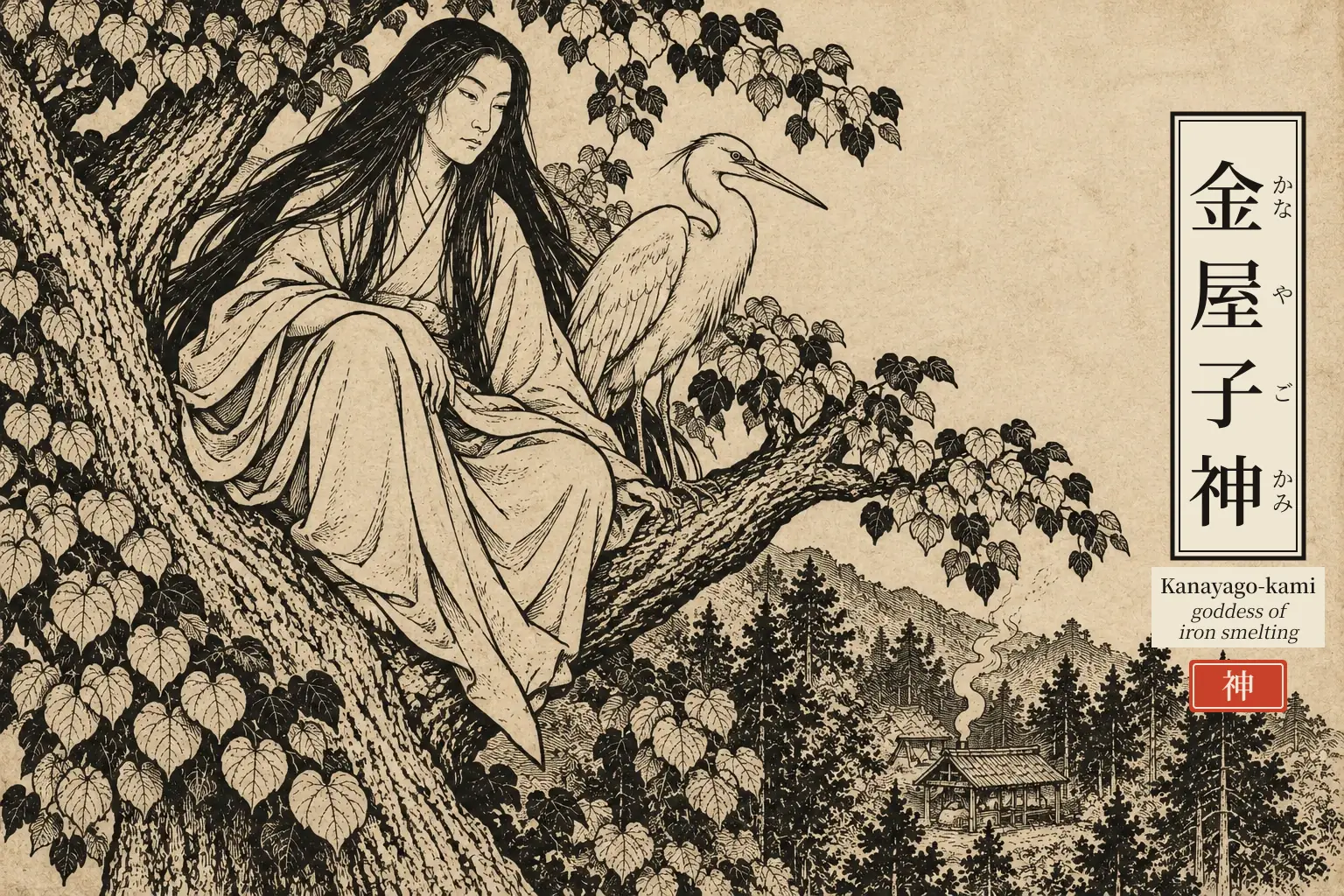
The legend is anchored at Kanayago Shrine. It stands in Nishihida, Yasugi City, Shimane — old Izumo Province. The shrine's own story starts with villagers praying for rain. Kanayago-kami answered first at Iwanabe, in old Harima Province, now Chikusa, Shisō City, Hyōgo. She said she had ties to the west. So she flew there on a white heron. She landed in a forest and rested in a katsura tree. One tradition has her stopping partway, at Kibi-no-Nakayama.
An ancestor of the shrine's priests found her there. His name is Abe Masashige. A wealthy man named Osada Hyōbu Asahi-chōja then built her shrine beside the tree. Another account credits the building to Abe Masashige alone. Wherever she settled, she is said to have worked herself. She took the role of murage — the foreman of a tatara smelting furnace — and taught smiths the craft directly.
Other shrines tell the route differently. A third version comes from the Kanayamahime-no-miya Engi, the founding text behind most local Kanayago legends. Its starting point is a district in Ōshū whose location is no longer clear.
| Tradition | Route |
|---|---|
| Kanayamahime-no-miya Engi | An unidentified district, Ōshū → Kibi-no-Nakayama → Hida |
| Shimane (Yoshida, Unnan) | Kibi-no-Nakayama → Hida |
| Tottori (Hino District) | Kibi-no-Nakayama → Inga, Nichinan → Hida |
The Shimane Museum of Ancient Izumo (2011) reads these routes another way. It links them to the spread of iron-smelting skill, carried by smiths as they moved between provinces.
What she will not have near the furnace
Kanayago-kami's taboos are specific enough to remember. They sit at the heart of most accounts.
- Hemp. She, or a murage working for her, is said to have tripped on hemp and died. So she dislikes hemp.
- Dogs and ivy. Chased by a dog, she tried to climb ivy to escape. The vine snapped, she fell, and the dog killed her. She dislikes both.
- Mandarin oranges and wisteria. In another telling, she escaped the same chase a different way. She climbed a mandarin tree, or clung to wisteria. Both plants are favored instead. The katsura is her sacred tree.
- Women. She disliked women intensely. Some say it was her own jealousy, since she is female herself. Workshops barred women from the smithing floor. Old foremen, it is said, would not even reuse bathwater a woman had used.
- Death. Here she breaks the pattern. She is said to welcome death's pollution, not avoid it. She told her foremen to hang corpses from the furnace's pillars. The iron, it was said, came out better for it.
These rules are recorded in detail in the Tetsuzan Hisho (鉄山秘書). It is an ironworking manual, written in 1784 by the furnace owner Shimohara Shigenaka. The book sat unknown for over a century. Tawara Kuniichi finally transcribed and published it in 1912.
Why corpses? The answer in a tree's name
Two explanations circulate. Neither is treated as settled.
One draws on old five-phases thought. In this system, everything is made of five elements: wood, fire, earth, metal and water. Each one produces the next. Earth produces metal.
Now look at her sacred tree. Katsura is written 桂. On the left is 木, "tree." On the right is 圭, which is 土, "earth," stacked twice. A corpse, in this thinking, also counts as earth. So the tree and the dead bring the same thing to the furnace: earth, and earth makes metal. By this reading, both may have served a better yield.
A separate theory reads the legend against the Kojiki (712). There, the goddess Izanami falls ill after giving birth to the fire god Kagutsuchi. In her illness, she vomits up the ore gods Kanayama-hiko and Kanayama-hime. Then she dies. One record, the Shimane-ken Kōhi Densetsu-shū (1927), reads the shrine's own name as encoding this story. By that reading, Hida is the place where the goddess herself died.
Other shrines, other names
Far to the west, near the old Iwami Ginzan silver mine, stands Sahime-yama Shrine. Some sources read "Sahime" as another name for the goddess. They guess that sa or sahi meant iron. Nearby Mt. Sanbe carried that same old name, Sahime-yama. It is separately tied to the god Nigihayahi and the Mononobe clan. Further east, a tatara work song preserved in Nishiawakura, Okayama, traces her origin to a forest called Abe-no-mori, in Katsuragi.
Kanayago-kami today
The cult has left a few small modern traces. She plays an important part in "Oyakata to Kamisama," a story in Ijūin Shizuka's collection Shōnenfu (2009). A high-end porcelain, Kinzan-yaki, is also said to take its name from her.